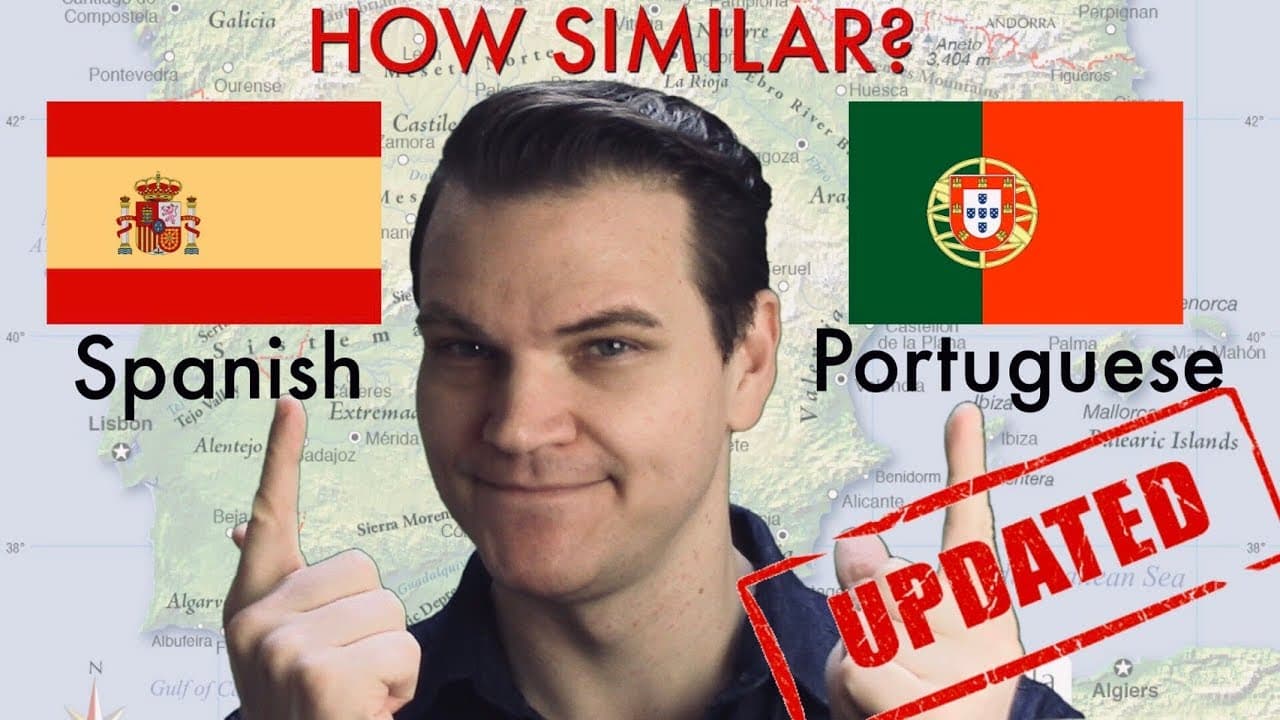
How Similar are Spanish and Portuguese?!
TL;DR
Spanish and Portuguese are similar yet distinct Ibero-Romance languages.
Transcript
today i think i'll compare portuguese with a special dialect of portuguese called spanish [Applause] hello everyone welcome to the langfocus channel and my name is paul today's topic is how similar are spanish and portuguese as you probably know spanish and portuguese are both ibero romance languages that share a common origin they're different eno... Read More
Key Insights
- Spanish and Portuguese share a common origin as Ibero-Romance languages, making them similar yet distinct.
- Written forms of Spanish and Portuguese are more mutually intelligible than their spoken forms.
- Portuguese speakers generally understand spoken Spanish better than vice versa due to pronunciation differences.
- Spanish and Portuguese share 89% lexical similarity, but false cognates can cause misunderstandings.
- Portuguese has more complex phonology, with additional sounds and nasal vowels not present in Spanish.
- Pronunciation differences include variations in consonants like 'b', 'd', and 'g', and vowel sounds.
- Grammatical structures are similar, but differences exist in verb usage, gender, and word order.
- Cultural and regional influences affect the usage and understanding of these languages in various contexts.
Install to Summarize YouTube Videos and Get Transcripts
Explore YouTube Video Summarizer or Get YouTube Transcript Extractor
Questions & Answers
Q: Why are Spanish and Portuguese considered sister languages?
Spanish and Portuguese are considered sister languages because they both originate from the Ibero-Romance branch of the Romance languages. They share a common Latin root, which results in a high degree of lexical similarity and similar grammatical structures. However, they have evolved separately, leading to distinct phonological and grammatical differences.
Q: How do pronunciation differences affect mutual intelligibility between Spanish and Portuguese?
Pronunciation differences significantly affect mutual intelligibility between Spanish and Portuguese, particularly in spoken forms. Portuguese has a more complex phonology, with additional sounds and nasal vowels that are not present in Spanish. These differences make it generally easier for Portuguese speakers to understand spoken Spanish than for Spanish speakers to understand spoken Portuguese.
Q: What are some examples of false cognates between Spanish and Portuguese?
False cognates between Spanish and Portuguese can lead to misunderstandings. For example, 'pelado' means 'skinned' or 'peeled' in Spanish, but in Brazilian Portuguese, it also means 'naked'. Another example is 'propina', which means 'tip' in Spanish, 'tuition fees' in Portugal's Portuguese, and 'bribe' in Brazilian Portuguese. These differences highlight the importance of context in understanding each language.
Q: How do grammatical structures differ between Spanish and Portuguese?
While Spanish and Portuguese share many grammatical structures, there are notable differences. For instance, the perfect tense is formed with different auxiliary verbs: 'haber' in Spanish and 'ter' in Portuguese. Gender assignments can differ, as seen in words ending in '-aje' in Spanish being masculine, while their Portuguese equivalents ending in '-agem' are feminine. Additionally, word order can vary, such as the placement of object pronouns.
Q: What role does phonology play in the differences between Spanish and Portuguese?
Phonology plays a crucial role in distinguishing Spanish from Portuguese. Portuguese has a more complex phonological system, including additional consonant sounds, nasal vowels, and more diphthongs. These phonological differences contribute to the distinct sound of each language and affect mutual intelligibility, especially in spoken communication.
Q: How do cultural and regional influences affect the use of Spanish and Portuguese?
Cultural and regional influences significantly affect the use and understanding of Spanish and Portuguese. Variations in pronunciation, vocabulary, and grammar can be observed across different regions. For example, Brazilian Portuguese and European Portuguese differ in pronunciation and vocabulary, influenced by cultural factors and historical developments. Similarly, regional dialects of Spanish can vary widely across Latin America and Spain.
Q: In what ways are Spanish and Portuguese similar in terms of vocabulary?
Spanish and Portuguese share about 89% lexical similarity, meaning that many words have cognates or equivalents in the other language. This similarity is due to their common Latin origin. However, even with lexical similarity, some words can have different meanings or usage in each language, which can lead to misunderstandings if not understood in context.
Q: What challenges might learners face when studying both Spanish and Portuguese?
Learners studying both Spanish and Portuguese might face challenges related to pronunciation differences, false cognates, and grammatical nuances. While the languages are similar, these differences require careful attention to avoid misunderstandings. Additionally, learners may need to adapt to regional variations and cultural contexts that influence language use, which can add complexity to the learning process.
Summary & Key Takeaways
-
Spanish and Portuguese are closely related Ibero-Romance languages with a high degree of lexical similarity. However, significant differences in pronunciation and phonology make spoken forms less mutually intelligible. Portuguese speakers typically understand spoken Spanish better due to these differences.
-
The two languages share many grammatical structures, but there are notable differences in verb usage, gender, and word order. False cognates can lead to misunderstandings, and cultural influences play a role in language use and comprehension.
-
Pronunciation differences include variations in consonants and vowels, with Portuguese featuring more complex phonology, including nasal vowels and additional sounds. These differences contribute to the distinct nature of each language, despite their common origins.
Read in Other Languages (beta)
Share This Summary 📚
Summarize YouTube Videos and Get Video Transcripts with 1-Click
Try YouTube Summary with ChatGPT & Claude or YouTube Transcript Generator
Explore More Summaries from Langfocus 📚


Summarize YouTube Videos and Get Video Transcripts with 1-Click
Try YouTube Summary with ChatGPT & Claude or YouTube Transcript Generator