How to Grow a YouTube Channel in 90 Days
TL;DR
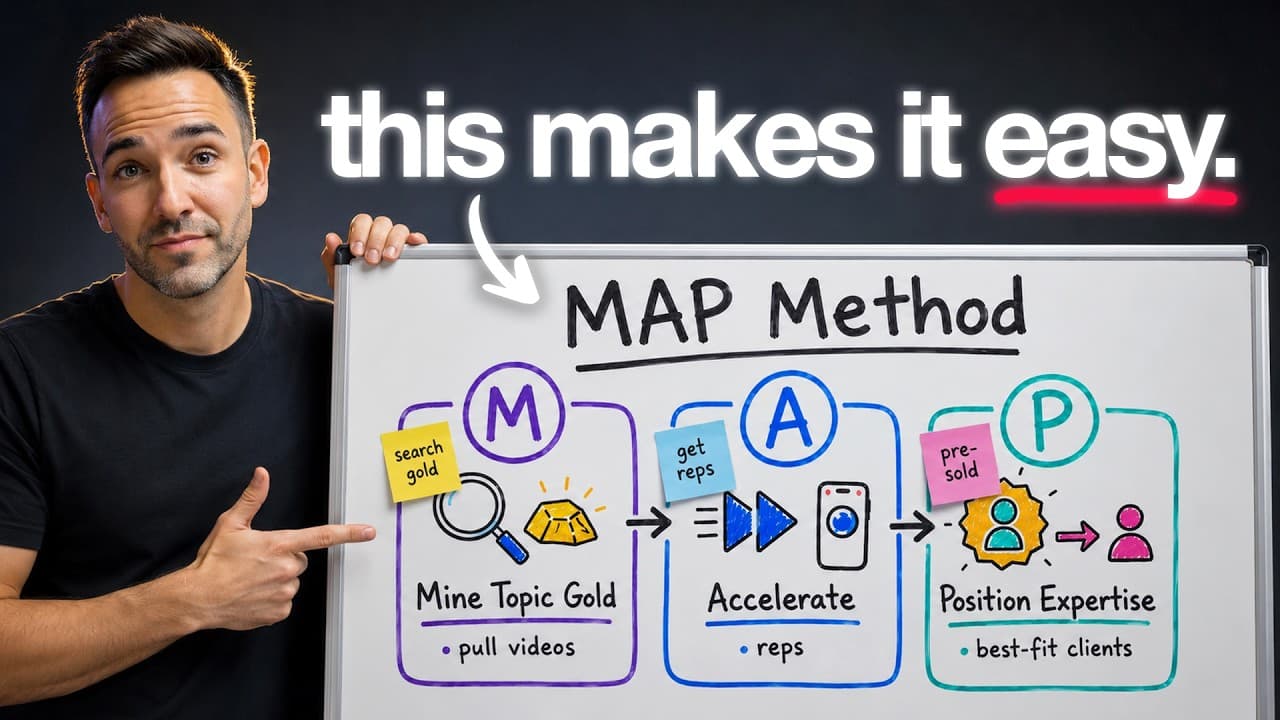
Start by publishing searchable answers to questions your ideal clients already ask, then prioritize repeated practice over early views or subscriber counts. Build 15 to 20 validated ideas by the end of week two, publish two videos per week during weeks three through eight if possible, and place a booking link at the top of every description.
Transcript
Small channels are blowing up on YouTube right now. This local SEO expert started booking clients worth over a hundred grand in annual recurring revenue in his first 90 days of starting a YouTube channel. And this freelancing coach started filling up her membership steadily in those same 90 days. And you've probably dreamed about doing the same thi... Read More
Key Insights
- Pull videos are searchable videos that answer questions ideal clients actively type into YouTube. They give new channels a reliable discovery path before YouTube has enough audience knowledge to recommend their content broadly on viewers' homepages.
- Strong topic ideas are often hidden in routine client interactions. Questions asked on calls, common mistakes within the field, and explanations repeated frequently can become an initial list of videos grounded in demonstrated customer needs.
- YouTube's underscore wildcard technique can expose real search phrases. In an incognito window, reduce a topic to two or three core words, place underscores before and between them, and record relevant autocomplete suggestions in a spreadsheet.
- Keywords and titles perform different jobs. A keyword reflects what someone searches for, while the finished title adds curiosity, specificity, or a promised result that gives the searcher a reason to select one video over competing results.
- A practical content calendar contains at least 15 to 20 searchable ideas by the end of week two. Each idea should match the creator's expertise and address something the intended clients would genuinely want to watch.
- Repetition is the fastest route to better presentation skills. Speaking naturally, organizing ideas clearly, and engaging a camera are practical abilities developed by recording and publishing repeatedly, not merely through planning, studying, or waiting to feel ready.
- Upload count is the primary metric during weeks three through eight. The recommended sprint is two pull videos per week when possible, with attention placed on completing the work instead of monitoring early views or subscriber growth.
- Simple production reduces barriers to publishing. A phone, teleprompter app, available recording space, basic cuts, and occasional on-screen text are sufficient, while outsourced editing can further shorten the path between recording and publication.
- More videos from this channel:
- More from this channel: Wes McDowell
Install to Summarize YouTube Videos and Get Transcripts
Explore YouTube Video Summarizer or Get YouTube Transcript Extractor
Questions & Answers
Q: How can a new YouTube channel get discovered?
A new channel can get discovered by creating pull videos that answer questions people are already entering into YouTube search. Established channels may receive substantial homepage distribution because YouTube already understands their audiences, but a new channel cannot depend on that. Search-focused videos create a library that appears when ideal clients actively seek relevant answers.
Q: How do you find YouTube topics that potential clients want?
Start with knowledge gathered from direct client work. Write down questions that appear on nearly every call, errors people repeatedly make in your field, and concepts you often have to explain. Expand that list with research into adjacent questions, misconceptions, and recurring problems, then validate the resulting topics through YouTube's search suggestions before scheduling them.
Q: How does the YouTube underscore wildcard trick work?
Open YouTube in an incognito window so personal search history does not influence the suggestions. Reduce a potential topic to two or three essential words, then enter underscores before and between those words in the search bar. YouTube fills the blanks with phrases people search for, which can be collected in a spreadsheet when they fit your expertise.
Q: How should YouTube keywords be turned into clickable titles?
Keep the keyword's core meaning so the video remains connected to the search query, then add a clear reason to click. The title can emphasize the best, easiest, or fastest approach, or promise a specific result. For example, a flat topic about dealing with difficult clients can become a title about resolving the problem without losing the contract.
Q: How many YouTube video ideas should be planned initially?
The plan calls for a content calendar containing at least 15 to 20 pull-video ideas by the end of week two. These ideas should be based on phrases people are searching for, remain relevant to ideal clients, and fall within the creator's qualifications. This prepared list supplies the videos used during the following publishing sprint.
Q: How often should a new creator publish during the 90-day plan?
During weeks three through eight, the suggested target is two pull videos per week if the creator can manage it. This period is treated as a concentrated practice sprint designed to build skill through repeated performance. The main measurement is the number of uploads completed, rather than views, subscribers, or other early channel results.
Q: What production setup does a beginning YouTube creator need?
A beginner can record with a phone, use a teleprompter app, and film in whatever suitable space is available. Editing can remain limited to removing mistakes and pauses, plus adding occasional text to emphasize important points. A studio and elaborate set are unnecessary at this stage, and editing may be outsourced when affordable.
Q: How can YouTube videos help turn viewers into clients?
Place a link to the business's booking page at the top of every video description. That simple path allows an interested viewer to act immediately after deciding they may want to hire the creator. Searchable informational videos can establish trust and demonstrate expertise, while the booking link connects that attention to a direct business opportunity.
Summary & Key Takeaways
-
New business channels should initially create pull videos that answer questions prospective clients actively search for. Topic discovery begins with recurring client questions, frequent mistakes, and repeated explanations. Research tools and YouTube autocomplete can then reveal adjacent questions, misconceptions, and keyword phrases that reflect demonstrated search behavior within the intended niche.
-
Each core keyword should become a compelling title that preserves search relevance while promising a useful outcome. By the end of week two, the creator should have at least 15 to 20 qualified pull-video ideas in a content calendar. Keywords help a video appear, while stronger titles encourage searchers to choose it.
-
Weeks three through eight form an acceleration phase focused on publishing and improving through repetition. The suggested pace is two videos per week when possible, using simple equipment, restrained editing, and optional outsourced editing. Early success is measured by completed uploads, while a prominent booking link creates a direct path from viewing to hiring.
Read in Other Languages (beta)
Share This Summary 📚
Summarize YouTube Videos and Get Video Transcripts with 1-Click
Try YouTube Summary with ChatGPT & Claude or YouTube Transcript Generator
Explore More Summaries from Wes McDowell 📚




Summarize YouTube Videos and Get Video Transcripts with 1-Click
Try YouTube Summary with ChatGPT & Claude or YouTube Transcript Generator