How to Make YouTube Ideas Memorable and Ownable
TL;DR
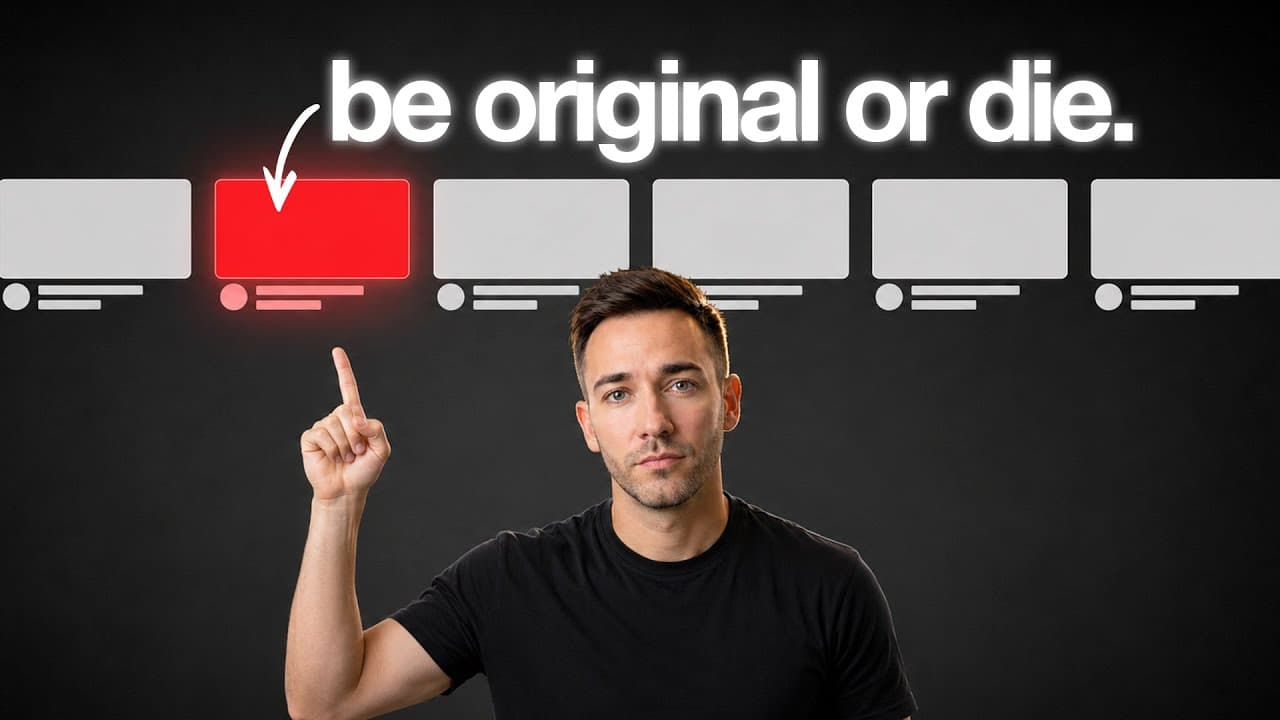
Give familiar advice a distinctive name, structure, or visual form so viewers can remember, share, and associate it with you. These signature concepts can turn generic guidance into recognizable intellectual property without requiring original research, using formats such as proper names, acronyms, diagrams, numbered lists, formulas, and rules.
Transcript
So, I recently went down a rabbit hole studying all the outlier videos on business channels across all kinds of different niches. You know, the ones that blew up way more than their other videos did. And I wanted to figure out for myself what they all had in common. And the pattern I found was surprisingly consistent. Just about every outlier video... Read More
Key Insights
- Concept signing is the practice of taking an idea people already discuss and giving it a distinctive name or structure that feels proprietary. The resulting signature concept lets a creator present familiar advice as recognizable intellectual property without claiming that the underlying idea itself is entirely new.
- A named concept is easier to retain and share because the name gives viewers a stable verbal handle. The transcript compares unnamed advice to liquid water and a named concept to ice: the substance remains the same, but its defined shape allows people to hold it and pass it along.
- Proper names are the most accessible signature-concept format because only the label must be new. Examples from the transcript include deep work, shallow work, the debt snowball, connoisseurship content, and the walk-up webinar, each of which packages a broader or familiar idea in memorable language.
- Acronyms work as memory triggers by compressing a method into one word whose letters represent its components. FIRE and SPIN selling illustrate how an acronym can organize several ideas, remain memorable weeks later, create natural on-screen material, and sometimes support recognizable variations.
- Diagrams make an idea visual, portable, and reusable across multiple videos. The Eisenhower Matrix, the Hedgehog concept, and the Golden Circle show how grids, overlapping circles, or concentric rings can become the lesson itself while encouraging screenshots, saves, shares, and future callbacks.
- Numbered lists create a finite, structured system that encourages viewers to discover every item. The five counterintuitive values and the SB7 framework demonstrate how numbering can transform a broad philosophy into a process while also generating separate videos about the overall framework and each individual component.
- Formulas give soft advice the appearance of a precise relationship between variables. Pain plus reflection equals progress and the value equation show how equations can make viewers examine, rewind, and reconsider a concept, while each variable can provide material for additional explanations or videos.
- Rules frame guidance as certain rather than optional, making ordinary advice more compelling to click and apply. The 20/3/8 rule and the 2-minute rule demonstrate how numbers or firm labels can package recommendations for titles and thumbnails while creating curiosity about what the rule means.
- More videos from this channel:
- More from this channel: Wes McDowell
Install to Summarize YouTube Videos and Get Transcripts
Explore YouTube Video Summarizer or Get YouTube Transcript Extractor
Questions & Answers
Q: What is concept signing for YouTube videos?
Concept signing is the practice of taking an idea that may already be familiar and giving it a distinctive name, framework, diagram, formula, acronym, numbered structure, or rule. The named result is a signature concept. Its purpose is to make generic advice feel ownable, memorable, shareable, and attributable to the creator without requiring the underlying idea to be completely new.
Q: How can a small YouTube channel make familiar advice feel new?
A smaller channel can create recognizable newness by packaging familiar advice as a signature concept. Instead of waiting months to conduct custom research or trying to invent a completely original method, the creator can name the idea or organize it into an acronym, diagram, numbered list, formula, or rule. This gives viewers a distinct handle for remembering and sharing the lesson.
Q: Why does naming a concept make it more memorable?
Naming gives an abstract idea a stable form that viewers can recall, repeat, and attribute. The transcript compares unnamed advice to water that flows through a person's hands, while a named concept resembles ice that can be picked up and passed along. The underlying advice may remain unchanged, but its label helps it stay intact when people discuss or share it.
Q: What are the six types of signature concepts?
The six types presented are proper names, acronyms, diagrams, numbered lists, formulas, and rules. A proper name labels an idea, an acronym compresses several steps into memorable letters, and a diagram visualizes relationships. A numbered list defines a finite system, a formula connects variables, and a rule frames guidance as a firm principle rather than an optional suggestion.
Q: How do acronyms improve educational YouTube content?
Acronyms compress a multi-part method into a single memorable word, with each letter serving as a prompt for one component. The transcript uses FIRE and SPIN selling as examples. This structure helps viewers recall the method after watching, organizes what might otherwise be a loose list of tips, and provides natural visuals when each letter is written or explained on screen.
Q: Why are diagrams useful as signature concepts?
Diagrams can become the central content rather than merely illustrating it. A simple grid, Venn diagram, or set of concentric circles can organize an entire lesson in a form viewers can screenshot, save, pin, and share. The creator can also reuse the same image in later videos, giving returning viewers a recognizable callback that connects multiple pieces of content.
Q: How can a numbered framework generate more YouTube videos?
A numbered framework establishes a finite list that viewers can understand as a complete system. It can support one overview video covering every item, followed by individual videos that explore each component in greater depth. The transcript illustrates this with five counterintuitive values, where one signature concept could support one overview plus a separate discussion of every value.
Q: Why do formulas and rules make advice more compelling?
Formulas present relationships between ideas in a compact structure that can feel precise and worth examining, even when they are not traditional mathematics. Rules create a different effect by presenting advice as firm and broadly applicable rather than optional. Both formats also provide strong visual packaging for videos, including formulas drawn on screen and rule names placed in thumbnails.
Summary & Key Takeaways
-
Outlier business videos commonly offer something that feels new, but creators do not always need original research or a genuinely new method. Concept signing creates perceived novelty by giving an existing idea a proprietary name or structure, producing a signature concept that audiences can recognize, remember, discuss, and attribute to its creator.
-
A signature concept gives otherwise fluid advice a stable form. A proper name provides a verbal handle, an acronym compresses multiple steps, and a diagram makes the lesson visually shareable. Numbered lists establish clear boundaries, formulas give relationships an authoritative structure, and rules turn optional-sounding tips into seemingly universal guidance.
-
Signature concepts also create practical advantages for YouTube content. They can strengthen titles and thumbnails, provide memorable on-screen visuals, encourage screenshots or rewatches, and support follow-up videos. The creator presents concept signing as an accessible way for smaller business channels to differentiate familiar advice and attract both viewers and potential clients.
Read in Other Languages (beta)
Share This Summary 📚
Summarize YouTube Videos and Get Video Transcripts with 1-Click
Try YouTube Summary with ChatGPT & Claude or YouTube Transcript Generator
Explore More Summaries from Wes McDowell 📚




Summarize YouTube Videos and Get Video Transcripts with 1-Click
Try YouTube Summary with ChatGPT & Claude or YouTube Transcript Generator