How to Create and Sell Digital Products for Passive Income
TL;DR
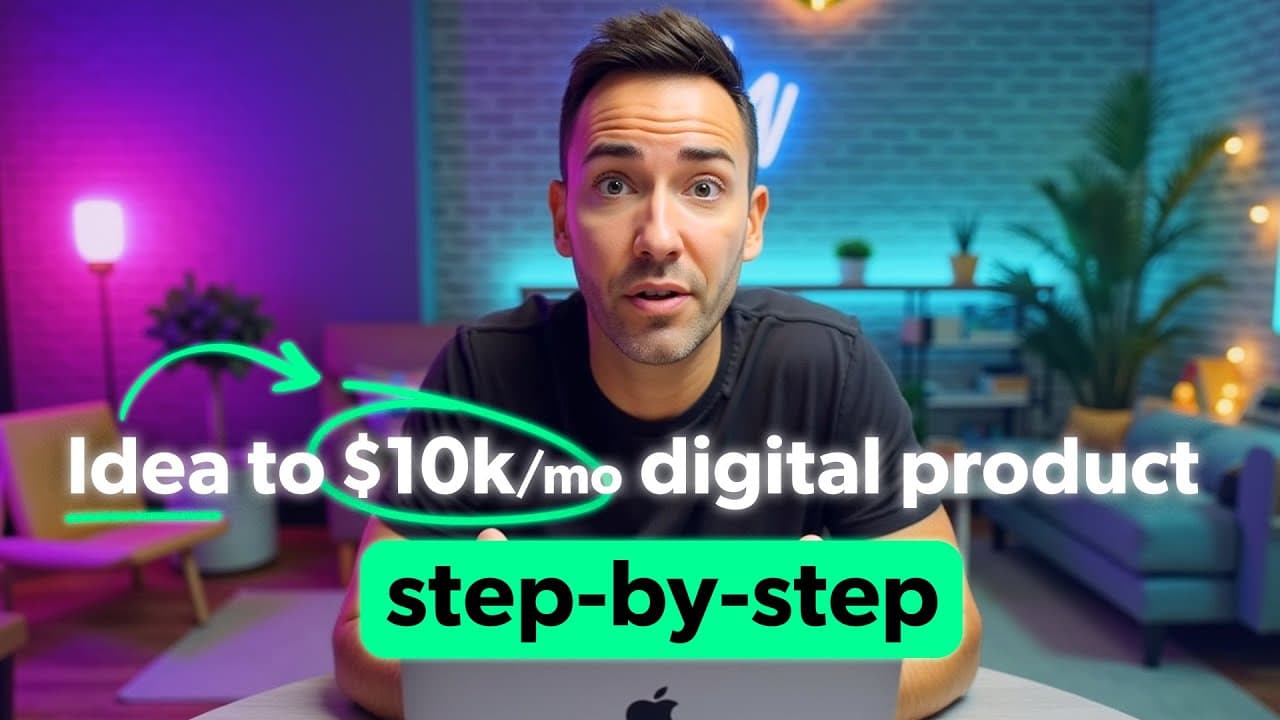
Digital products let you earn money automatically without trading time for income. Start by picking an area you know, package it into templates, workbooks, swipe files, or short video workshops, and build a small online storefront to sell globally. Use AI to speed creation and avoid heavy upfront costs.
Transcript
Most business owners are trapped in a cycle. They only make money when they're actively working with clients. Miss a day, lose money. Take a vacation, lose money. But digital products are the income stream that work for you, even while you sleep. Take Thomas Frank. He created a single notion template for content creators, and it's made him over $2.... Read More
Key Insights
- Digital products scale with the same effort whether selling to one person or ten thousand.
- Templates and visuals are highlighted as top sellers because they provide ready-to-use systems, not just information.
- Workbooks guide users through a complete process from start to finish, increasing perceived value and outcomes.
- Swipe files offer proven examples that buyers can copy, reducing uncertainty and boosting conversions.
- Video workshops are focused mini-courses that are faster to create yet command solid prices.
- Guides and ebooks must be actionable and narrowly focused to solve specific problems.
- You can start with what you already know and repurpose your expertise into digital formats.
- Avoid relying on marketplaces; hosting your own storefront improves margins and brand control.
- More videos from this channel:
- More from this channel: Wes McDowell
Install to Summarize YouTube Videos and Get Transcripts
Explore YouTube Video Summarizer or Get YouTube Transcript Extractor
Questions & Answers
Q: How do I choose a digital product idea based on my expertise
Begin with what you already know and the problems you regularly solve in your day job. Consider your strongest skills, recurring client questions, and tasks you perform often. Then brainstorm product formats that map to those problems, such as templates for workflows, step by step workbooks, or short video workshops. Validate ideas by listing potential outcomes buyers want and estimating the time to deliver.
Q: What product types are most effective for beginners
Templates provide a ready to use framework that helps others implement your system quickly, making them highly attractive. Workbooks guide users through a complete process, increasing perceived value. Swipe files give proven examples that reduce guesswork. Video workshops offer focused, actionable training that is faster to produce than full courses. Guides and ebooks stay effective when they are narrowly focused and practical.
Q: How can AI help in creating a digital product quickly
AI can help brainstorm ideas based on your expertise, draft outlines and content outlines, generate copy or scripts, and design covers or visuals. Use it to speed up the planning phase, flesh out a first draft, and then refine with your own expertise. The result is a professional, cohesive product created in a fraction of the time it would take manually.
Q: Why should I host my own storefront instead of using Gumroad or Etsy
Owning your storefront preserves control over customer experience, branding, and pricing. Marketplaces can change fees and algorithms, reducing margins and visibility. A personal store keeps the focus on your product, improves branding consistency, and can scale with your business as you add new items or bundles.
Q: What is a practical path to go from idea to finished digital product
Start by validating your idea with a quick outline of expected outcomes. Create the content in a Google Doc, then generate a simple cover image with an AI tool. Compile everything into a PDF if applicable, and set up a basic storefront. After a soft launch, collect feedback, adjust pricing or format, and publish updated versions to grow momentum.
Q: How should I price digital products for beginners
Pricing should reflect the value and effort saved for buyers. Look at comparable items such as templates at 149, workshops around 100, or guides priced at a few dollars to 20 or 1995 for specialty content. Start with a reasonable entry price to attract first customers, then offer bundles or updates to raise average order value.
Q: What makes a good landing page for a digital product
A strong landing page clearly states the problem, presents the solution you offer, and shows tangible outcomes buyers will get. Include a preview or samples, a simple outline of what’s included, social proof if available, and a straightforward call to action. Optimize the layout for quick skimming and trust-building elements.
Q: Where can I find customers for a digital product
Global reach is a key advantage of digital products. Use your existing audience or networks, create clear messaging about outcomes, and leverage content marketing like short videos or posts that demonstrate results. Direct buyers to your storefront with simple, persuasive copy and a compelling cover image to convert browsers into buyers.
Summary & Key Takeaways
-
This video explains why digital products offer scalable income with minimal overhead, and shows how to turn expertise into online products that can sell repeatedly without constant active work.
-
It covers product types such as templates, workbooks, swipe files, video workshops, and guides, with concrete price examples and fast creation tips using AI tools.
-
It emphasizes choosing a problem you can solve, designing a professional cover, and hosting your own storefront to maximize margins and brand control.
Read in Other Languages (beta)
Share This Summary 📚
Summarize YouTube Videos and Get Video Transcripts with 1-Click
Try YouTube Summary with ChatGPT & Claude or YouTube Transcript Generator
Explore More Summaries from Wes McDowell 📚




Summarize YouTube Videos and Get Video Transcripts with 1-Click
Try YouTube Summary with ChatGPT & Claude or YouTube Transcript Generator