How to build a Vision Transformer with PyTorch
TL;DR
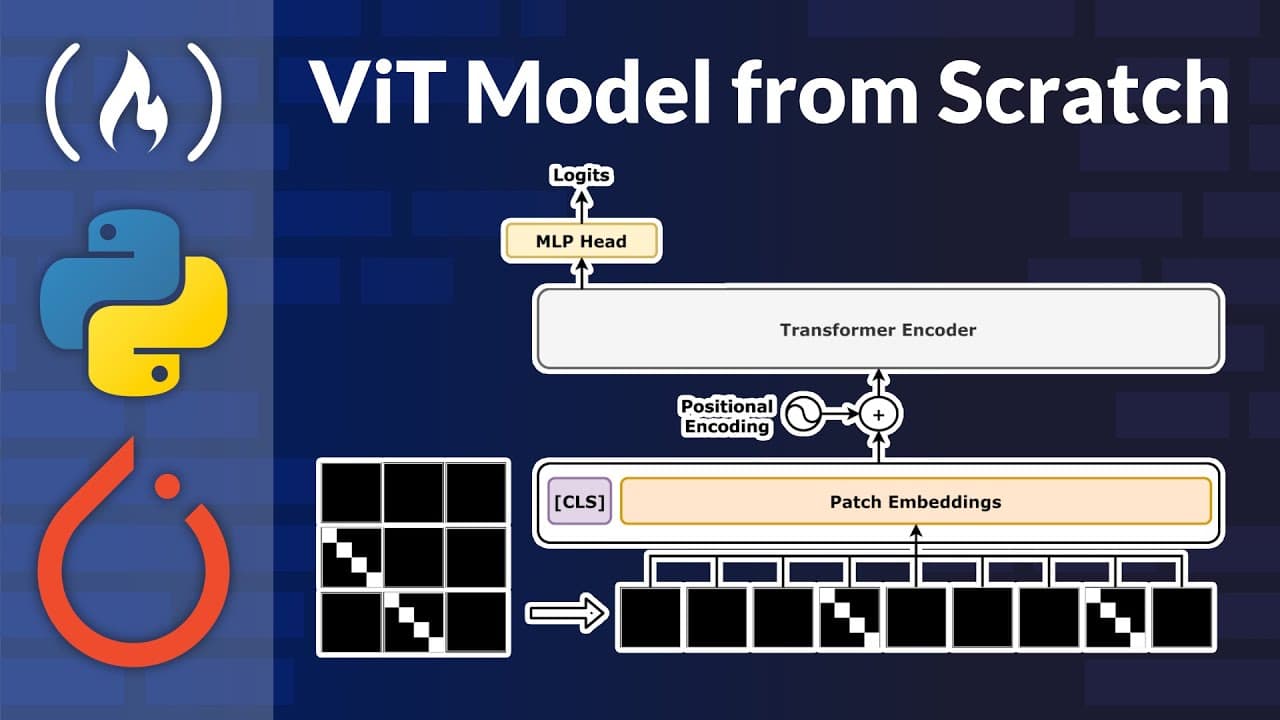
You can build a Vision Transformer from scratch in PyTorch by tokenizing the image into patches, mapping patches to embeddings, adding positional information, and feeding the sequence through transformer encoders for classification. The process includes data loading, preprocessing, training for epochs, and optional data augmentation to compare results.
Transcript
Learn to build a vision transformer from scratch using PyTorch. This hands-on course guides you through each component from patch embedding to the transformer encoder. Train your custom VIT model on CR10 and gain practical experience in image classification. Transition from CNN's to transformers in this efficient end toend tutorial. Muhammad Al Abr... Read More
Key Insights
- ViT uses patches instead of pixels by splitting the image and flattening patches into a sequence before embedding.
- Patch embedding maps each patch to a high dimensional vector which becomes the transformer input.
- Positional encoding is added because transformers lack built in order information, preserving spatial structure.
- A CLS token is added to summarize the image sequence for classification tasks.
- Encoder blocks in ViT consist of multi head attention, residual connections, and layer normalization.
- A decoder block is not used in the standard ViT architecture for image classification tasks.
- Data loading, preprocessing, and batching are essential steps before feeding data to the model.
- Training includes building a loop with a loss function and optimizer and can be extended with augmentation for improved results.
- More videos from this channel:
- More from this channel: freeCodeCamp.org
Install to Summarize YouTube Videos and Get Transcripts
Explore YouTube Video Summarizer or Get YouTube Transcript Extractor
Questions & Answers
Q: How to start building a Vision Transformer with PyTorch from scratch?
Begin by importing necessary libraries, then load CIFAR 10 using the torchvision datasets package. Transform images into patches, flatten them, and create a patch embedding layer to map patches to dense vectors. Add positional encodings, introduce a CLS token, and stack transformer encoder layers with normalization. Finally, train the model and evaluate its accuracy on the test set.
Q: What role do patches and embeddings play in ViT?
Patches act as the basic units of the image, similar to tokens in NLP. Each patch is flattened and passed through a learnable embedding to produce high dimensional vectors. These embeddings form a sequence that the transformer encoder can process, enabling the model to learn spatial relationships and visual patterns across patches.
Q: Why is positional encoding necessary in Vision Transformers?
Positional encoding provides the model with information about the order and spatial arrangement of patches. Since the transformer architecture does not inherently capture sequence order, adding positional information helps the model distinguish where each patch sits in the image, which is crucial for recognizing shapes and spatial context.
Q: What is the purpose of the CLS token in ViT?
The CLS token is a special learnable vector prepended to the patch sequence. Its final output from the transformer encoder is used for classification, encapsulating information from all patches. This approach mirrors how a summary token is used in NLP transformers for downstream prediction.
Q: What components constitute a Vision Transformer encoder block?
An encoder block includes a multi head attention mechanism to focus on different parts of the input, followed by residual connections and layer normalization to stabilize training. A feed forward network further refines representations, with another normalization step before passing to the next block.
Q: Is a decoder needed for ViT classification tasks?
No, a decoder block is not used in the standard Vision Transformer configuration for image classification. The architecture relies on the encoder stack to extract features from patched inputs, and the classification head uses the CLS token output to predict classes.
Q: How does data augmentation affect ViT training in this tutorial?
The tutorial explores applying augmentation techniques such as horizontal flips and random crops to the training data. This augmentation changes the distribution of inputs, encouraging the model to generalize better. A retraining cycle is performed to compare results with and without augmentation.
Q: What practical steps are shown for training and evaluating ViT in PyTorch?
The workflow includes setting up the environment, configuring hyperparameters, creating data loaders, building the ViT architecture from scratch, defining loss and optimizer, implementing the training loop, and visualizing training and testing accuracy. Predictions on new data are demonstrated to illustrate practical use of the trained model.
Summary & Key Takeaways
-
A step by step workflow is shown from data loading to model training and evaluation, focusing on patch based tokenization and transformer encoder usage.
-
The tutorial emphasizes end to end implementation including data augmentation and predictions after training to illustrate practical results.
-
The example uses CIFAR 10 as the dataset and demonstrates how to fine tune the model and visualize improvements after augmentation.
Read in Other Languages (beta)
Share This Summary 📚
Summarize YouTube Videos and Get Video Transcripts with 1-Click
Try YouTube Summary with ChatGPT & Claude or YouTube Transcript Generator
Explore More Summaries from freeCodeCamp.org 📚






Summarize YouTube Videos and Get Video Transcripts with 1-Click
Try YouTube Summary with ChatGPT & Claude or YouTube Transcript Generator