What Do Creation Myths Reveal About Sexual Reproduction?
TL;DR
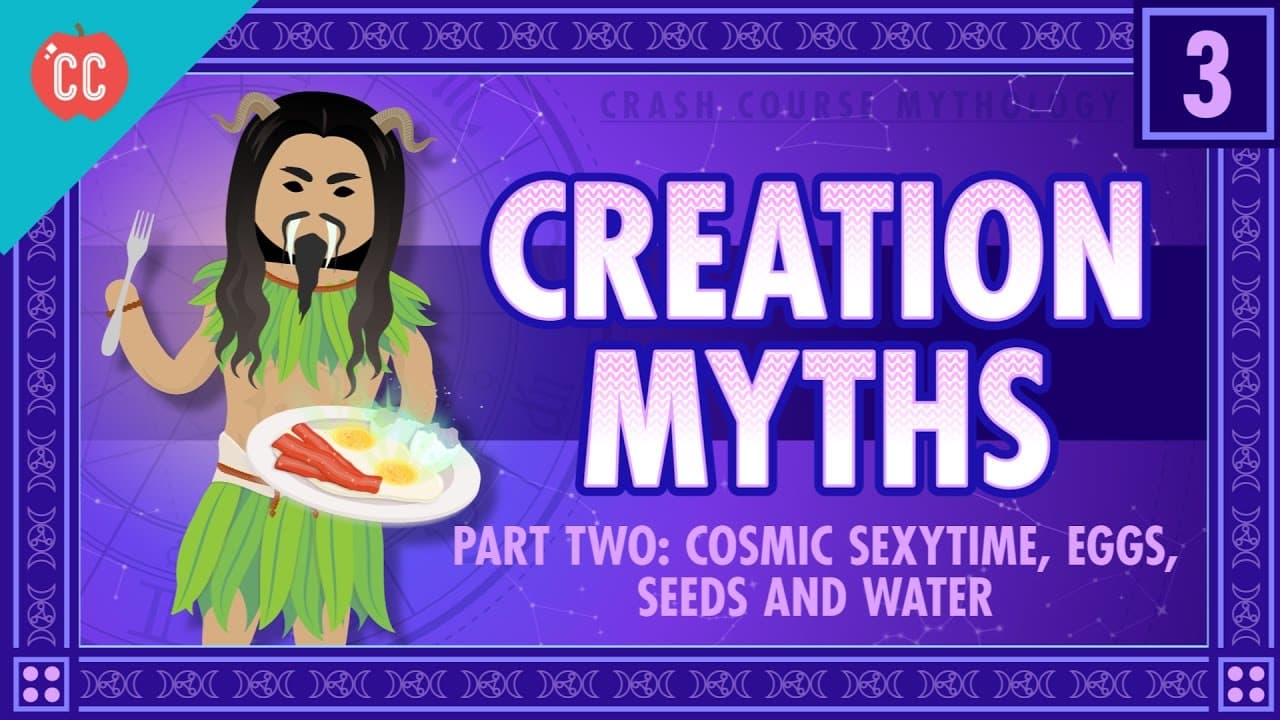
Creation myths often depict sexual reproduction as a central theme, illustrating the universe's origins through cosmic acts and metaphors. Many myths portray solitary male creators using bodily fluids or cosmic eggs, highlighting cultural perspectives and the overlap of themes like chaos and duality across different traditions.
Transcript
Hi! I'm Mike, this is Crash Course Mythology and today, we're going to talk about something that's almost impossible to avoid when discussing creation myths: Sex. Or, more specifically, sexual reproduction. It's going to be a little awkward. Stop covering your ears Thot, you're gonna be fine! You can handle it. We can all handle it. We're all adult... Read More
Key Insights
- Creation myths often involve sexual reproduction, symbolizing the birth of the universe through cosmic sexual acts or analogies.
- Egyptian creation myths depict gods creating new entities through bodily fluids, suggesting a male-centric view of creation.
- The Boshongo Bantu myth features a solitary male creator, Mbombo, who vomits the sun, moon, and living creatures, drawing parallels to childbirth.
- The Greek myth of Aphrodite's birth involves violent castration, highlighting themes of violence and creation intertwined in mythology.
- Cosmic eggs appear in several myths, such as the Indian and Persian stories, symbolizing the birth of the universe from a primordial state.
- Chinese mythology combines the cosmic egg with yin-yang duality, illustrating the balance of opposites in creation.
- World-parent myths often depict creation through the division of a primordial being, such as Phan Ku in Chinese mythology.
- Creation myths from various cultures show overlapping themes, like chaos, duality, and the use of bodily fluids, reflecting universal human concerns.
Install to Summarize YouTube Videos and Get Transcripts
Explore YouTube Video Summarizer or Get YouTube Transcript Extractor
Questions & Answers
Q: What is the significance of sexual reproduction in creation myths?
Sexual reproduction in creation myths symbolizes the generation of life and the universe. It reflects the natural human process of birth and creation, often using analogies like seeds and cosmic eggs to explain how the cosmos and its elements came into being. These myths highlight the importance of fertility and the continuity of life.
Q: How do Egyptian creation myths depict the creation process?
Egyptian creation myths often involve a solitary male god using bodily fluids to create new entities. In one version, the creator god uses saliva and other fluids to form gods Shu and Tefnut. This suggests a patrilineal culture where creation occurs without a female presence, emphasizing male-centric creation narratives.
Q: What parallels exist between Mbombo's creation story and human childbirth?
Mbombo's creation story parallels human childbirth through the imagery of pain and bodily expulsion. Mbombo, a solitary male creator, experiences pain and vomits the sun, moon, and living creatures. This mirrors the labor and delivery process, albeit in a more symbolic and mythological context, highlighting the creative power of the body.
Q: How does the Greek myth of Aphrodite's birth reflect themes of violence and creation?
The Greek myth of Aphrodite's birth involves the violent act of castration, where Chronos cuts off his father's genitals, leading to the birth of Aphrodite from sea foam. This myth intertwines themes of violence and creation, showing how destructive acts can lead to new life and beauty, reflecting complex human emotions and relationships.
Q: What role do cosmic eggs play in creation myths?
Cosmic eggs in creation myths symbolize the universe's birth from a primordial state. They represent potential and the beginning of life, often containing elements like water, earth, and sky. Myths from India, Persia, and China feature cosmic eggs, highlighting the universal motif of creation emerging from chaos or nothingness.
Q: How does yin-yang duality influence Chinese creation myths?
In Chinese creation myths, yin-yang duality represents the balance of opposites, such as male-female and light-dark, essential for creation. The myth of Phan Ku illustrates this duality, where chaos is separated into complementary elements, forming the earth and sky. This reflects the belief in harmony and balance as fundamental to the universe.
Q: What are world-parent myths, and how do they depict creation?
World-parent myths depict creation through the division or transformation of a primordial being. In these myths, the universe emerges from the body of a creator god, as seen with Phan Ku in Chinese mythology. These narratives often involve metaphorical or literal sexual reproduction, illustrating the interconnectedness of life and the cosmos.
Q: How do creation myths from different cultures share common themes?
Creation myths from various cultures share themes like chaos, duality, and the use of bodily fluids, reflecting universal human concerns about origins and existence. These myths often involve solitary creators, cosmic elements, and metaphors for birth, showing how diverse societies address similar existential questions through storytelling.
Summary & Key Takeaways
-
Crash Course Mythology explores creation myths across cultures, focusing on themes of sexual reproduction, cosmic eggs, and bodily fluids. Egyptian, African, Greek, Indian, Persian, and Chinese myths are examined, revealing commonalities and cultural perspectives on creation.
-
The episode discusses how creation myths use sexual metaphors, such as seeds and cosmic eggs, to explain the universe's origins. It highlights the role of solitary male creators and dualities, like yin-yang, in these narratives.
-
Through humor and analysis, the episode uncovers the symbolic meanings behind myths involving gods, violence, and cosmic elements. It encourages viewers to interpret these stories while appreciating their shared themes and cultural significance.
Read in Other Languages (beta)
Share This Summary 📚
Summarize YouTube Videos and Get Video Transcripts with 1-Click
Try YouTube Summary with ChatGPT & Claude or YouTube Transcript Generator
Explore More Summaries from CrashCourse 📚

Summarize YouTube Videos and Get Video Transcripts with 1-Click
Try YouTube Summary with ChatGPT & Claude or YouTube Transcript Generator