What Is the RAISE Act and How Does It Regulate AI Developments?
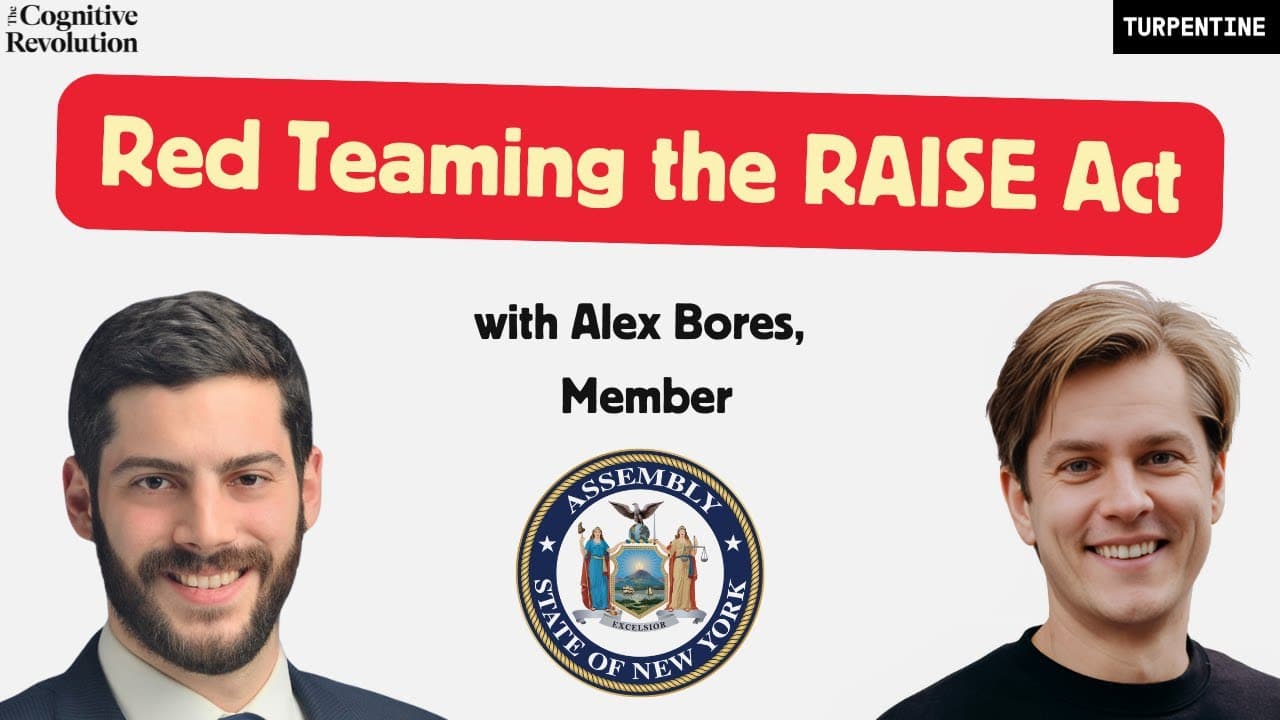
TL;DR
The RAISE Act proposes minimum safety standards for large AI developers focusing on frontier models. It requires them to create safety plans, undergo third-party audits, and establish whistleblower protections to reduce catastrophic risks. The bill targets companies with significant training expenditures, ensuring that those developing advanced AI technologies adhere to basic safety protocols.
Transcript
Hello and welcome back to the cognitive revolution. Today my guest is Alex Boris, New York State Assembly member representing New York's state district 73 on the east side of Manhattan and sponsor of the raise act, a bill designed to set a minimum standard for safety practices among large AI developers. In the generally polarized political environm... Read More
Key Insights
- The RAISE Act aims to set minimum safety standards for large AI developers, focusing on frontier models and addressing potential risks.
- Alex Bores, with a background in technology, emphasizes the need for clear safety protocols, third-party audits, and whistleblower protections.
- The bill targets large developers, defined by significant training expenditures, and requires them to develop and publish safety plans.
- Knowledge distillation is a key focus, ensuring models derived from frontier models are also subject to safety standards.
- The bill is neutral regarding open source, allowing companies to assess risks and decide their approach to model releases.
- Critics of state-level regulation worry about fragmented laws; however, Bores highlights ongoing collaboration among states to harmonize efforts.
- Whistleblower protections are included, but the penalties for retaliation are relatively low compared to the resources of large AI companies.
- The legislative process involves potential compromises and industry input, aiming for a balanced approach to AI regulation.
Install to Summarize YouTube Videos and Get Transcripts
Explore YouTube Video Summarizer or Get YouTube Transcript Extractor
Questions & Answers
Q: What is the main goal of the RAISE Act?
The RAISE Act aims to establish minimum safety standards for large AI developers working with frontier models. It requires these developers to create and publish safety plans, undergo third-party audits, and implement whistleblower protections to prevent catastrophic risks, such as those involving chemical, biological, radiological, or nuclear threats, and automated crime.
Q: How does the RAISE Act define large AI developers?
Large AI developers are defined as companies that have spent at least $100 million cumulatively on training frontier models. A frontier model is defined as having either 10^26 parameters and $100 million spent on training or being derived from a frontier model through knowledge distillation with at least $5 million spent.
Q: What are the key provisions of the RAISE Act?
The RAISE Act requires large AI developers to develop and publish safety plans, undergo third-party audits, disclose critical safety incidents, and provide whistleblower protections. These measures aim to ensure that AI models do not create unreasonable risks of harm, such as causing 100 or more deaths or over $1 billion in damages.
Q: How does the RAISE Act address open source AI models?
The RAISE Act is neutral regarding open source AI models. It allows companies to assess the risks and decide their approach to releasing models. The bill emphasizes that companies should consider the potential risks and make informed decisions about whether to open source or keep models closed.
Q: What are the potential challenges of implementing the RAISE Act?
Challenges include ensuring that third-party audits are not subject to regulatory capture, defining what constitutes an unreasonable risk of harm, and addressing concerns about state-level legislation leading to fragmented regulations. The bill's penalties for whistleblower retaliation are relatively low, which may also pose challenges in enforcement.
Q: How does the RAISE Act handle internal deployments of AI models?
The RAISE Act covers internal deployments of AI models, requiring companies to apply the same safety standards and protocols as they would for external deployments. This includes developing safety plans, undergoing audits, and ensuring that models do not pose unreasonable risks of harm.
Q: What is the legislative process for the RAISE Act?
The legislative process involves passing the bill through multiple committees in both houses of the New York State Legislature, followed by a floor vote and the governor's signature. The process includes collaboration with industry stakeholders and public input to refine the bill and address potential concerns.
Q: What is Alex Bores' perspective on AI regulation?
Alex Bores supports a balanced approach to AI regulation that encourages innovation while ensuring public safety. He emphasizes the importance of collaboration with industry stakeholders and believes that clear safety protocols, third-party audits, and whistleblower protections are essential for responsible AI development.
Summary & Key Takeaways
-
The RAISE Act, sponsored by New York Assembly Member Alex Bores, proposes minimum safety standards for large AI developers, focusing on frontier models. It requires safety plans, third-party audits, and whistleblower protections, aiming to prevent catastrophic risks. The bill is designed to be minimally burdensome, aligning with existing voluntary commitments from AI developers.
-
Bores, with a tech background, explains the bill's focus on large developers with significant training expenditures. The bill includes provisions for knowledge distillation to ensure safety standards apply to models derived from frontier models. It is neutral regarding open source, allowing companies to assess risks and decide their approach.
-
The bill addresses potential objections related to regulatory capture and state-level legislation, with Bores emphasizing collaboration among states to harmonize efforts. Whistleblower protections are included, but penalties for retaliation are relatively low. The legislative process involves potential compromises and industry input to balance innovation and safety.
Read in Other Languages (beta)
Share This Summary 📚
Summarize YouTube Videos and Get Video Transcripts with 1-Click
Try YouTube Summary with ChatGPT & Claude or YouTube Transcript Generator
Explore More Summaries from Cognitive Revolution "How AI Changes Everything" 📚




Summarize YouTube Videos and Get Video Transcripts with 1-Click
Try YouTube Summary with ChatGPT & Claude or YouTube Transcript Generator