What Are Rocks and How Do They Form? Crash Course Geography #18
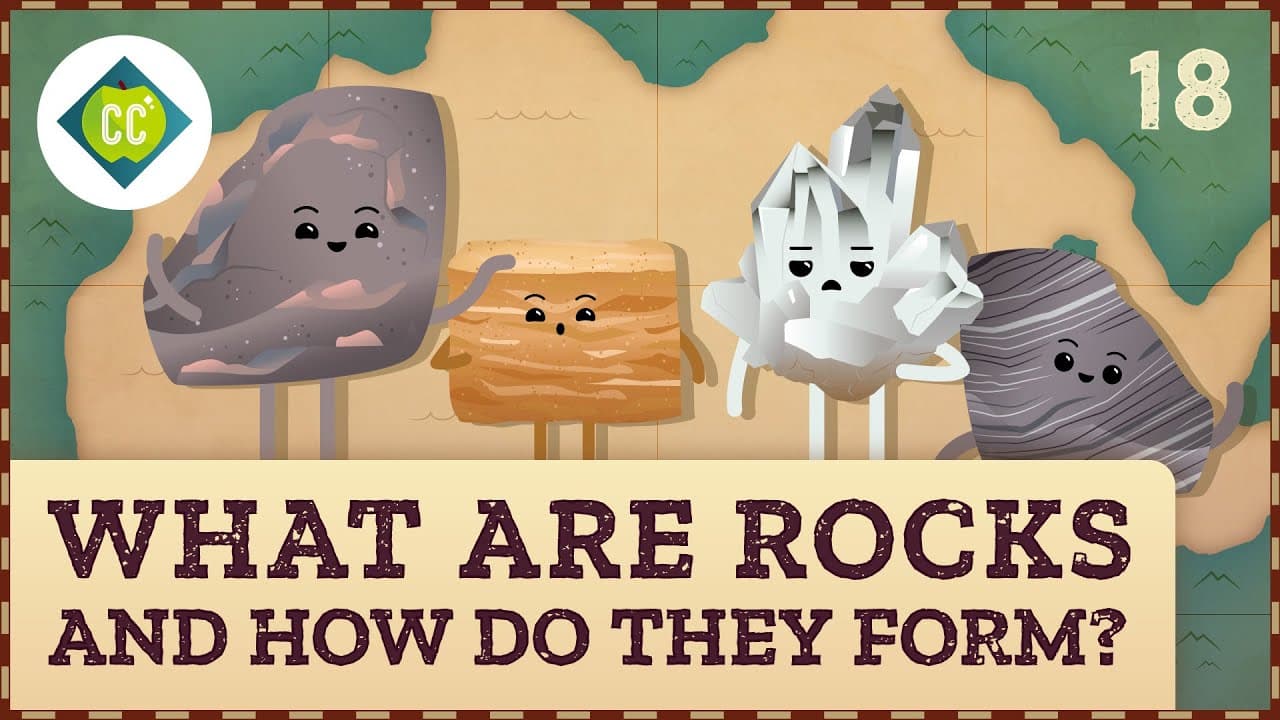
TL;DR
Earth's rocks have formed over billions of years through various geological processes, including volcanic activity, sedimentation, and metamorphism.
Transcript
From towering mountains to the gravel and pebbles along a river, Earth’s solid exterior is made of a huge variety of rocks. Some are even being formed this very moment as active volcanoes spew lava that hardens as it hits the atmosphere or ocean. But most of the Earth’s rocks are extremely old. Each rock is a shapeshifter, changing form over time w... Read More
Key Insights
- 💁 Earth's solid exterior is composed of a variety of rocks that have formed through different geological processes.
- 💯 The Earth is made up of layers, including the crust, mantle, and core, each with its own distinct chemical composition and temperature.
- 👨🎤 The rock cycle allows for the transformation of rocks from one type to another through processes such as melting, solidification, and metamorphism.
- 👨🎤 Different types of rocks, such as igneous, sedimentary, and metamorphic rocks, have unique characteristics and form under specific conditions.
- 🖐️ Geological processes such as volcanic activity, sedimentation, and metamorphism play a crucial role in the formation and transformation of Earth's rocks.
- 👨🎤 Weathering and erosion contribute to the exposure and transport of rocks, while sedimentation leads to the formation of sedimentary rocks.
- 💁 The study of rocks and their transformations helps scientists understand Earth's history, including the formation of continents and the origin of the planet.
Install to Summarize YouTube Videos and Get Transcripts
Explore YouTube Video Summarizer or Get YouTube Transcript Extractor
Questions & Answers
Q: How did the Earth's solid exterior form?
The Earth's solid exterior formed as the solar system was forming, with the collapsing of a swirling nebula of dust and gas under its own gravity.
Q: What are the two types of crust on Earth?
The two types of crust are continental crust, which makes up the landmasses, and oceanic crust, which forms the ocean floors.
Q: How do scientists study the Earth's interior?
Scientists study the Earth's interior by analyzing seismic waves from earthquakes and modeling the Earth's layers.
Q: How does magma cool and solidify into rock?
Magma cools and solidifies beneath the Earth's surface, forming intrusive igneous rocks, while lava that erupts onto the surface cools and solidifies into extrusive igneous rocks.
Q: How do rocks transform through metamorphism?
Rocks can undergo metamorphism through intense temperature and pressure changes, leading to the recrystallization of minerals and the formation of new metamorphic rocks.
Q: What are some examples of sedimentary rocks?
Examples of sedimentary rocks include sandstone, formed from cemented sand particles, limestone, formed from the remains of organisms, and coal, formed from organic matter in swampy environments.
Q: How are rocks affected by weathering and erosion?
Rocks can be weathered and eroded by the Earth's atmosphere, water, and living things, leading to the exposure of new surfaces and the deposition of sediments.
Q: What is the rock cycle?
The rock cycle is a continuous process where rocks can transform from one type to another through various geological processes such as melting, solidification, and metamorphism.
Summary & Key Takeaways
-
Earth's solid exterior is made up of a variety of rocks that have formed through processes such as volcanic activity and sedimentation.
-
The Earth is composed of different layers, including the thin and low-density crust, the thick mantle, and the dense core.
-
Rocks can transform through the rock cycle, where they can change from igneous to sedimentary or metamorphic rocks.
Read in Other Languages (beta)
Share This Summary 📚
Summarize YouTube Videos and Get Video Transcripts with 1-Click
Try YouTube Summary with ChatGPT & Claude or YouTube Transcript Generator
Explore More Summaries from CrashCourse 📚


Summarize YouTube Videos and Get Video Transcripts with 1-Click
Try YouTube Summary with ChatGPT & Claude or YouTube Transcript Generator