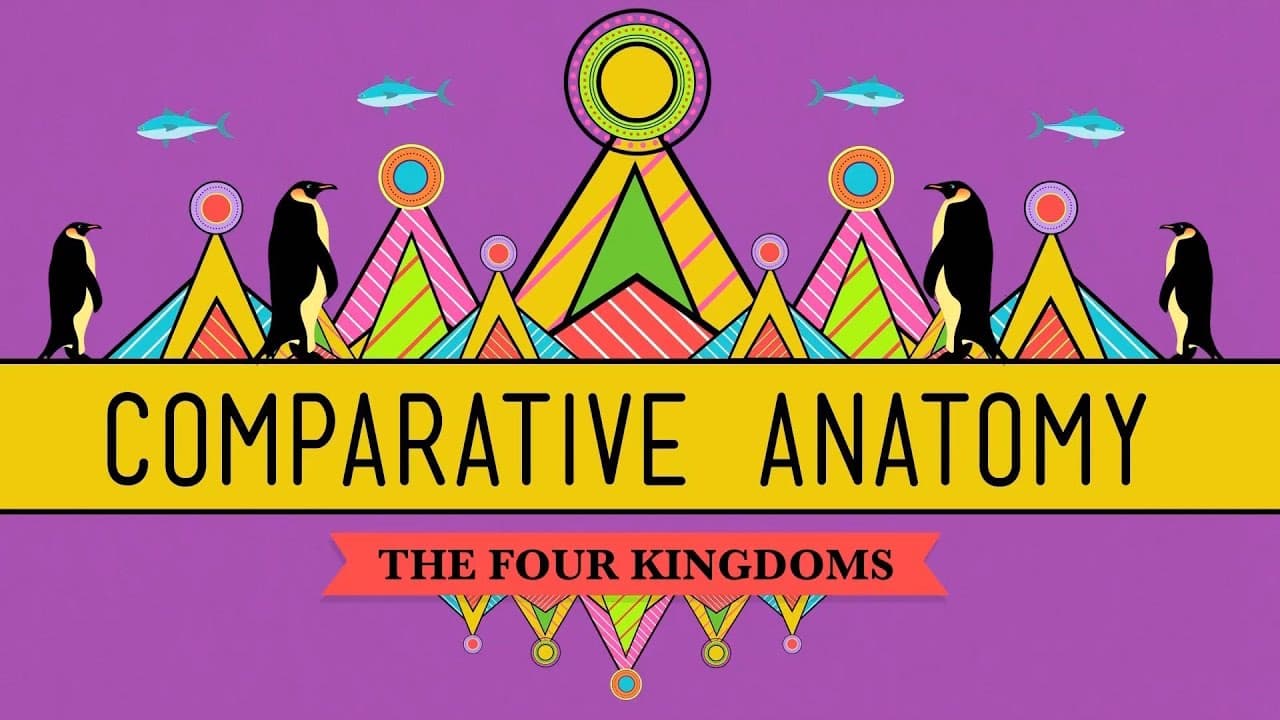
Comparative Anatomy: What Makes Us Animals - Crash Course Biology #21
TL;DR
Comparative anatomy reveals evolutionary links between animal species.
Transcript
Hi, I want you to meet my friend Shoshanna. She's a Zebra Finch and she is very good at it. She's here to help me talk about comparative anatomy, which is the study of similarities and differences between the anatomies of animals. We study comparative anatomy because it helps us learn more about our evolution and our shared ancestry. Organisms have... Read More
Key Insights
- Comparative anatomy examines anatomical similarities and differences to understand evolutionary relationships among species, highlighting shared ancestry.
- Locomotion and heterotrophy are key characteristics of the animal kingdom, distinguishing animals from plants and other life forms.
- Convergent evolution occurs when unrelated species develop similar traits due to similar environmental pressures, complicating evolutionary analysis.
- Thomas Henry Huxley, a pioneer in comparative anatomy, linked paleontology and biology, supporting Darwin's theory of evolution.
- Animal bodies share a basic cellular blueprint, with cells forming tissues that perform essential functions like protection and movement.
- The four primary tissue types in animals are epithelial, connective, muscle, and nerve tissues, each with distinct structures and functions.
- Organs are composed of tissues and work together in systems to perform vital functions, demonstrating anatomical complexity.
- The common ancestor of animals had a digestive and muscular system, laying the foundation for the diversity of life forms today.
Install to Summarize YouTube Videos and Get Transcripts
Explore YouTube Video Summarizer or Get YouTube Transcript Extractor
Questions & Answers
Q: What is the significance of comparative anatomy in biology?
Comparative anatomy is significant in biology because it provides insights into evolutionary relationships by examining anatomical similarities and differences among species. It helps scientists understand how different organisms are related through common ancestry and how they have adapted to their environments over time.
Q: How does convergent evolution complicate the study of evolutionary relationships?
Convergent evolution complicates the study of evolutionary relationships because it involves unrelated species developing similar traits independently due to similar environmental pressures. This can make it challenging to determine whether similarities in anatomy are due to shared ancestry or convergent evolution, requiring careful analysis.
Q: Who was Thomas Henry Huxley and what was his contribution to biology?
Thomas Henry Huxley was a pioneering biologist known as the Father of Comparative Anatomy. He contributed to biology by linking paleontology and biology, supporting Darwin's theory of evolution, and demonstrating the evolutionary relationship between birds and dinosaurs. His work helped establish the foundation for modern evolutionary biology.
Q: What are the four primary tissue types in animals and their functions?
The four primary tissue types in animals are epithelial, connective, muscle, and nerve tissues. Epithelial tissue covers organs and lines cavities, connective tissue provides support and structure, muscle tissue enables movement, and nerve tissue conducts electrical signals for communication within the body. Together, they form the basis of animal anatomy.
Q: How do organs and organ systems contribute to animal function?
Organs are composed of tissues that work together to perform specific functions, and they are organized into organ systems that carry out complex tasks necessary for survival. For example, the digestive system processes food, the skeletal system provides support, and the nervous system coordinates responses, illustrating the complexity of animal anatomy.
Q: What distinguishes animals from plants and other life forms?
Animals are distinguished from plants and other life forms primarily by their locomotion and heterotrophy. Animals move to find food, escape predators, and reproduce, while plants are typically stationary. Animals are also heterotrophs, obtaining energy from consuming other organisms, unlike plants that produce their own food through photosynthesis.
Q: What role does the common ancestor play in animal evolution?
The common ancestor plays a crucial role in animal evolution as it represents the original organism from which all animals evolved. This ancestor had a digestive and muscular system, which provided the foundation for the diverse anatomical structures and functions seen in modern animals, illustrating the shared evolutionary history of the animal kingdom.
Q: Why is the study of tissues important in understanding animal biology?
The study of tissues is important in understanding animal biology because tissues are the building blocks of organs and organ systems. By examining how different tissue types function and interact, scientists can gain insights into how animals perform vital processes, adapt to their environments, and maintain homeostasis, contributing to a comprehensive understanding of animal life.
Summary & Key Takeaways
-
Comparative anatomy helps us understand evolutionary relationships by studying anatomical similarities and differences among species. It reveals how animals share common traits due to shared ancestry, despite diverse adaptations.
-
Thomas Henry Huxley, a key figure in comparative anatomy, used fossil records to connect paleontology with biology, supporting Darwin's evolutionary theory and highlighting the links between birds and dinosaurs.
-
Animal bodies consist of four primary tissue types: epithelial, connective, muscle, and nerve tissues. These tissues form organs and organ systems, enabling animals to perform essential functions like movement, digestion, and communication.
Read in Other Languages (beta)
Share This Summary 📚
Summarize YouTube Videos and Get Video Transcripts with 1-Click
Try YouTube Summary with ChatGPT & Claude or YouTube Transcript Generator
Explore More Summaries from CrashCourse 📚


Summarize YouTube Videos and Get Video Transcripts with 1-Click
Try YouTube Summary with ChatGPT & Claude or YouTube Transcript Generator