What Is the Autonomic Nervous System and Its Functions?
TL;DR
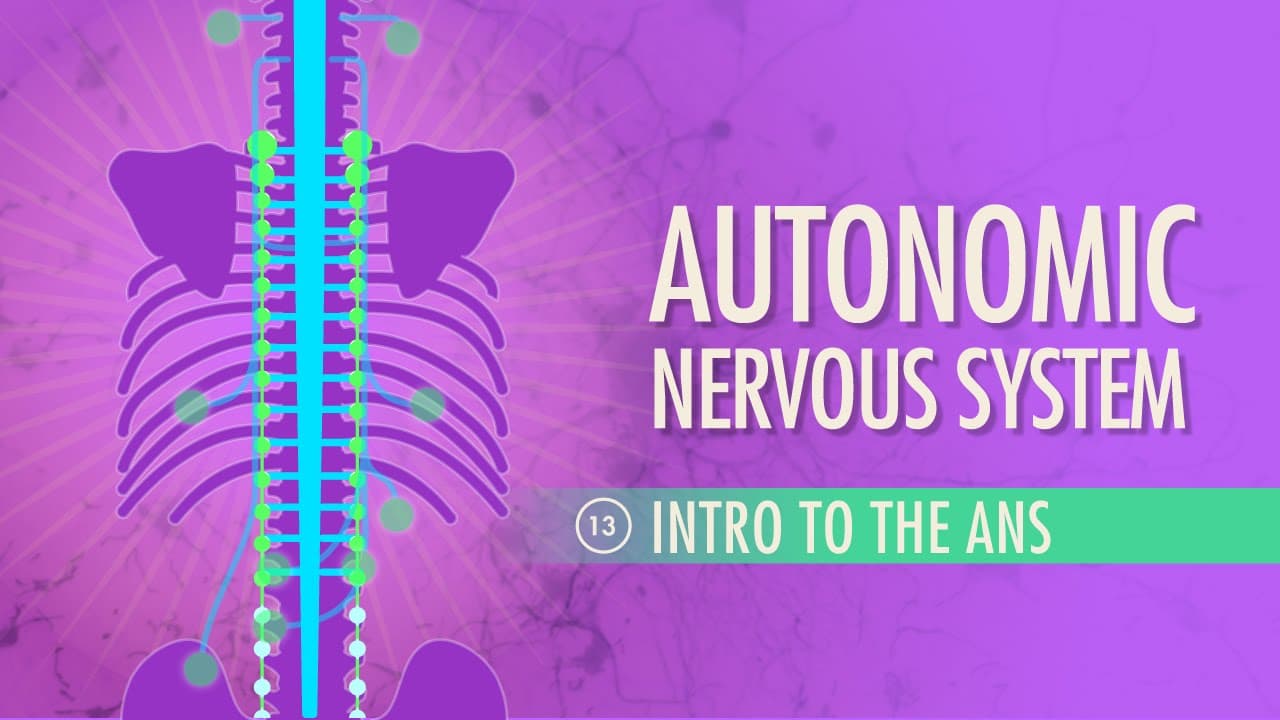
The autonomic nervous system consists of two divisions: the sympathetic, which prepares the body for 'fight or flight' responses, and the parasympathetic, which promotes 'rest and digest' functions. These systems operate through different anatomical structures, with sympathetic fibers originating from the thoracolumbar region for rapid responses, while parasympathetic fibers come from craniosacral regions for targeted control over specific organs.
Transcript
No matter what you’re a fan of, you can probably think of two characters who fit the description. Holmes and Watson. Brennan and Booth. Kirk and Spock. Ron and Hermione. They’re close. They understand each other in ways that others don’t, and you really can’t picture one without the other. But when when happens, they usually react in different ways... Read More
Key Insights
- The autonomic nervous system comprises two main divisions: sympathetic and parasympathetic, which regulate involuntary body functions.
- Sympathetic system is responsible for 'fight or flight' responses, increasing alertness and energy expenditure during stress.
- Parasympathetic system handles 'rest and digest' functions, promoting relaxation and conservation of energy.
- The nerve fibers of the sympathetic system originate from thoracolumbar regions, facilitating quick coordination of organ functions.
- Parasympathetic fibers originate from craniosacral regions, allowing for targeted and efficient communication with specific organs.
- Sympathetic ganglia are located close to the spinal cord, enabling widespread and rapid response to stress signals.
- Parasympathetic ganglia are situated near effector organs, allowing for precise and localized control of bodily functions.
- The anatomical differences between these systems explain their contrasting roles in managing stress and relaxation.
Install to Summarize YouTube Videos and Get Transcripts
Explore YouTube Video Summarizer or Get YouTube Transcript Extractor
Questions & Answers
Q: What are the main divisions of the autonomic nervous system?
The autonomic nervous system is divided into two main parts: the sympathetic and parasympathetic systems. The sympathetic system is responsible for arousing the body and preparing it for action, often referred to as the 'fight or flight' response. The parasympathetic system, on the other hand, is in charge of resting, digesting, and repairing, promoting relaxation and energy conservation.
Q: How do the sympathetic and parasympathetic systems differ in their origins?
The sympathetic nerve fibers originate from the thoracolumbar region, specifically between the thoracic vertebrae and the lumbar vertebrae. This allows for quick coordination of organ functions during stress. In contrast, the parasympathetic fibers originate from the craniosacral regions, sprouting from the base of the brain and the sacral spinal cord, facilitating targeted communication with specific organs.
Q: Where are the ganglia located in the sympathetic system?
In the sympathetic system, the ganglia are located close to the spinal cord. This proximity allows for rapid and widespread communication during stress events, enabling a single stress signal to trigger responses in multiple effectors, such as the heart, lungs, and adrenal glands, facilitating the 'fight or flight' response.
Q: What role do parasympathetic ganglia play in the autonomic nervous system?
Parasympathetic ganglia are situated near or within the effector organs. This strategic placement allows for precise and localized control of bodily functions, such as digestion and waste excretion. The parasympathetic system uses specific signals to manage energy conservation and maintain homeostasis, promoting 'rest and digest' activities.
Q: How do the axon lengths differ between the two systems?
In the sympathetic system, the preganglionic fibers are shorter than the postganglionic ones due to the proximity of the ganglia to the spinal cord. Conversely, in the parasympathetic system, the preganglionic fibers are longer, extending to the effector organs where the ganglia are located, resulting in shorter postganglionic fibers.
Q: What is the significance of the anatomical differences between the systems?
The anatomical differences between the sympathetic and parasympathetic systems are crucial for their distinct functions. The sympathetic system's structure supports rapid, widespread responses to stress, while the parasympathetic system's layout allows for targeted, efficient communication, facilitating relaxation and energy conservation. These differences ensure balanced regulation of involuntary body functions.
Q: How do the sympathetic and parasympathetic systems work as foils?
The sympathetic and parasympathetic systems act as foils by providing contrasting effects on the body. While the sympathetic system prepares the body for action and stress through 'fight or flight' responses, the parasympathetic system promotes relaxation and recovery through 'rest and digest' functions. Their opposing actions help maintain homeostasis and balance in the body's involuntary processes.
Q: What is the impact of the sympathetic system on the body during stress?
During stress, the sympathetic system triggers the 'fight or flight' response, increasing heart rate, redirecting blood flow to muscles, and releasing adrenaline. This prepares the body for immediate action, enhancing alertness and energy expenditure. The system's rapid, widespread communication ensures that the body can respond quickly and effectively to perceived threats.
Summary & Key Takeaways
-
The autonomic nervous system consists of the sympathetic and parasympathetic systems, which regulate involuntary functions like heart rate and digestion. These systems work as foils, with the sympathetic system triggering 'fight or flight' responses and the parasympathetic system promoting 'rest and digest' activities.
-
Sympathetic nerve fibers originate from the thoracolumbar region, while parasympathetic fibers come from craniosacral regions. This anatomical distinction allows the sympathetic system to coordinate rapid, widespread responses, whereas the parasympathetic system provides targeted, localized control.
-
Sympathetic ganglia are located near the spinal cord, facilitating quick communication during stress. In contrast, parasympathetic ganglia are near effector organs, enabling specific and efficient interaction. These structural differences underpin the systems' respective roles in stress management and energy conservation.
Read in Other Languages (beta)
Share This Summary 📚
Summarize YouTube Videos and Get Video Transcripts with 1-Click
Try YouTube Summary with ChatGPT & Claude or YouTube Transcript Generator
Explore More Summaries from CrashCourse 📚




Summarize YouTube Videos and Get Video Transcripts with 1-Click
Try YouTube Summary with ChatGPT & Claude or YouTube Transcript Generator