How Did Andrew Ng and Chris Manning Shape NLP?
TL;DR
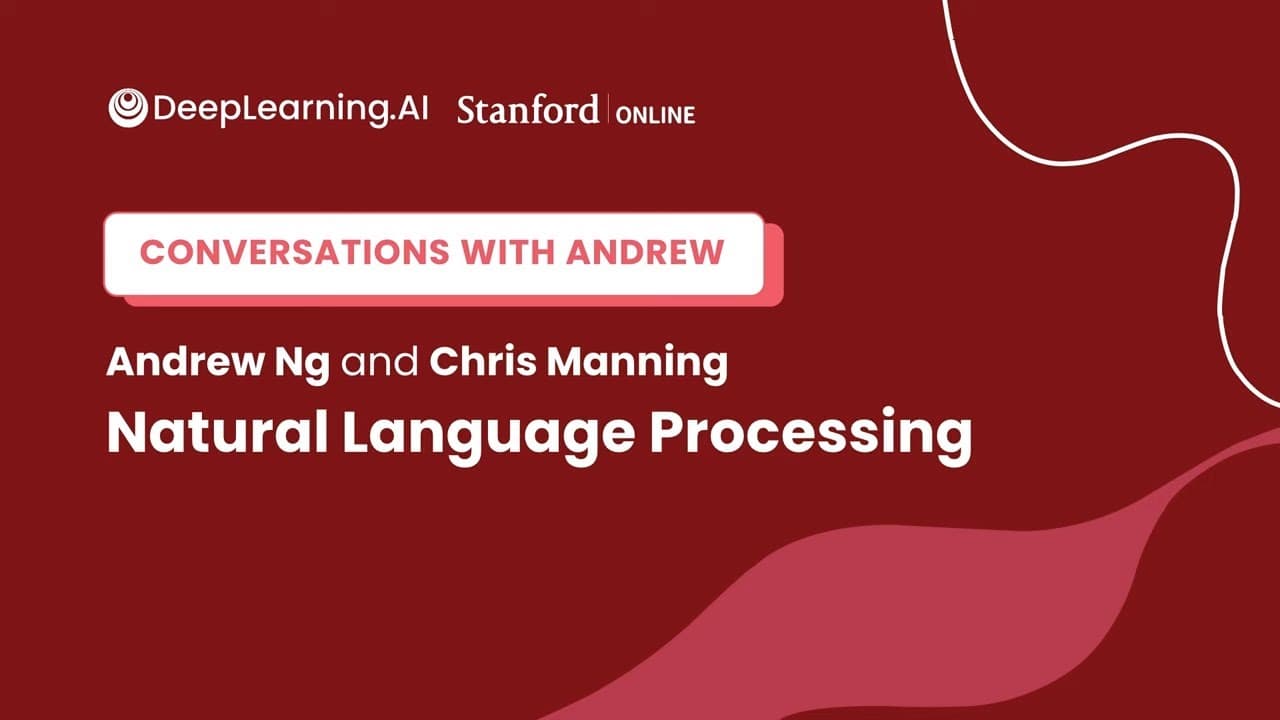
Andrew Ng and Chris Manning discuss their groundbreaking work in natural language processing (NLP), exploring the evolution from rule-based systems to machine learning. They highlight the impact of large language models like Transformers, emphasizing the balance between data-driven approaches and structured linguistic insights, while encouraging new entrants in the field to build on these advancements.
Transcript
foreign hi I'm delighted to be here with my old friend and collaborator Professor Chris Manning Chris has a very long and impressive bio but just briefly he is Professor of computer science at staff University and also the director of the Stanford AI lab and he also has a distinction of being the most highly cited researcher in NLP or natural langu... Read More
Key Insights
- 💦 Professor Manning's transition from linguistics to machine learning and NLP was driven by his interest in how human languages work and computational ideas.
- 💨 The availability of digital language data in the early 90s paved the way for the integration of statistical and probabilistic approaches in NLP.
- 🌥️ Large language models, such as Transformers, have revolutionized NLP by enabling models to learn from vast amounts of data and acquire a deep understanding of language.
- 😒 The future of NLP is extremely bright, with the potential for further advancements in natural language capabilities and the use of AI models as instruction languages.
- 👾 While machine learning and data-driven approaches dominate NLP, there is still a space for models with structured inductive bias that exploit the nature of language.
- 🏛️ The accessibility of machine learning libraries and abstractions, such as TensorFlow and PyTorch, has reduced the need for a deep understanding of calculus and mathematical foundations in building deep learning models.
- 👨🔬 Despite the reliance on data-driven approaches, some background in mathematics and linguistic understanding can still be valuable in NLP research and development.
Install to Summarize YouTube Videos and Get Transcripts
Explore YouTube Video Summarizer or Get YouTube Transcript Extractor
Questions & Answers
Q: How did Professor Manning's background in linguistics contribute to his interest in machine learning and NLP?
Professor Manning's fascination with human languages and how people understand them led him to explore computational ideas, eventually bridging the gap between linguistics and machine learning. This multidisciplinary background shaped his research and career in NLP.
Q: How did the availability of digital text and speech data impact the field of NLP?
The availability of digital language data allowed researchers to move away from rule-based approaches and towards statistical and probabilistic models. This shift paved the way for the integration of machine learning techniques in NLP and opened new possibilities for analyzing and understanding human language.
Q: What is the significance of large language models, such as Transformers, in NLP?
Large language models have had a profound impact on NLP, as they can learn from vast amounts of text data and acquire a deep understanding of language. These models have been successfully applied to various NLP tasks, and their development has propelled the field forward.
Q: How do large language models learn from data, and what are the potential applications of these models?
Large language models are trained through self-supervised learning, where they predict the next word in a sentence based on the preceding context. This allows them to learn not only the patterns and meanings of individual words but also the structure of sentences and even world knowledge. These models can be applied to tasks such as question answering, summarization, and sentiment analysis.
Summary & Key Takeaways
-
Professor Manning's interest in human languages and computational ideas led him to the study of syntax in linguistics and eventually to machine learning and NLP.
-
The availability of digital text and speech data in the early 90s sparked a shift towards statistical and probabilistic approaches in NLP, leading to the rise of machine learning in the field.
-
The development of large language models, such as Transformers, has revolutionized NLP by enabling models to learn from vast amounts of data and perform tasks like question answering and summarization.
Read in Other Languages (beta)
Share This Summary 📚
Summarize YouTube Videos and Get Video Transcripts with 1-Click
Try YouTube Summary with ChatGPT & Claude or YouTube Transcript Generator
Explore More Summaries from Stanford Online 📚
Summarize YouTube Videos and Get Video Transcripts with 1-Click
Try YouTube Summary with ChatGPT & Claude or YouTube Transcript Generator