How to Improve Nontechnical Writing by Imitation
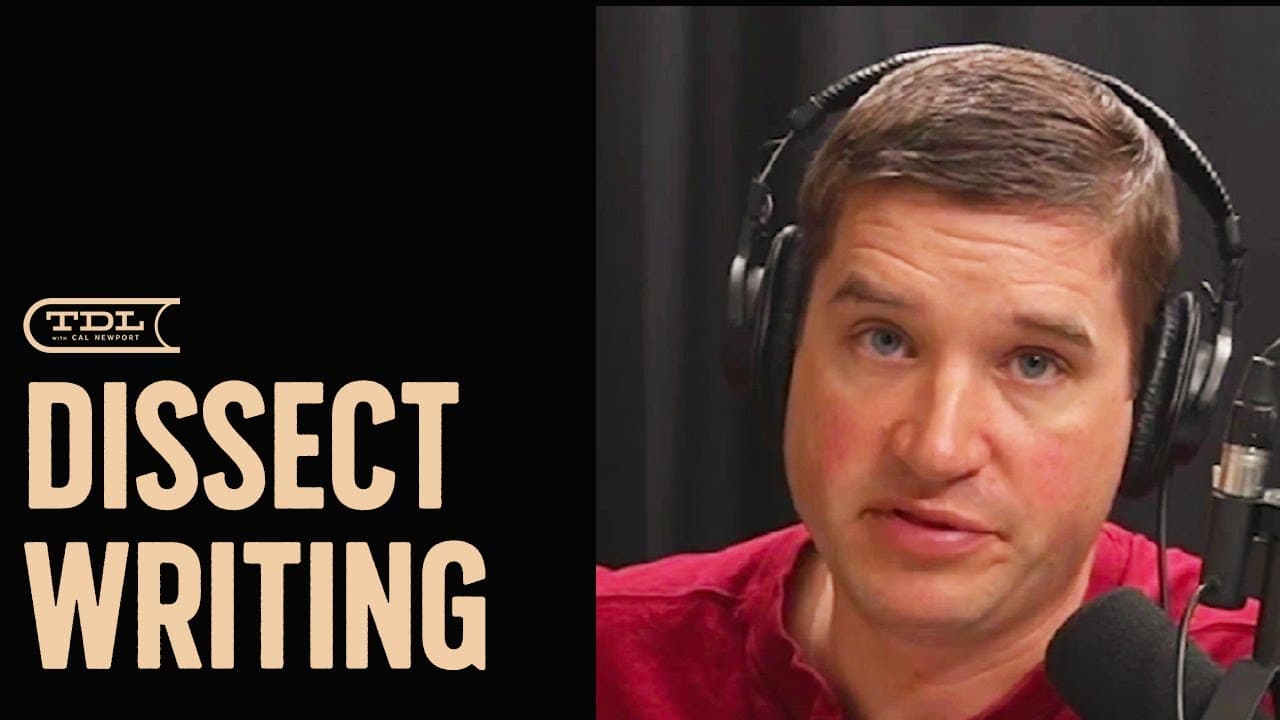
TL;DR
Improve nonfiction writing by dissecting work you admire, identifying its structural formula, and using that formula in your own articles. Practice for editors who can reject or substantially revise your submissions, because external standards, pressure, and feedback make the exercise more deliberate than writing only for yourself.
Transcript
all right jesse i think we have time for a couple more quick calls who do we have next alright next question we have a question about writing non-technical stuff hey cal my name is abhishek i've been following your writing since the google reader days thanks for all the advice over the years my question is about getting better at writing i have rea... Read More
Key Insights
- The most direct way to develop nonfiction style is to dissect admired writing, identify its formula, and reproduce that formula in an original piece. This creates a focused exercise instead of relying on broad reading or unguided repetition.
- Article structure can be analyzed as a sequence of functions, including an opening story, a cliffhanger, a transition, an idea introduction, and a return to the original story. Naming these components makes a writer's stylistic choices easier to practice.
- Deliberate writing practice requires direction, because repeating the act of writing does not automatically strengthen style. A borrowed article formula provides a specific target, while the resulting draft reveals which techniques work and which ones fail.
- Imitation can become an early stage of personal style development. Newport argues that writers can first mimic structures they admire, then gradually evolve those patterns into their own style as they gain experience and build their nonfiction writing abilities.
- Benjamin Franklin developed his writing through reconstruction exercises. He broke essays or poetry into component parts, tried to reproduce them from scratch, and later applied what he had learned while writing anonymous letters for his brother's newspaper.
- Writing for editors creates stronger practice conditions than writing only for yourself. A submission may be rejected or heavily edited, so the possibility of external judgment raises the stakes and encourages the writer to improve the piece before presenting it.
- Newport practiced nonfiction by deconstructing authors such as Malcolm Gladwell, Clive Thompson, and Stephen Johnson. He then pitched articles whose subjects allowed him to practice the particular formats and structural formulas he had been studying.
- Flak Magazine served as Newport's editorial training ground for roughly two years between his second and third books. He valued it for access to serious editors and meaningful submission standards, not because the publication offered a large audience.
Install to Summarize YouTube Videos and Get Transcripts
Explore YouTube Video Summarizer or Get YouTube Transcript Extractor
Questions & Answers
Q: How can I improve my nontechnical writing style?
Improve nontechnical writing by selecting articles from authors whose style produces the effect you want, then breaking each article into functional sections. Identify what happens in the opening, how ideas are introduced, where transitions occur, and how earlier stories return. Write a new article that follows the same structural formula, review what succeeds or fails, and repeat the exercise with another format.
Q: How do I dissect an article written by an author I admire?
Dissect an admired article by outlining its sections and describing the job performed by each one. Newport's examples include an opening story, a cliffhanger, a transition, an introduction of the main idea, and a later return to the opening story. The goal is to uncover the article's working formula, then use that formula as a clear framework for an original piece.
Q: Why does imitating another writer help develop a personal style?
Imitation provides a concrete direction for practice. Instead of merely writing repeatedly, you attempt to reproduce a specific structure and can observe which parts work in your own piece. Newport says this process builds the necessary writing muscles and eventually evolves into an individual style. The borrowed formula is therefore a training framework, not necessarily the writer's permanent voice.
Q: What is deliberate practice for nonfiction writing?
Deliberate practice for nonfiction writing combines a specific stylistic target with demanding execution and evaluation. Newport recommends deconstructing an admired article, identifying its formula, and writing an original article in direct emulation of that structure. The exercise becomes even stronger when an editor can reject or revise the result, because pressure and feedback encourage greater effort than unguided repetition.
Q: Why should writers submit work to editors instead of only publishing on a personal blog?
Writing for editors introduces standards, pressure, and feedback that private writing may not provide. An editor can reject a weak submission or edit it heavily, which gives the writer a reason to stretch and improve. Newport contrasts this environment with writing only for a personal blog or journal, where the writer may publish without facing the same external test of quality.
Q: How did Cal Newport practice popular nonfiction writing?
Newport deconstructed articles by writers including Malcolm Gladwell, Clive Thompson, and Stephen Johnson. He mapped their structures, pitched topics that allowed him to practice particular formats, and wrote accepted pieces in direct emulation of the articles he had studied. He directed this work toward Flak Magazine, where real editors evaluated submissions and could reject pieces that were not strong enough.
Q: How did Benjamin Franklin learn to write through imitation?
Benjamin Franklin took essays or poetry, separated them into component parts, and attempted to reproduce the writing from scratch. Newport describes this as a mimic-based method used because Franklin lacked another way to learn while apprenticed in his brother's printing shop in Boston. Franklin later applied what he had learned by writing anonymous letters for his brother's newspaper under invented characters.
Q: What should a writer look for when choosing a place to submit practice articles?
A useful practice publication should have real editors, accept submissions, need content, and maintain standards strong enough to reject or substantially edit weak work. Newport chose Flak Magazine because he was good enough to place pieces there while still facing serious evaluation. He emphasizes that the publication's audience size mattered less than the pressure and feedback created by its editorial process.
Summary & Key Takeaways
-
Cal Newport recommends studying admired nonfiction authors at the structural level. Break an article into sections, identify what each section accomplishes, and note devices such as an opening story, a cliffhanger, an idea introduction, a transition, and a return to the opening. Then write an original article using that formula.
-
Imitation is deliberate practice when it gives the writer a clear direction and a way to evaluate what works. Newport used this method with writers including Malcolm Gladwell, Clive Thompson, and Stephen Johnson. He says the borrowed patterns eventually evolve into a personal style as the writer develops stronger nonfiction skills.
-
Newport also recommends writing for editing rather than practicing only through a personal blog or journal. He submitted work to Flak Magazine, where real editors could reject or heavily edit weak pieces. The audience was not his main concern. Editorial standards created pressure, feedback, and motivation to make each experiment better.
Read in Other Languages (beta)
Share This Summary 📚
Summarize YouTube Videos and Get Video Transcripts with 1-Click
Try YouTube Summary with ChatGPT & Claude or YouTube Transcript Generator
Explore More Summaries from Cal Newport 📚

Summarize YouTube Videos and Get Video Transcripts with 1-Click
Try YouTube Summary with ChatGPT & Claude or YouTube Transcript Generator