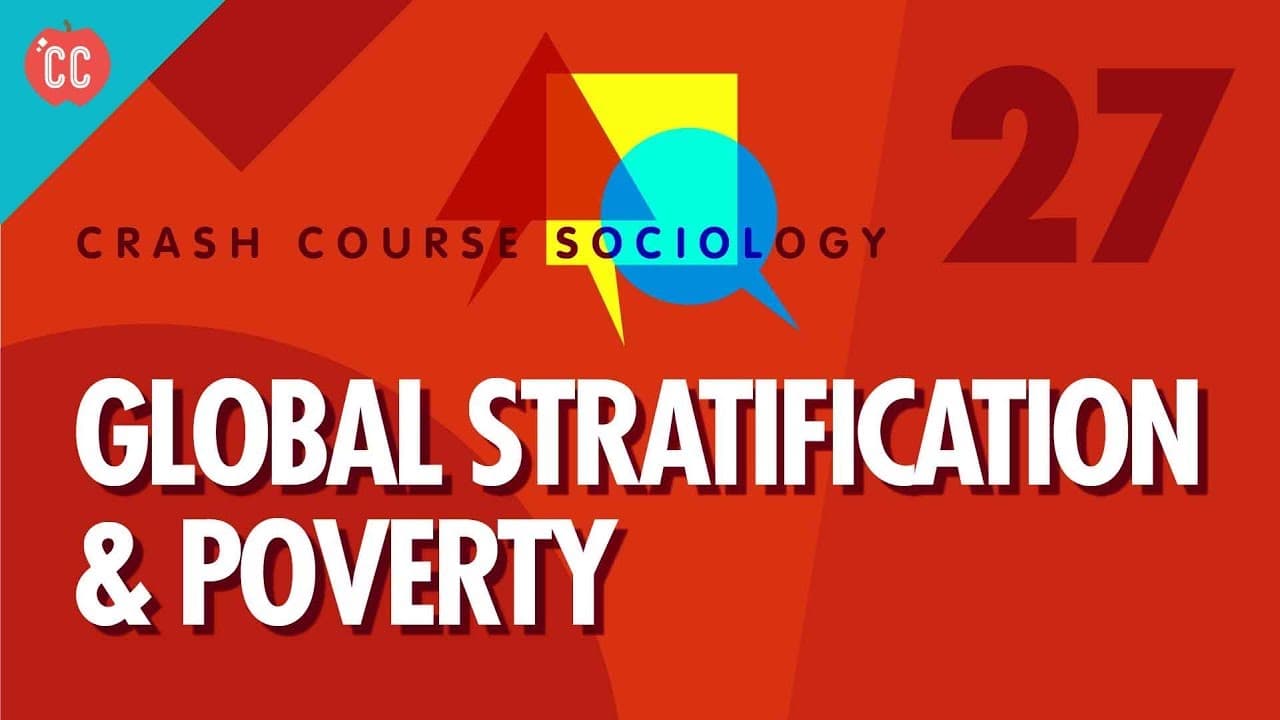
How Do Global Stratification and Poverty Differ Worldwide? Crash Course Sociology #27
TL;DR
Global stratification describes how countries are grouped by economic productivity and living standards, using measures such as GDP and GNI rather than outdated “First World” and “Third World” labels. The four income groups range from high-income countries with yearly GNI above $12,500 to low-income countries with GNI below $1,000. Read on to compare these groups and understand how absolute poverty threatens basic survival.
Transcript
You’ve heard of “First World Problems,” right? Someone cracks the screen on their iPhone or gets the wrong order at Starbucks, and then they go on Twitter and complain about their hashtag First World Problems. So, you’re heard the phrase, but have you thought about the implications of talking about countries as First or Third? Where do these names ... Read More
Key Insights
- Global stratification is the classification of countries based on economic productivity and standards of living.
- The terms 'First World' and 'Third World' are outdated and inaccurate, originating from Cold War political blocs.
- Countries are now categorized as high income, upper middle income, lower middle income, and low income, based on Gross National Income (GNI).
- High income countries have GNI above $12,500 with high urbanization and industrialization.
- Upper middle income countries have GNI between $4,000 and $12,500, with advancing economies and urbanization.
- Lower middle income countries have GNI between $1,000 and $4,000, with economies based on manufacturing and natural resources.
- Low income countries have GNI less than $1,000, with economies primarily based on agriculture and facing severe poverty challenges.
- Global poverty is influenced by factors like technology access, population growth, gender inequalities, and historical colonialism.
Install to Summarize YouTube Videos and Get Transcripts
Explore YouTube Video Summarizer or Get YouTube Transcript Extractor
Questions & Answers
Q: What is global stratification, and how are countries classified?
Global stratification describes differences among countries in economic productivity and standards of living. Sociologists classify countries as high income, upper middle income, lower middle income, or low income using measures such as Gross Domestic Product and Gross National Income.
Q: Why are “First World” and “Third World” considered outdated terms?
The terms originated during the Cold War, when Western capitalist countries were called the First World, the Soviet Union and its allies the Second World, and other countries the Third World. They are inaccurate because more than 100 countries can fall under the Third World label despite having vastly different economies; for example, average income per capita in Botswana is nine times that of Rwanda.
Q: What characterizes high-income countries?
High-income countries have yearly GNI above $12,500, and 79 countries belong to this group. They generally have higher living standards, concentrated industry and technology, and highly urban populations, with 81% of residents living in or near cities.
Q: What defines an upper-middle-income country?
Upper-middle-income countries have yearly GNI between $4,000 and $12,500, with 56 countries in this category. They tend to have advancing manufacturing and high-tech markets, substantial urbanization, public infrastructure such as education and health services, and comfortable living standards for most citizens.
Q: What conditions are common in lower-middle-income countries?
Lower-middle-income countries have yearly GNI between $1,000 and $4,000, and their economies center on manufacturing and natural-resource production. Only 40% of their populations live in urban areas, while quality healthcare and education are often limited to wealthier people; their maternal mortality rate is five times that of upper-middle-income countries.
Q: What challenges do low-income countries face?
Low-income countries have yearly GNI below $1,000, with 31 countries in this group. They are primarily rural and agriculture-based, while facing greater disease rates, weaker healthcare and education systems, and limited access to food and clean water; 8% of children die before age five.
Q: How do relative poverty and absolute poverty differ?
Relative poverty exists in every society, regardless of its overall income level. Absolute poverty occurs when insufficient resources become life-threatening, making it distinct from the poverty commonly seen in high-income countries such as the United States.
Q: How does global poverty affect children?
Child poverty can lead to malnutrition, homelessness, and dangerous or illegal work. UNICEF estimates that 18.5 million children worldwide are orphans and 150 million are engaged in child labor, while hunger accounts for half of all child deaths worldwide.
Summary & Key Takeaways
-
Global stratification involves categorizing countries based on economic productivity and living standards, moving away from outdated terms like 'First World' and 'Third World'. The categories now include high income, upper middle income, lower middle income, and low income countries. This classification highlights the diverse economic challenges and living conditions globally.
-
High income countries, with GNI above $12,500, are highly urbanized and industrialized, while upper middle income countries have advancing economies. Lower middle income countries rely on manufacturing and natural resources, and low income countries, primarily agricultural, face severe poverty challenges.
-
Global poverty's causes include limited technology access, rapid population growth, gender inequalities, and historical colonialism. Addressing these social, cultural, and economic forces is crucial for reducing poverty and improving living conditions worldwide.
Read in Other Languages (beta)
Share This Summary 📚
Summarize YouTube Videos and Get Video Transcripts with 1-Click
Try YouTube Summary with ChatGPT & Claude or YouTube Transcript Generator
Explore More Summaries from CrashCourse 📚


Summarize YouTube Videos and Get Video Transcripts with 1-Click
Try YouTube Summary with ChatGPT & Claude or YouTube Transcript Generator