How to Cultivate Creativity and Find Better Ideas
TL;DR
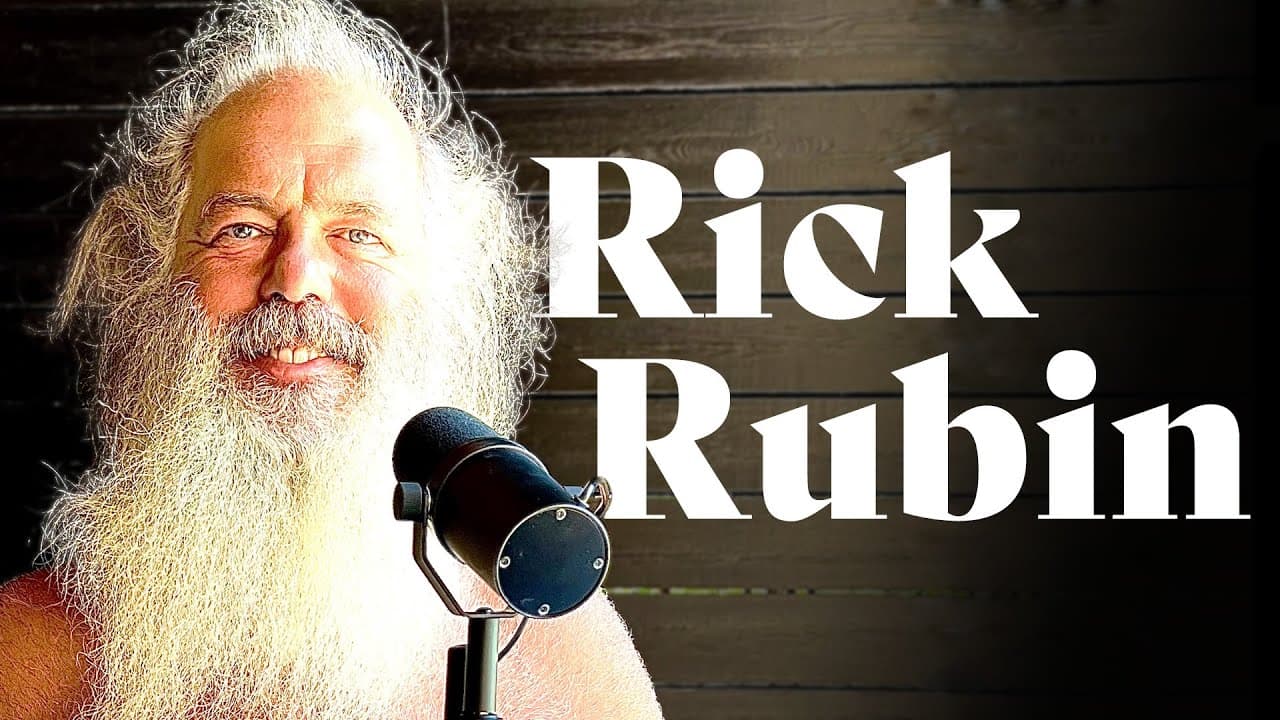
Creativity grows through openness, presence, intuition, and sustained attention to the work itself. Rick Rubin recommends treating problems as opportunities to discover reusable principles, remaining receptive to ideas from an undefined source, and judging success by the integrity of the creative process rather than by audience reaction or conventional expectations.
Transcript
today I want to talk about magic I want to talk about awe and wonder and Oneness and I want to do that with a very special human for most he needs no introduction an absolute icon of modern music whose influence on culture has been nothing short of Titanic Rick Rubin is one of the greatest producers of all time noted for his unique and some might s... Read More
Key Insights
- Creativity is an innate human capacity rather than a talent reserved for professional artists. Cultivating it requires openness to possibility, wonder, energy, and the present moment, making the creative act a broader way of living rather than merely a method for producing music or other finished works.
- The Creative Act is a collection of transferable principles derived from studio experience. Rubin spent seven years documenting productive moments and reconsidering earlier decisions so he could identify the thought processes behind them and offer tools that people might apply within their own lives.
- Intuition is often the starting point for a useful creative decision. Rubin says many studio choices originally emerged as immediate reactions to problems, and only later could he reverse engineer those choices to identify a principle that might help another person confront a similar obstacle.
- Creative problems are signals that invite closer attention. Writer's block, a weak transition, an incomplete album, or difficulty communicating a story can each become a portal for discovering a new approach instead of serving only as evidence that the work has failed.
- "Walk This Way" was selected to connect early hip-hop with familiar popular music. Rubin recognized that the Aerosmith song's verses relied on rhythmic phrasing rather than melody, allowing Run-DMC to perform the material faithfully while also making it function naturally as rap.
- A producer's contribution is not limited to operating equipment or supplying musical instructions. The conversation frames production as attentive problem-solving that helps identify what a work needs, supports the artist's expression, and creates conditions in which a stronger version of the material can emerge.
- Success in creative work is connected to the work itself rather than controlled by audience response. The discussion distinguishes an artist's responsibility for making honest, compelling work from external judgments, encouraging creators to concentrate on choices they can actually make during the process.
- Openness and humility help creators remain receptive to ideas. Rubin describes inspiration through concepts such as the muse or source, emphasizing presence and sensitivity rather than total personal control, while practical experimentation turns received possibilities into music and other completed forms.
- Related book: The Creative Act
- Export your Kindle highlights to Glasp: How to Download Highlights and Notes from Kindle
Install to Summarize YouTube Videos and Get Transcripts
Explore YouTube Video Summarizer or Get YouTube Transcript Extractor
Questions & Answers
Q: How can someone cultivate creativity in everyday life?
Creativity can be cultivated by treating it as a way of being rather than as a specialized professional activity. Openness, presence, wonder, and sensitivity to possibility make it easier to notice promising ideas. When a difficulty appears, examine it closely instead of immediately rejecting the work. The resulting response may reveal a principle that can be reused in other creative situations.
Q: What is the main idea behind The Creative Act?
The Creative Act presents principles drawn from Rick Rubin's experiences solving problems in the studio, but it is not structured as a memoir about famous musicians. Rubin wanted to understand the intuitive choices behind productive moments and translate them into useful tools. The book therefore explores creativity, artistic awareness, openness, and the conditions that help meaningful work emerge.
Q: How did Rick Rubin develop the principles in his book?
Rubin spent seven years observing creative work and reconsidering decisions from projects across his career. When something productive happened in real time, he made notes and asked whether a broader principle was operating. He also reverse engineered earlier choices he could remember, focusing on the thought process used to solve each problem rather than on celebrating the finished recordings.
Q: Why are creative problems useful to artists?
Creative problems reveal where attention and experimentation are needed. Rubin identifies examples such as writer's block, an ineffective song transition, an album that feels incomplete, or a story that must be communicated indirectly. An intuitive response may solve the immediate issue, while later reflection can uncover a transferable principle that helps with different projects and situations.
Q: Why did Rick Rubin choose "Walk This Way" for Run-DMC?
Rubin felt that Run-DMC's completed album was still missing something and wanted to demonstrate that hip-hop was not completely foreign to familiar music. He selected Aerosmith's "Walk This Way" because its verses were built around rhythmic sentence-like phrasing rather than a conventional melody. That structure allowed the established song to work naturally as a rap performance.
Q: What does a music producer contribute to creative work?
A producer helps recognize what a work needs and supports the artist in solving the problems that prevent it from reaching its strongest form. Rubin's account emphasizes attentive listening, intuitive judgment, and choices about elements such as songs, transitions, phrasing, and storytelling. The role is therefore broader than technical operation and depends heavily on perception and creative problem-solving.
Q: How should an artist relate to the audience?
An artist can consider the audience without making audience approval the controlling standard for every creative choice. The discussion places emphasis on the work of creativity and on defining success within the making process. Because external reactions cannot be fully controlled, the creator's practical responsibility is to remain attentive, make honest choices, and develop the strongest work available.
Q: What role do openness and humility play in creativity?
Openness and humility allow a creator to receive possibilities without assuming that every idea must be forced through conscious control. Rubin discusses the muse or source as a way of understanding inspiration and emphasizes being present enough to notice what arrives. Humility also supports experimentation because the artist can follow the needs of the work instead of defending an initial assumption.
Summary & Key Takeaways
-
Rick Rubin developed The Creative Act by examining intuitive decisions made across his studio work. For seven years, he documented useful moments, revisited earlier projects, and reverse engineered how particular problems had been solved. His purpose was to extract principles that other people could apply without making the book a memoir about his career.
-
Creative work often begins with sensing that something is missing before knowing precisely what the problem is. Rubin illustrates this through Run-DMC's recording of Aerosmith's "Walk This Way," chosen because its non-melodic, phrase-driven verses could function naturally as rap while connecting an unfamiliar musical form with a song listeners already recognized.
-
Rubin presents creativity as a way of being that depends on openness, wonder, humility, and presence. Artists receive possibilities by remaining sensitive to their surroundings and then refine those possibilities through practical work. Producers support that process by listening closely, recognizing obstacles, asking useful questions, and helping artists reveal their strongest available expression.
Read in Other Languages (beta)
Share This Summary 📚
Summarize YouTube Videos and Get Video Transcripts with 1-Click
Try YouTube Summary with ChatGPT & Claude or YouTube Transcript Generator
Explore More Summaries from Rich Roll 📚
Summarize YouTube Videos and Get Video Transcripts with 1-Click
Try YouTube Summary with ChatGPT & Claude or YouTube Transcript Generator