What Are the Romance Languages and Why Do They Matter?
TL;DR
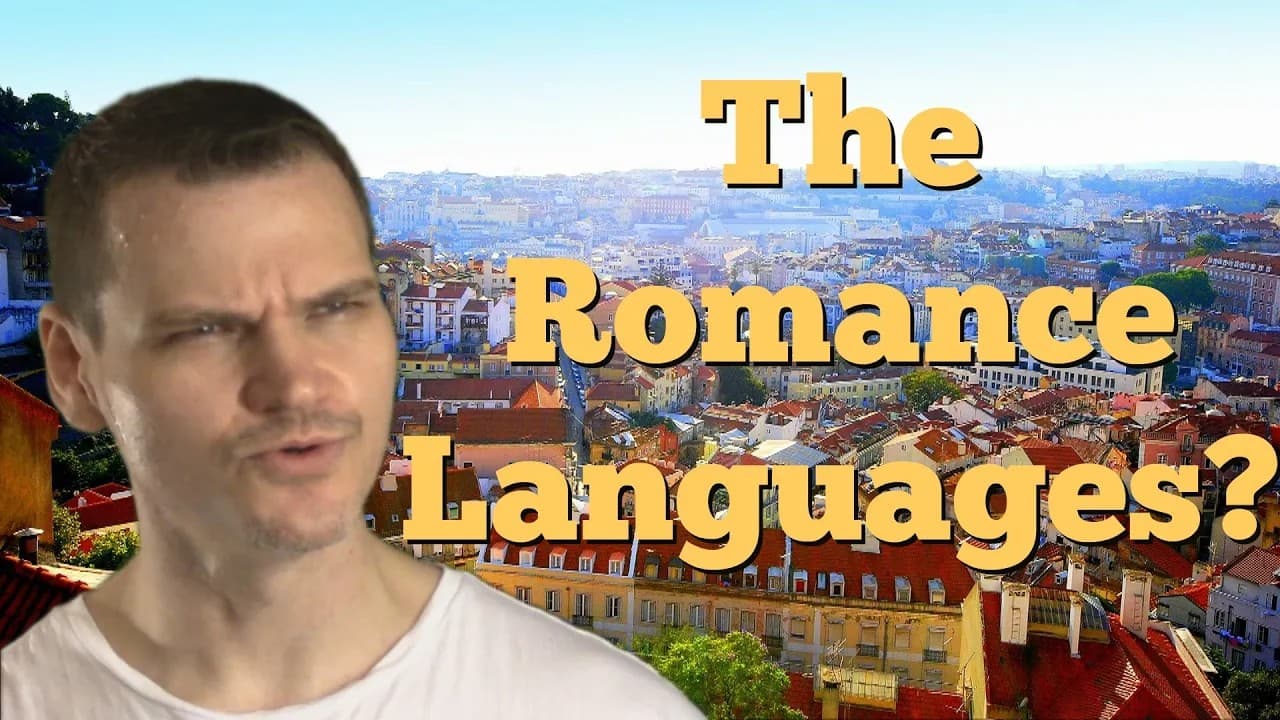
The Romance languages are the descendants of Latin, and the main ones are Spanish, Portuguese, French, Italian and Romanian. Together they have 800 million native speakers. They split from Vulgar Latin after the Roman Empire fell, and colonization carried several of them across the world.
Transcript
The Romance Languages I guess this is the part where I make a cliché joke about the language of "romance." Ok, Cut! Cliché joke over. Finished. Hello everyone! Welcome to the LangFocus channel, and my name is Paul. Today I'm going to be talking about the Romance languages. Not the language of Romance, but the Romance languages. Why should you c... Read More
Key Insights
- The Romance languages are called that because they all developed from Latin, the language of the Romans and the Roman Empire. The name has no link to romantic love, despite the common joke.
- There are 800 million native speakers of Romance languages worldwide. The most important ones are French, Spanish, Italian, Portuguese and Romanian, which are widely spoken in Europe and several are spoken around the globe.
- Vulgar Latin was the common, everyday speech of ordinary people, as opposed to Classical Latin, the formal language of the upper classes. Here, vulgar simply means common or vernacular, and Vulgar Latin spread among local populations.
- The Romance languages diverged because there was no TV, no radio and no universal education to anchor people to a standard Latin. After the Empire fell, the spoken varieties drifted further apart into separate languages.
- The Romance languages form a dialect continuum, so neighboring villages can understand each other while distant ones cannot. This makes it hard to say where one language ends and the next begins, or to count them.
- Modern nation-states and free education turned certain dialects into standards, such as Parisian French and Castilian Spanish. This caused many older dialects to collapse into fewer national and regional languages.
- Spanish has 410 million native speakers, Portuguese 216 million, French 75 million, Italian 60 million and Romanian about 25 million. Catalan, spoken in Catalonia, adds 4 million native speakers.
- Colonization spread Spanish, Portuguese and French worldwide, while Italy started building colonies late and so exported its language far less. Spanish is official in 19 countries of the Western Hemisphere, and Portuguese dominates South America through Brazil.
Install to Summarize YouTube Videos and Get Transcripts
Explore YouTube Video Summarizer or Get YouTube Transcript Extractor
Questions & Answers
Q: Why are they called the Romance languages?
They are called the Romance languages because they all developed from Latin, the language of the Romans and the Roman Empire. As the Empire spread through Western Europe, local populations in most areas adopted Latin. The word refers to Rome, not to romantic love, even though the name invites a cliché joke.
Q: What is the difference between Classical Latin and Vulgar Latin?
Two forms of Latin were used across the Roman Empire. Classical Latin was the formal language used by the upper classes, while Vulgar Latin was the common, everyday speech of ordinary people. Vulgar here just means common or vernacular, and Vulgar Latin is the form that spread among the local populations.
Q: How many people speak Romance languages?
There are 800 million native speakers of Romance languages around the world. Spanish has 410 million native speakers, Portuguese 216 million, French 75 million, Italian 60 million and Romanian about 25 million. Catalan adds roughly 4 million native speakers in the Catalonia region of Spain.
Q: Why did Latin split into different Romance languages?
Over time, Vulgar Latin in different areas of the Roman Empire evolved separately into different varieties of spoken Latin. After the Empire fell they diverged even more. In those days there was no TV, no radio and no universal education to keep people anchored to a standard form, so the spoken forms drifted apart easily.
Q: Why is it hard to count how many Romance languages exist?
The Romance languages form a dialect continuum. Along a line from Portugal to Italy, or from Southern France to Northern France, neighboring villages understand each other, but villages farther apart find it harder because their dialects differ more. Because of this, it is difficult to determine where one language ends and another begins.
Q: Why are most Romance language speakers outside the EU?
Only 42% of the EU population, about 210 million people, speak a Romance language, which is just 26% of all Romance speakers. The rest are elsewhere because France, Spain and Portugal colonized the world and spread their languages. Spanish is spoken by 377 million people in the Western Hemisphere, and Portuguese by 202.6 million in Brazil.
Q: Are the Romance languages mutually intelligible?
The answer is yes and no, depending on the case. The highest mutual intelligibility seems to be between Spanish and Portuguese, Spanish and Italian, or Italian and Romanian. Sometimes it runs mostly one way: Portuguese speakers often understand Spanish well, but Spanish speakers struggle with Portuguese because of its complex phonology.
Q: Will learning one Romance language help you learn another?
Yes, learning one Romance language helps with another, though it will not make it automatic or super easy. All of them come from the same Latin roots, so much of the vocabulary comes from Latin, and much of the grammatical structure is similar and based in Latin. The major Romance languages are a good choice for use in many places around the world.
Summary & Key Takeaways
-
Romance languages are the descendants of Latin, which spread through Western Europe with the Roman Empire. Local people adopted the common Vulgar Latin, which later diverged into separate spoken varieties and then separate languages once the Empire fell and nothing kept speakers tied to a standard form.
-
Because the Romance languages form a dialect continuum, counting them is difficult. Nation-states and free education later selected certain dialects as standards, such as Parisian French and Castilian Spanish. The main languages today are Spanish, Portuguese, French, Italian and Romanian, plus Catalan, with about 800 million native speakers overall.
-
Colonization explains why only about 26% of Romance speakers live in the EU. Spanish, Portuguese and French spread worldwide, while Italian did not. Regional languages like Sardinian and Occitan are fading among the young, but Catalan thrives. Mutual intelligibility varies, and learning one Romance language helps with another.
Read in Other Languages (beta)
Share This Summary 📚
Summarize YouTube Videos and Get Video Transcripts with 1-Click
Try YouTube Summary with ChatGPT & Claude or YouTube Transcript Generator
Explore More Summaries from Langfocus 📚



Summarize YouTube Videos and Get Video Transcripts with 1-Click
Try YouTube Summary with ChatGPT & Claude or YouTube Transcript Generator