Products
Features
YouTube Video Summarizer
Summarize YouTube videos
Web & PDF Highlighter
Highlight web pages & PDFs
Chat with PDF
Ask any PDF questions with AI
Ask AI Clone
Chat with your highlights & memories
Audio Transcriber
Transcribe audio files to text
Glasp Reader
Read and highlight articles
Kindle Highlight Export
Export your Kindle highlights
Idea Hatch
Hatch ideas from your highlights
Integrations
Obsidian Plugin
Notion Integration
Pocket Integration
Instapaper Integration
Medium Integration
Readwise Integration
Snipd Integration
Hypothesis Integration
Apps & Extensions
Chrome Extension
Safari Extension
Edge Add-ons
Firefox Add-ons
iOS App
Android App
Discover
Discover
Ideas
Discover new ideas and insights
Articles
Curated articles and insights
Books
Book recommendations by great minds
Posts
Essays and notes from readers
Quotes
Inspiring quotes collection
Videos
Curated videos and summaries
Explore Glasp
Glasp Newsletter
Weekly insights and updates
Glasp Talk
Interview series with great minds
Glasp Blog
Latest news and articles
Glasp Use Cases
Learn how others use Glasp
Build & Support
Glasp API
Access Glasp's API for developers
MCP Connector
Connect Glasp to Claude & ChatGPT
Community
Glasp Reddit Community
Students
Student discount and benefits
FAQs
Frequently Asked Questions
AboutPricing
DashboardLog inSign up

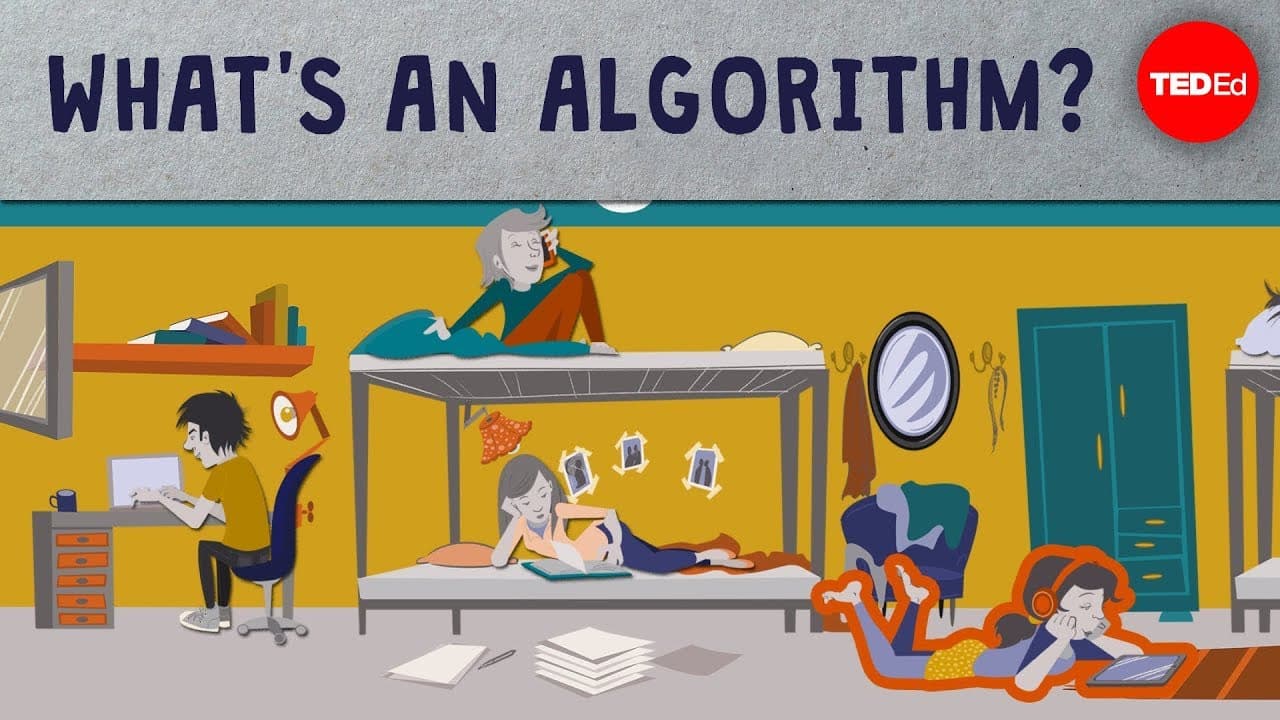
What Is an Algorithm and How Do They Work?
2.5M views
•
May 20, 2013
by
TED-Ed
YouTube video player
What Is an Algorithm and How Do They Work?

TL;DR

An algorithm is a systematic set of instructions for solving problems, applicable to both computers and humans. For instance, when counting people, you can increment a counter by 1 for each individual or optimize the process by counting in pairs or groups, which improves efficiency. Algorithms may include conditions to handle specific scenarios, making them versatile for various tasks.

Transcript

Translator: Andrea McDonough Reviewer: Jessica Ruby What's an algorithm? In computer science, an algorithm is a set of instructions for solving some problem, step-by-step. Typically, algorithms are executed by computers, but we humans have algorithms as well. For instance, how would you go about counting the number of people in a room? Well, if you... Read More

Key Insights

  • 😫 Algorithms are sets of instructions for problem-solving, used by both computers and humans.
  • 🧑 Counting people is an algorithm, starting at 0 and incrementing by 1 for each person.
  • 💨 Counting people in pairs or groups can optimize the process and make it faster.
  • 😑 Pseudocode helps express algorithms in a programming-like syntax.
  • 👯 Introducing conditions or branches in algorithms can handle different scenarios, like odd numbers of people.
  • 🖐️ Algorithms can be further optimized by counting in larger groups, but human limitations may come into play.
  • 💻 Whether executed by computers or humans, algorithms are essential for problem-solving.

Install to Summarize YouTube Videos and Get Transcripts

Explore YouTube Video Summarizer or Get YouTube Transcript Extractor

Questions & Answers

Q: What is an algorithm?

An algorithm is a set of step-by-step instructions for solving a problem, whether executed by computers or humans.

Q: How do algorithms relate to counting people?

Counting people is an example of an algorithm, where you start at 0 and increment by 1 for each person in the room.

Q: How can counting people be optimized?

Counting people can be optimized by counting them in pairs or groups, rather than one by one, which can make the process faster.

Q: What is the role of pseudocode in expressing algorithms?

Pseudocode is a way to express algorithms in a syntax resembling a programming language, making it easier to understand and analyze the steps involved.

Summary & Key Takeaways

  • An algorithm is a set of instructions for solving a problem, and it can be executed by computers or humans.

  • Counting people one by one is an algorithm, where you start at 0 and increment by 1 for each person in the room.

  • Counting people in pairs or groups can optimize the process and make it faster.


Read in Other Languages (beta)

English

Share This Summary 📚

Summarize YouTube Videos and Get Video Transcripts with 1-Click

Download browser extensions on:

Try YouTube Summary with ChatGPT & Claude or YouTube Transcript Generator

Explore More Summaries from TED-Ed 📚
Why are sloths so slow? - Kenny Coogan thumbnail
Why are sloths so slow? - Kenny Coogan
TED-Ed
What is schizophrenia? - Anees Bahji thumbnail
What is schizophrenia? - Anees Bahji
TED-Ed
8 traits of successful people - Richard St. John thumbnail
8 traits of successful people - Richard St. John
TED-Ed
How to practice effectively...for just about anything - Annie Bosler and Don Greene thumbnail
How to practice effectively...for just about anything - Annie Bosler and Don Greene
TED-Ed
Why do women have periods? thumbnail
Why do women have periods?
TED-Ed
The myth of Hercules: 12 labors in 8-bits - Alex Gendler thumbnail
The myth of Hercules: 12 labors in 8-bits - Alex Gendler
TED-Ed

Summarize YouTube Videos and Get Video Transcripts with 1-Click

Download browser extensions on:

Try YouTube Summary with ChatGPT & Claude or YouTube Transcript Generator

Apps & Extensions

  • Chrome Extension
  • Safari Extension
  • Edge Add-ons
  • Firefox Add-ons
  • iOS App
  • Android App

Key Features

  • YouTube Video Summarizer
  • Web & PDF Summarizer
  • Web & PDF Highlighter
  • Chat with PDF
  • Ask AI Clone
  • Audio Transcriber
  • Glasp Reader
  • Kindle Highlight Export
  • Idea Hatch

Integrations

  • Obsidian Plugin
  • Notion Integration
  • Pocket Integration
  • Instapaper Integration
  • Medium Integration
  • Readwise Integration
  • Snipd Integration
  • Hypothesis Integration

More Features

  • APIs
  • MCP Connector
  • Blog & Post
  • Embed Links
  • Image Highlight
  • Personality Test
  • Quote Shots

Company

  • About us
  • Blog
  • Community
  • FAQs
  • Job Board
  • Newsletter
  • Pricing
Terms

•

Privacy

•

Guidelines

© 2026 Glasp Inc. All rights reserved.