How to Build a Color Description Model
TL;DR
Develop a fully integrated system to generate descriptions of target colors in context using the Stanford colors in context task. The system employs an encoder-decoder architecture to interpret color sequences and outputs natural language descriptions, with key considerations for tokenizer design and color representation in modeling.
Transcript
welcome back everyone this screencast is an overview of the homework and bake off associated with our unit on grounded language understanding more than any of the other assignments what we're asking you to do here is essentially develop a fully integrated system that addresses our task so the distinction between homework questions and original syst... Read More
Key Insights
- 🛝 The homework and bake off assignment focuses on developing a system for the grounded language understanding task.
- 💯 The core task is the Stanford colors in context task, where the goal is to generate descriptions of target colors in specific contexts.
- ⚾ The Torch color describer model, based on an encoder-decoder architecture, is used to generate natural language descriptions.
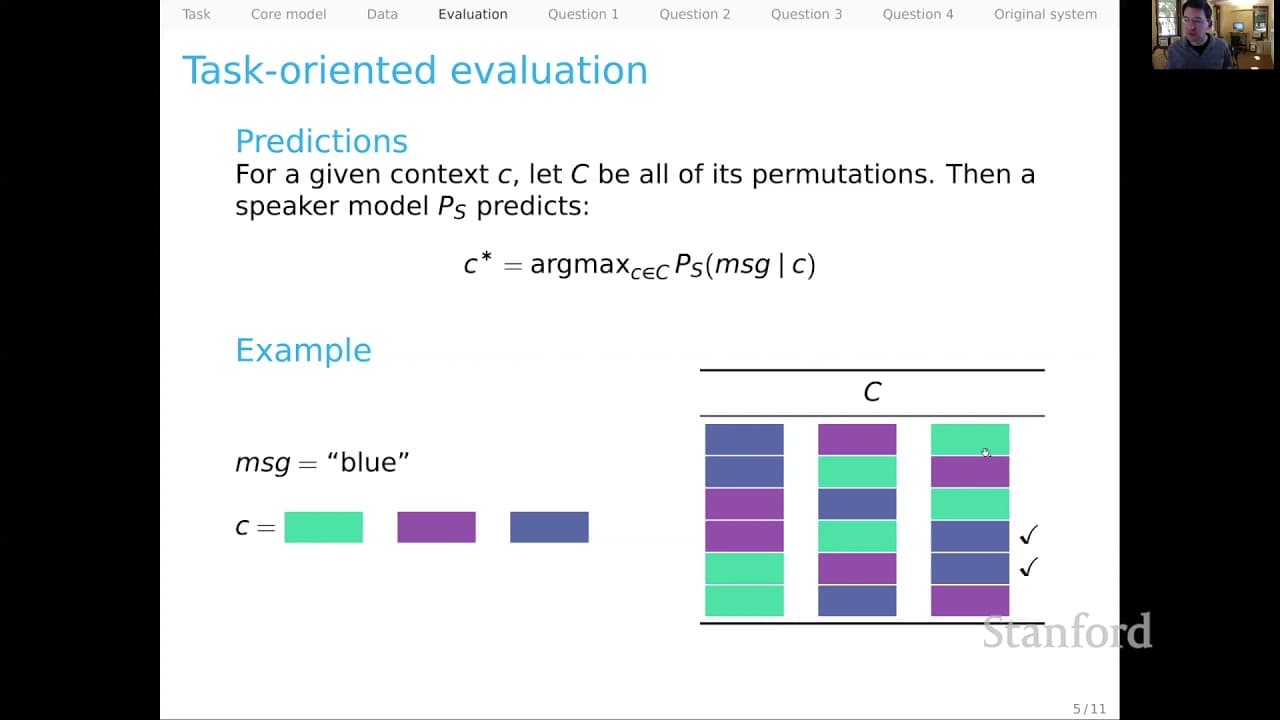
- ✋ Evaluating the accuracy of predictions is done based on the highest probability sequence with the target color in the final position.
- 😑 Tokenizer design, representation of colors, and pre-training with GloVe embeddings are important considerations for system improvement.
- 🏛️ Modifying the encoder-decoder classes, incorporating target color reminders, and using toy datasets for development are suggested approaches.
Install to Summarize YouTube Videos and Get Transcripts
Explore YouTube Video Summarizer or Get YouTube Transcript Extractor
Questions & Answers
Q: What is the main task of the homework and bake off assignment?
The main task is to develop a fully integrated system for the grounded language understanding task, specifically focusing on the Stanford colors in context task.
Q: How does the Torch color describer model work?
The model uses an encoder-decoder architecture, where the encoder takes color sequences as input and the decoder generates natural language descriptions of the target color in that context.
Q: What are the difficulty levels of the color sequences in the dataset?
The dataset has three conditions: far, split, and close. The far condition has distinct colors, making it easy to identify the target. The split condition has confusable colors, requiring more specific descriptions. The close condition has highly similar colors, leading to longer descriptions.
Q: How is the prediction accuracy evaluated in the task?
The prediction accuracy is determined by the system's highest probability sequence for a given context. The system is considered accurate if the predicted sequence has the target color in the final position, as designated by the model structure.
Summary & Key Takeaways
-
The homework and bake off assignment requires the development of a fully integrated system for the grounded language understanding task.
-
The core task is the Stanford colors in context task, where the goal is to generate a description of a target color in a given context.
-
The main model used is the encoder-decoder architecture of the Torch color describer, which takes color sequences as input and generates natural language descriptions.
Read in Other Languages (beta)
Share This Summary 📚
Summarize YouTube Videos and Get Video Transcripts with 1-Click
Try YouTube Summary with ChatGPT & Claude or YouTube Transcript Generator
Explore More Summaries from Stanford Online 📚
Summarize YouTube Videos and Get Video Transcripts with 1-Click
Try YouTube Summary with ChatGPT & Claude or YouTube Transcript Generator