What Is the Halting Problem and Why Undecidable?
TL;DR
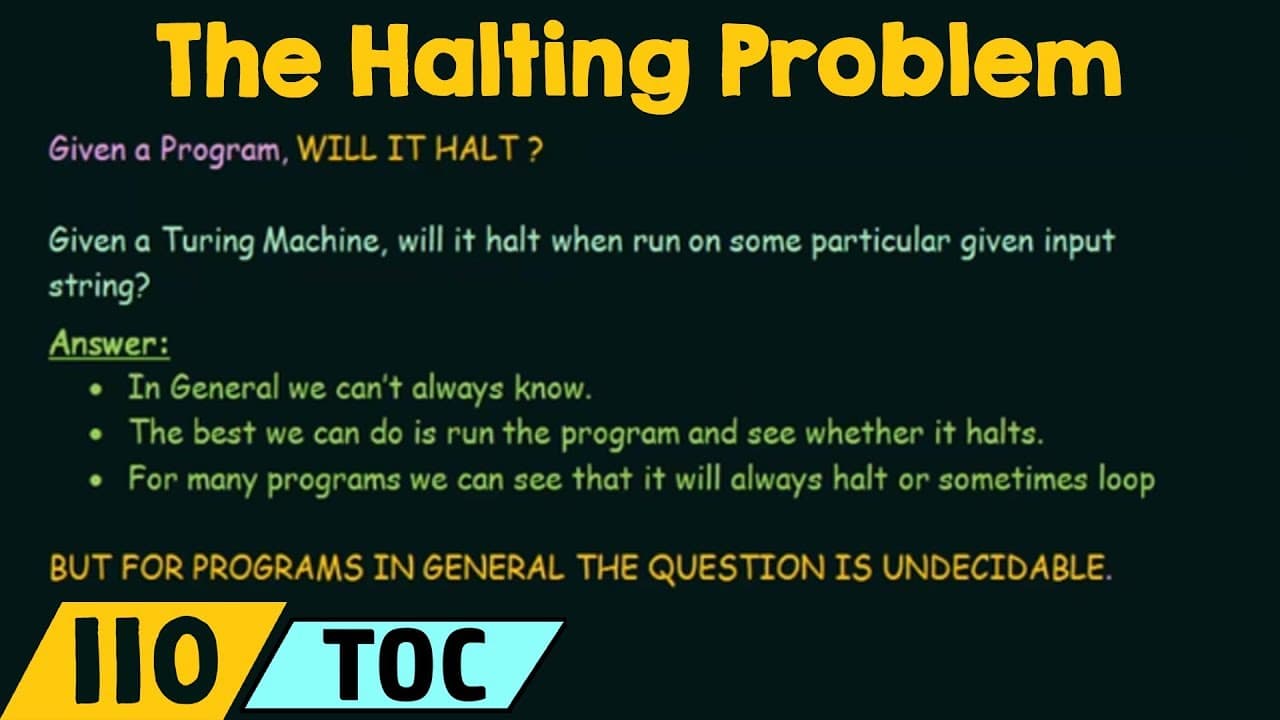
The halting problem asks if a given program will halt on a specific input, and the answer is that no general algorithm can decide this for all programs. In practice, we can test some programs by running them, but that does not prove termination for all cases. The problem is undecidable in theory.
Transcript
in this lecture we'll be studying about the halting problem so in the previous lectures we have studied about undecidability and we have also understood what is undecidability and now we will be taking an example of undecidability which is the halting problem alright so first let's see what is this halting problem so the halting problem says given ... Read More
Key Insights
- A halting decision would universally determine termination for any program and input.
- The halting problem is proven undecidable, meaning no general algorithm exists.
- Turing machines are used to formalize the halting question and its limits.
- We can test specific programs to observe behavior, but tests cannot generalize.
- Undecidability links to broader notions in computability and logic.
- No single algorithm can solve halting for all possible programs.
- Practical analysis must rely on restrictions or approximations.
- The concept clarifies why some program properties are impossible to verify universally.
Install to Summarize YouTube Videos and Get Transcripts
Explore YouTube Video Summarizer or Get YouTube Transcript Extractor
Questions & Answers
Q: How do we define the halting problem in simple terms
The halting problem asks whether a given program will eventually stop when run with a particular input. If the program terminates, we say it halts; if it runs forever, it does not. This question is supposed to have a single definitive answer for any program and input pair, but there is no universal algorithm that can decide this for all possible cases. This fundamental limitation arises from the nature of computation and self-reference, as formalized by Turing machines.
Q: Why is it impossible to have a universal halting algorithm
A universal halting algorithm would be able to analyze any program and input and always say yes it halts or no it does not. However, a classical diagonalization argument shows that such a machine cannot exist because it would lead to logical contradictions when self reference is involved. If we suppose a universal halting tester exists, we can construct a paradoxical program that behaves opposite to the tester’s prediction, breaking the assumption and proving undecidability.
Q: How does undecidability relate to Turing machines
Undecidability in this context means there is no Turing machine that can solve the halting problem for all possible programs and inputs. Turing machines provide a formal model of computation, and the halting problem demonstrates a fundamental limit of what can be computed by any algorithmic process modeled by such machines. This connection anchors the concept in a precise mathematical framework.
Q: What can we still determine about halt behavior in practice
In practice, we can often determine halting behavior for specific programs or restricted languages. By analyzing the structure of a program or using resource-bounded models, we may prove termination or identify potential infinite loops under given conditions. However, these conclusions do not generalize to all possible programs or inputs, reflecting the core undecidability of the general problem.
Q: What is the significance of the halting problem in computer science
The halting problem reveals a fundamental limit of computation and validates why some questions cannot be resolved by algorithms. It motivates the study of computability theory, complexity, and formal verification. Understanding halting helps explain why static analysis tools have scope limitations and why some properties of programs remain inherently unprovable in general.
Q: Can testing be used to assess whether a program halts
Testing can provide evidence about whether a program halts on given inputs, but it cannot prove termination in all cases. Because a program might behave differently on unseen inputs or under different conditions, a test set cannot guarantee universal termination. Therefore testing is informative but not definitive for the general halting question.
Q: How does the concept of self reference contribute to the problem
Self reference amplifies the difficulty because a program can reason about itself through a hypothetical halting tester. This creates a self-referential loop where the predicted outcome would have to apply to the predictor itself. Such constructions lead to contradictions that establish undecidability and underscore why universal solutions are impossible.
Q: What are practical implications for software verification
In software verification, the Halting Problem implies that tools cannot guarantee termination for every program and input. Practically, analysts use restrictions, such as well founded loops, bounded resources, or specific language subsets, to achieve provable termination. This limitation guides the design of reliable systems and the scope of automated reasoning.
Summary & Key Takeaways
-
The halting problem defines a fundamental limit on algorithmic prediction, showing that no universal checker can determine termination for every program and input. This undermines the hope of a perfect static analyzer for all software behavior. The discussion connects to Turing machines and undecidability.
-
We cannot design a universal machine that decides halting for all possible programs; instead, we rely on case-by-case testing and partial analyses. The concept helps explain why certain questions in computation are provably unsolvable.
-
Understanding the halting problem sets the stage for broader results in computability, showing that some questions have no algorithmic solution, while others remain solvable only for restricted languages or input domains.
Read in Other Languages (beta)
Share This Summary 📚
Summarize YouTube Videos and Get Video Transcripts with 1-Click
Try YouTube Summary with ChatGPT & Claude or YouTube Transcript Generator
Explore More Summaries from Neso Academy 📚






Summarize YouTube Videos and Get Video Transcripts with 1-Click
Try YouTube Summary with ChatGPT & Claude or YouTube Transcript Generator