What Are Scaling Laws in Language Models?
TL;DR
Scaling laws in language models help predict how model performance improves as models and datasets grow. By understanding these laws, researchers can optimize resource allocation, choosing between larger models or more extensive datasets. This approach allows for efficient model training, balancing compute resources and data usage to achieve optimal performance.
Transcript
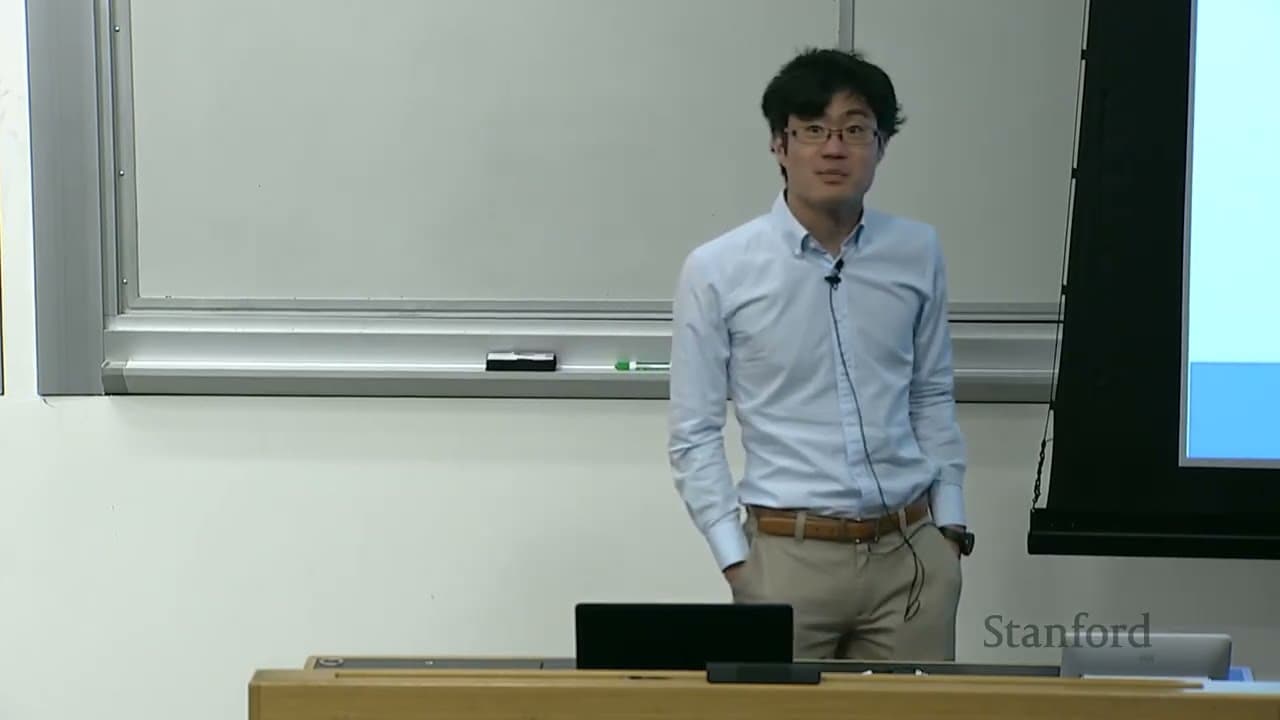
I'm going to talk a little bit about scaling laws. Originally, I think we were going to talk about inference, but I'll take a few minutes to start on scaling laws and then we'll figure out where we'll go from there. OK, so the whole point of scaling laws is kind of-- well, to begin with, I want you to put yourself into the following scenario. So yo... Read More
Key Insights
- Scaling laws predict the behavior of language models as they grow in size and data usage.
- They allow researchers to optimize the trade-off between model size and dataset size for efficient training.
- Scaling laws reveal a predictable relationship between data size and model performance on a log-log scale.
- Joint data-model scaling laws help determine the optimal balance of compute resources between model size and data size.
- The Chinchilla scaling law suggests an optimal ratio of 20 tokens per model parameter for efficient training.
- Scaling laws can guide hyperparameter tuning and architecture selection before large-scale training.
- These laws are applicable across different model types, including autoregressive and diffusion models.
- Inference costs have shifted focus toward more efficient models with higher token-to-parameter ratios.
Install to Summarize YouTube Videos and Get Transcripts
Explore YouTube Video Summarizer or Get YouTube Transcript Extractor
Questions & Answers
Q: What are scaling laws in language models?
Scaling laws in language models describe how model performance improves as the model size and dataset size increase. They offer a predictable relationship between these variables, often represented on a log-log scale, allowing researchers to optimize resources and make informed decisions about model and dataset scaling for efficient training.
Q: How do scaling laws help in optimizing language model training?
Scaling laws help in optimizing language model training by providing insights into the trade-offs between model size, dataset size, and compute resources. They enable researchers to determine the optimal balance for efficient training, ensuring that resources are allocated effectively to achieve the best possible model performance without unnecessary computational expense.
Q: What is the Chinchilla scaling law?
The Chinchilla scaling law is a guideline for the optimal ratio of tokens to model parameters, suggesting around 20 tokens per parameter. This ratio helps achieve efficient training by balancing the compute budget between model size and data size, ensuring that models are trained effectively without wasting resources on either overly large models or excessive data.
Q: Why is the token-to-parameter ratio important in language models?
The token-to-parameter ratio is crucial because it influences the efficiency and effectiveness of model training. An optimal ratio ensures that the model has enough data to learn effectively without being constrained by excessive computational demands. This balance helps achieve the best performance while minimizing training costs, particularly important when deploying models at scale.
Q: How do scaling laws influence hyperparameter tuning?
Scaling laws influence hyperparameter tuning by providing a framework to predict how changes in model size and dataset size will affect performance. This allows researchers to make informed decisions about hyperparameter settings before large-scale training, ensuring that models are optimized for the best performance based on empirical scaling relationships, rather than trial and error.
Q: What role do scaling laws play in architecture selection?
Scaling laws play a critical role in architecture selection by allowing researchers to compare different model architectures at small scales and predict their performance at larger scales. This helps identify architectures that will scale efficiently, guiding the choice of model design and ensuring that resources are invested in architectures that offer the best potential for performance improvement.
Q: How do scaling laws apply to different types of models?
Scaling laws are applicable to various types of models, including autoregressive and diffusion models. They provide a consistent framework for predicting performance improvements across different model architectures and tasks, demonstrating their robustness and versatility in guiding model development and optimization across diverse applications in language modeling.
Q: Why has the focus shifted towards higher token-to-parameter ratios in language models?
The focus has shifted towards higher token-to-parameter ratios to optimize inference costs in language models. As these models become products, the ongoing operational costs of running large models become significant. Increasing the token-to-parameter ratio allows for smaller, more efficient models that maintain high performance while reducing the computational expense of deployment, aligning with commercial and practical considerations.
Summary & Key Takeaways
-
Scaling laws in language models offer a framework for predicting performance improvements as models and datasets increase in size. By understanding these laws, researchers can optimize resource allocation, balancing the trade-off between larger models and more extensive datasets. This approach allows for efficient model training, ensuring the best use of compute resources and data to achieve optimal performance.
-
The Chinchilla scaling law, which suggests a ratio of 20 tokens per model parameter, exemplifies the practical application of scaling laws in optimizing training. These laws also guide hyperparameter tuning and architecture selection, enabling researchers to make informed decisions before committing to large-scale training runs. Additionally, scaling laws are robust across different model types, ensuring their broad applicability.
-
As language models become products, the focus has shifted towards optimizing inference costs. This has led to an increase in the token-to-parameter ratio, reflecting a preference for models that are both efficient and effective. Scaling laws provide a valuable tool for navigating these trade-offs, ensuring that models are both powerful and cost-effective in deployment.
Read in Other Languages (beta)
Share This Summary 📚
Summarize YouTube Videos and Get Video Transcripts with 1-Click
Try YouTube Summary with ChatGPT & Claude or YouTube Transcript Generator
Explore More Summaries from Stanford Online 📚





Summarize YouTube Videos and Get Video Transcripts with 1-Click
Try YouTube Summary with ChatGPT & Claude or YouTube Transcript Generator