What Is the ELECTRA Model for NLP?
TL;DR
The ELECTRA model enhances NLP performance by efficiently learning to identify token replacements, addressing BERT's limitations in pre-training and fine-tuning. By using a generator-discriminator structure, ELECTRA allows for more predictions and efficient data use, resulting in improved accuracy and better resource management during model training.
Transcript
welcome everyone this is part five in our series on contextual word representations we're going to be talking about the electra model electra stands for efficiently learning an encoder that classifies token replacements accurately which is a helpfully descriptive breakdown of a colorfully named model recall that i finished the bert screencast by id... Read More
Key Insights
- 💄 ELECTRA addresses limitations of the BERT model by introducing a generator-discriminator framework and making more efficient predictions.
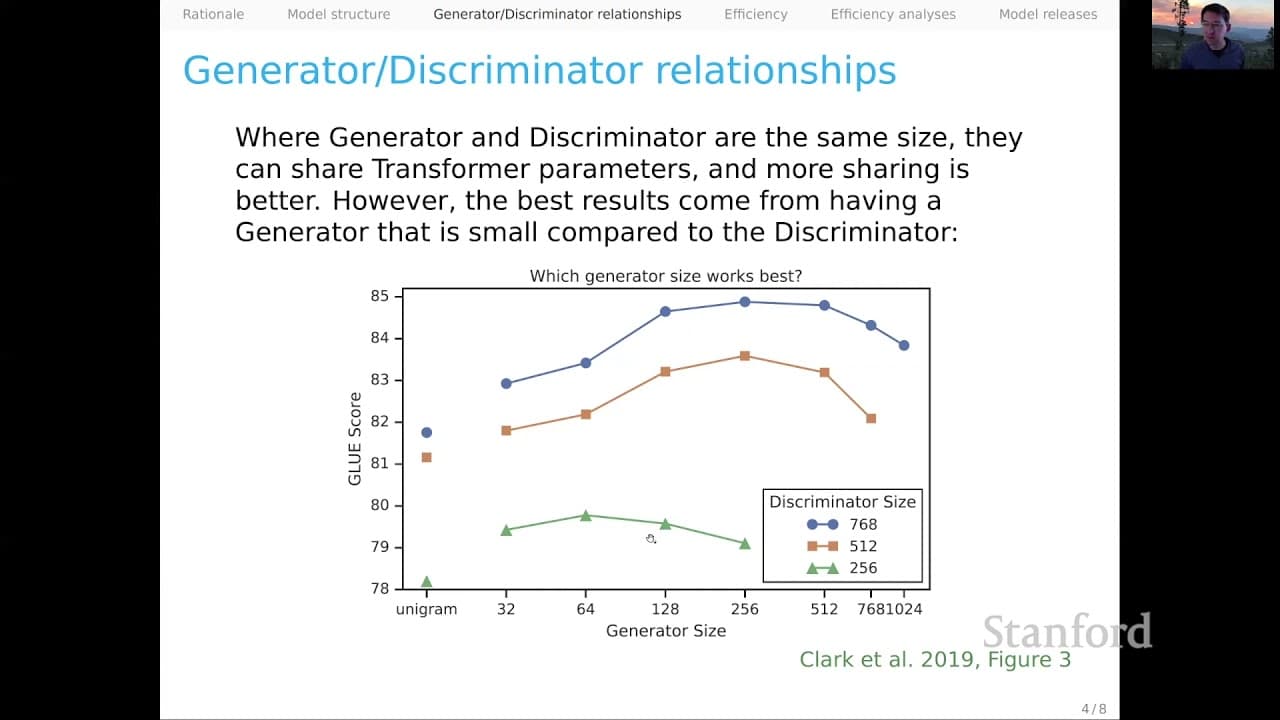
- 👋 The best results for ELECTRA are achieved when the discriminator size is two to three times larger than the generator's size.
- 💄 The model analysis emphasizes the importance of making more predictions and highlights the potential efficiency of ELECTRA training.
- ❓ Variations of the ELECTRA model, such as ELECTRA with all tokens predicted and ELECTRA with limited predictions, show varied performance.
Install to Summarize YouTube Videos and Get Transcripts
Explore YouTube Video Summarizer or Get YouTube Transcript Extractor
Questions & Answers
Q: How does ELECTRA address the limitations of the BERT model?
ELECTRA addresses the mismatch between pre-training and fine-tuning by introducing a generator-discriminator framework that reconstructs masked tokens, making more efficient use of available data.
Q: What is the main task of the discriminator in the ELECTRA model?
The discriminator in the ELECTRA model predicts which tokens in the input sequence were part of the original sequence and which have been replaced, resulting in a binary prediction task.
Q: What insights does the analysis provide on the efficiency of the ELECTRA model?
The analysis shows that a smaller generator size compared to the discriminator yields better results, and ELECTRA can be an efficient model in terms of training with fewer compute resources.
Q: How does ELECTRA compare to other variations of the model?
The study finds that ELECTRA outperforms other variations, such as ELECTRA with only masked tokens predicted and ELECTRA with predictions limited to specific tokens. It suggests that making more predictions improves model performance.
Summary & Key Takeaways
-
The ELECTRA model aims to improve on the limitations of the BERT model by addressing the mismatch between pre-training and fine-tuning.
-
ELECTRA introduces a generator-discriminator framework that reconstructs masked tokens in the input sequence.
-
The model demonstrates that a smaller generator size compared to the discriminator yields better results, and it offers efficient alternatives to training with fewer compute resources.
Read in Other Languages (beta)
Share This Summary 📚
Summarize YouTube Videos and Get Video Transcripts with 1-Click
Try YouTube Summary with ChatGPT & Claude or YouTube Transcript Generator
Explore More Summaries from Stanford Online 📚

Summarize YouTube Videos and Get Video Transcripts with 1-Click
Try YouTube Summary with ChatGPT & Claude or YouTube Transcript Generator