What Are the Key Themes in Pride and Prejudice?
TL;DR
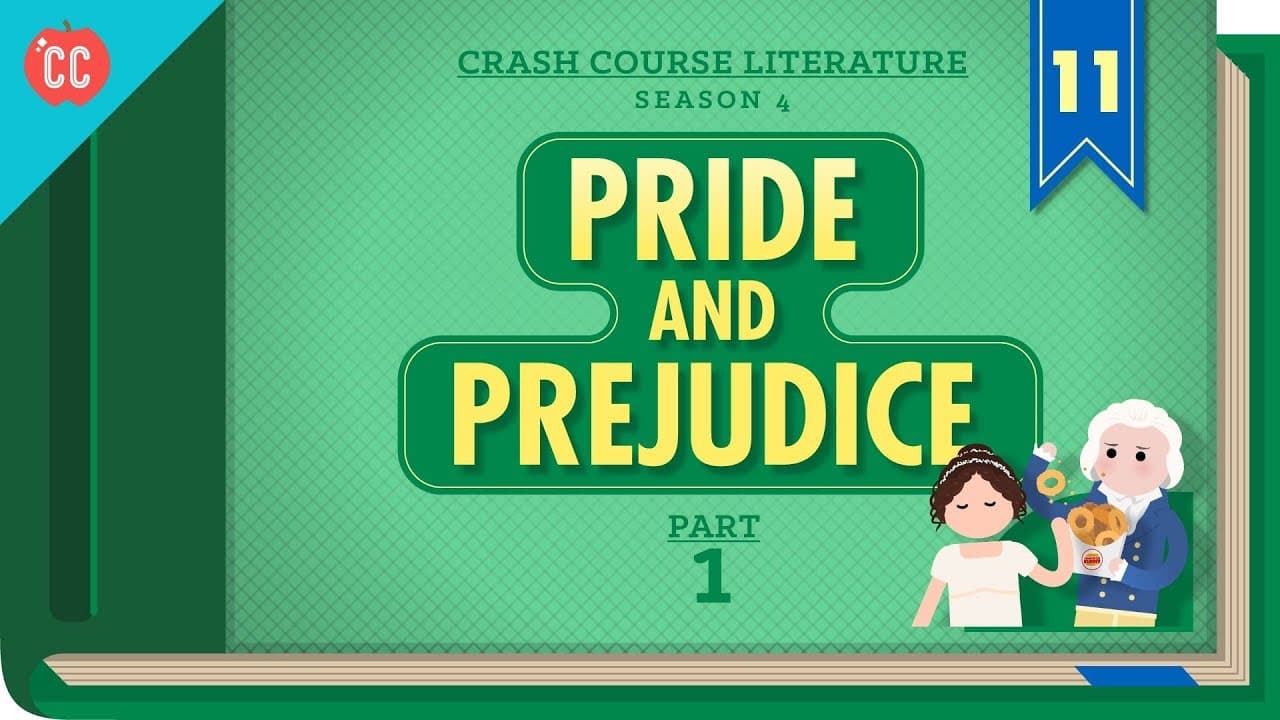
Key themes in Pride and Prejudice include love, class, and economic anxiety, exemplified through the Bennet family's struggles to marry off their daughters. The novel critiques societal expectations, showcasing Elizabeth Bennet's rejection of marriage solely for financial security, while also reflecting Jane Austen's own experiences with financial insecurity and personal choice.
Transcript
Hi I’m John Green, this is Crash Course Literature and it is a truth universally acknowledged that a video series about world literature must be in want of a Jane Austen episode. / So here it is. Today, we’ll be discussing Pride and Prejudice, Austen’s Regency-era novel of life, liberty and bonnets. The book was first published in 1813, it’s a soci... Read More
Key Insights
- Pride and Prejudice, set in Regency England, explores themes of love, class, and economic anxiety through the story of the Bennet family.
- Jane Austen's life and experiences, including her financial struggles and decision not to marry, are mirrored in the novel's themes and characters.
- The novel critiques the societal expectation for women to marry for financial security rather than love, as seen in Elizabeth Bennet's rejection of Mr. Collins.
- Austen's writing style, including the use of free indirect discourse, allows readers to intimately experience the characters' thoughts and emotions.
- Pride and Prejudice challenges the notion of romantic love as purely emotional, emphasizing the importance of rationality and mutual respect in relationships.
- The book reflects the political and social changes of the time, including discussions about women's rights and the impact of the American and French Revolutions.
- Austen's work is often mischaracterized as genteel and conservative, but it is actually sharp, witty, and critical of human behavior and societal norms.
- The novel's enduring popularity is due to its precise language, timeless themes, and the universal appeal of its characters' struggles and triumphs.
Install to Summarize YouTube Videos and Get Transcripts
Explore YouTube Video Summarizer or Get YouTube Transcript Extractor
Questions & Answers
Q: What is the social and historical context of Pride and Prejudice?
Pride and Prejudice is set in Regency England, a period marked by political uncertainty and economic volatility. This era saw a rising middle class, a burgeoning consumer culture, and a shift from an agrarian to an industrial economy. The novel reflects these changes and the growing discussions about women's rights, as women had limited rights and were often pressured to marry for financial security.
Q: How does Jane Austen's life influence Pride and Prejudice?
Jane Austen's life experiences significantly influence Pride and Prejudice. Like her character Elizabeth Bennet, Austen faced financial insecurity and societal pressure to marry. She rejected a suitor, prioritizing personal happiness over financial security, a theme explored through Elizabeth's character. Austen's own financial struggles and decision to remain unmarried are mirrored in the novel's exploration of marriage, class, and economic anxiety.
Q: What narrative style does Austen use in Pride and Prejudice?
In Pride and Prejudice, Jane Austen employs a narrative style known as free indirect discourse. This technique allows the third-person narrator to adopt the thoughts and feelings of characters, creating an intimate connection between readers and characters. This style enables readers to experience the emotions and internal conflicts of characters like Elizabeth Bennet, enhancing the novel's exploration of themes like love and societal expectations.
Q: How does Pride and Prejudice challenge the notion of romantic love?
Pride and Prejudice challenges the notion of romantic love as purely emotional by emphasizing the importance of rationality and mutual respect in relationships. The novel critiques the idea of love at first sight, as seen in Elizabeth and Darcy's initial dislike, and highlights the dangers of overwhelming emotions. Austen suggests that true love involves a balance of emotion, logic, and mutual understanding, rather than instant physical attraction.
Q: What themes does Pride and Prejudice explore?
Pride and Prejudice explores themes of love, class, economic anxiety, and societal expectations. The novel critiques the pressure on women to marry for financial security, as seen in Elizabeth Bennet's rejection of Mr. Collins. It also examines the balance between individual happiness and familial duty, as Elizabeth navigates her desires against societal norms. The enduring relevance of these themes contributes to the novel's timeless appeal.
Q: How does Austen's writing style contribute to the novel's impact?
Austen's writing style in Pride and Prejudice, characterized by wit, irony, and precision, contributes to the novel's impact by offering sharp social critique and deep character insights. Her use of free indirect discourse allows readers to intimately experience characters' thoughts and emotions, while her precise language and lack of physical descriptions focus attention on the characters' internal struggles and societal challenges, enhancing the novel's exploration of themes.
Q: Why is Pride and Prejudice still relevant today?
Pride and Prejudice remains relevant today due to its timeless exploration of themes like love, class, and societal expectations. The novel's critique of societal norms, especially regarding marriage and women's roles, resonates with modern readers. Austen's sharp wit, insightful characterizations, and pioneering narrative style continue to captivate audiences, making the novel a staple in discussions about literature and human relationships.
Q: What role does social class play in Pride and Prejudice?
Social class plays a significant role in Pride and Prejudice, influencing characters' relationships, marriage prospects, and societal interactions. The novel examines the impact of class distinctions on personal happiness and societal expectations, as seen in the Bennet family's financial struggles and the pressure to marry well. Austen critiques the rigid class structures of Regency England, highlighting the challenges and limitations faced by characters navigating these societal norms.
Summary & Key Takeaways
-
John Green discusses Jane Austen's Pride and Prejudice, highlighting its themes of love, class, and societal expectations in Regency England. The novel follows the Bennet family and their struggles with economic anxiety and marriage prospects, particularly focusing on Elizabeth Bennet's journey.
-
Austen's life experiences, including her financial struggles and decision not to marry, are reflected in the novel's themes and characters. The book critiques societal norms, especially the expectation for women to marry for financial security rather than love.
-
The novel uses a pioneering narrative style, free indirect discourse, to intimately convey characters' thoughts and emotions. Pride and Prejudice challenges the notion of romantic love as purely emotional, emphasizing rationality and mutual respect in relationships.
Read in Other Languages (beta)
Share This Summary 📚
Summarize YouTube Videos and Get Video Transcripts with 1-Click
Try YouTube Summary with ChatGPT & Claude or YouTube Transcript Generator
Explore More Summaries from CrashCourse 📚






Summarize YouTube Videos and Get Video Transcripts with 1-Click
Try YouTube Summary with ChatGPT & Claude or YouTube Transcript Generator