How the Leaning Tower of Pisa Was Saved: Crash Course Engineering #40
TL;DR
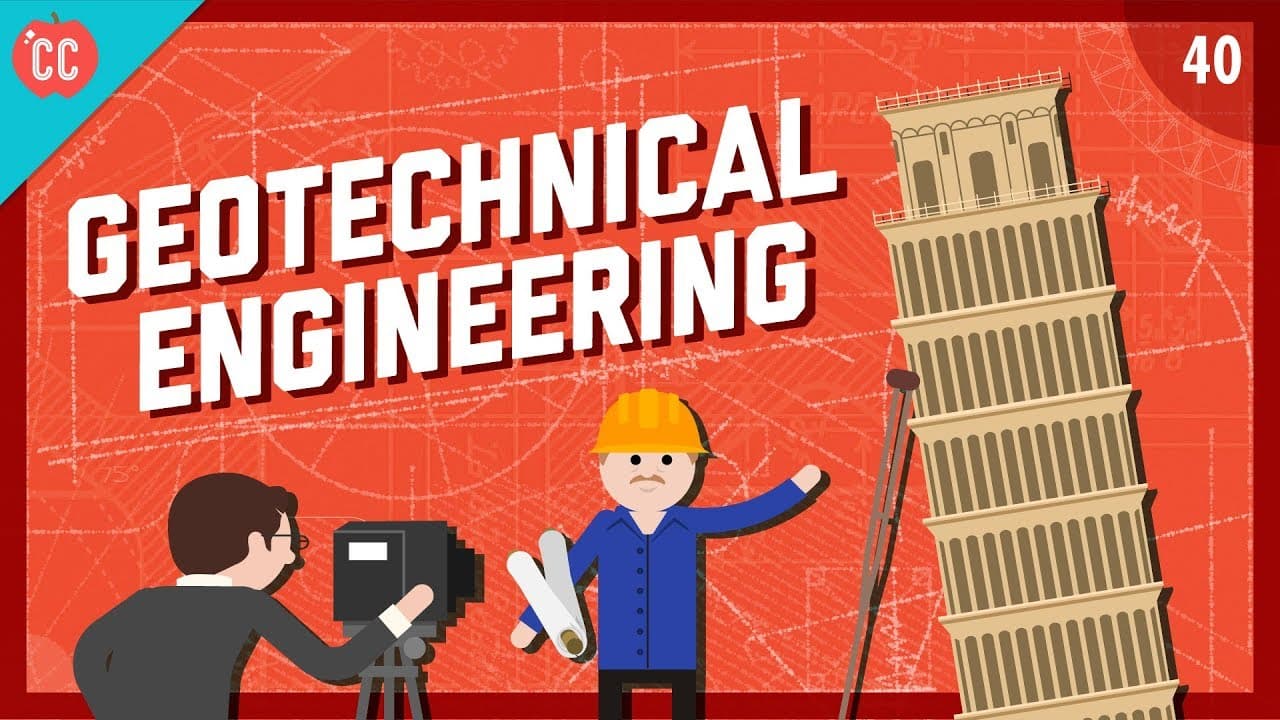
The Leaning Tower of Pisa was protected from collapse by a team of Italian engineers formed in 1990 to preserve its iconic tilt while addressing instability linked to its foundation and supporting soil. Its foundations were not deep enough, so the tower’s mass exceeded the soil’s bearing capacity and shifted the ground. Read on to understand the geotechnical and seismic principles behind stable structures.
Transcript
In 12th century Italy, a tower was under construction in the town of Pisa. The design was for a beautiful, freestanding bell tower in the finest romanesque style. But as construction of the third level began, something went wrong: the whole tower began to tilt. And by the time it was finished, everything was noticeably leaning to one side. Thankful... Read More
Key Insights
- 👨🎤 Geotechnical engineering involves investigating the rock and soil to determine their suitability for building structures.
- 🧑🏭 Soil's bearing capacity, shear strength, and cohesion are essential factors in designing stable foundations.
- ❓ Seismic engineering focuses on protecting structures from the stress and movement caused by earthquakes, including considering liquefaction of loose, sandy soils.
- 🛝 The ground isn't a homogenous material, and its properties can vary significantly from one location to another.
- 🖐️ Geotechnical and seismic engineering play vital roles in ensuring the safety and longevity of infrastructure, especially in areas prone to earthquakes.
- ❓ Finite element analysis and physical testing are used to simulate and understand the effects of earthquakes on structures.
Install to Summarize YouTube Videos and Get Transcripts
Explore YouTube Video Summarizer or Get YouTube Transcript Extractor
Questions & Answers
Q: How was the Leaning Tower of Pisa saved from collapsing?
A team of Italian engineers was formed in 1990 to prevent the tower from suffering the same fate as Pavia’s Civic Tower while maintaining Pisa’s iconic tilt. Their challenge centered on the support beneath the structure, where the foundation and soil had allowed the tower to lean.
Q: What caused the Leaning Tower of Pisa to tilt?
The tower’s foundations were not deep enough to support it after it reached a certain height. The stress from the tower’s mass exceeded the soil’s bearing capacity, shifting the ground and tilting the foundation.
Q: When did the Leaning Tower of Pisa begin to tilt?
The tower began tilting during its construction in 12th-century Italy, as work on the third level started. By the time construction was finished, the entire structure was noticeably leaning to one side.
Q: What is soil bearing capacity?
Bearing capacity is the amount of force that soil can withstand over a given area without drastically changing shape. If the applied stress exceeds that capacity, the ground can fail mechanically and stop fully supporting the structure.
Q: Why is a building’s foundation important?
A foundation connects a structure to the ground and transmits forces into it. The soil must provide a reaction force that supports the building and prevents it from falling over, sinking, or snapping.
Q: What determines the bearing capacity of soil?
Bearing capacity depends on the depth and design of the foundation as well as the qualities of the soil. Because engineers usually cannot control the soil at a site, they must understand it and design the foundation around potential problems.
Q: What is soil shear strength?
Shear strength measures how much shear stress soil can tolerate before failing. Higher shear strength generally allows the soil to resist more stress and increases bearing capacity, although stronger soil can be harder to excavate.
Q: How do geotechnical and seismic engineers evaluate structural safety?
Geotechnical engineers investigate rock and soil, including grain size, shape, cohesion, mineral composition, and moisture levels, to estimate properties such as shear strength. Seismic engineers use finite element analysis, modeling, and physical testing to study how structures respond to earthquake-driven ground movement.
Summary & Key Takeaways
-
Geotechnical engineers investigate the rock and soil that structures will be built on, considering how the ground's characteristics may affect stability.
-
Soil's bearing capacity, or how much force it can withstand without changing shape, is crucial for designing stable foundations.
-
Seismic engineers focus on protecting structures from earthquakes, using statics, dynamics, and finite element analysis to ensure buildings can withstand the stress caused by ground movement.
Read in Other Languages (beta)
Share This Summary 📚
Summarize YouTube Videos and Get Video Transcripts with 1-Click
Try YouTube Summary with ChatGPT & Claude or YouTube Transcript Generator
Explore More Summaries from CrashCourse 📚






Summarize YouTube Videos and Get Video Transcripts with 1-Click
Try YouTube Summary with ChatGPT & Claude or YouTube Transcript Generator