How Does Temu Disrupt American E-Commerce?
TL;DR
Temu competes by connecting Chinese factories and wholesalers directly with consumers, offering extremely low prices while accepting slower delivery than major US retailers. Heavy advertising, gamified shopping, and support from parent company PDD helped it grow rapidly, but repeat purchasing, product quality, safety, regulatory scrutiny, and the economics of its expansion remain significant tests.
Transcript
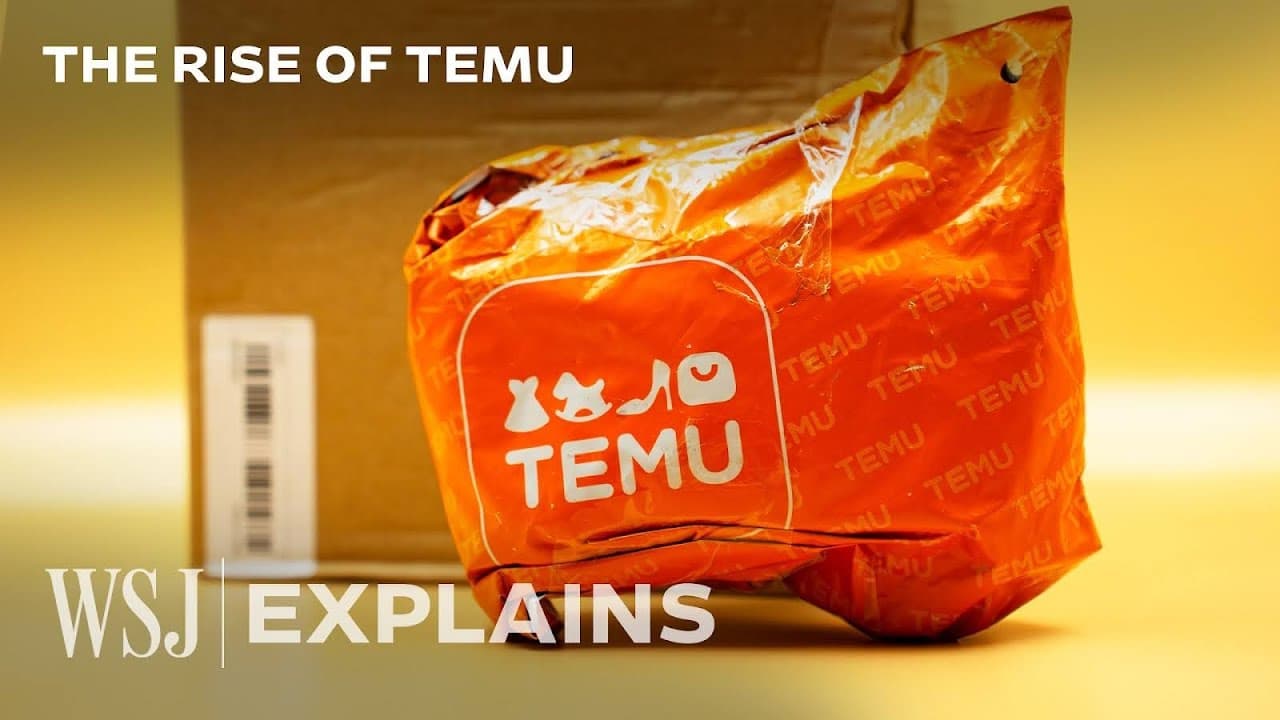
- [Narrator] It took discount retail app Temu a year to get to 51 million monthly active users in the US. That's approaching the 67 million user base that Amazon spent decades building. Temu gained ground by selling cheap goods shipped from China, like this $20 coat or $9 stainless steel water bottle. And its positioning itself to be a bigger playe... Read More
Key Insights
- Temu reached 51 million monthly active users in the US within one year, approaching Amazon's 67 million users, which took decades to build. Worldwide, Temu quickly acquired more than 161 million monthly app users.
- Temu's growth is powered by unusually large advertising expenditures. The company spent $1.7 billion on advertising in 2023, while JP Morgan analysts estimated that spending could approach $3 billion in 2024.
- Temu's shopping experience is designed like a game, using roulette-style rewards, promotional credits, countdown timers, and low-stock messages. These features create urgency while keeping shoppers engaged with the platform's extremely inexpensive product selection.
- Temu's marketplace connects factories and wholesalers directly with consumers, reducing the role of traditional middlemen. Its low-price strategy persuaded shoppers to tolerate standard shipping times of six to 22 days and express delivery of four to 11 days.
- Temu sold an estimated $17 billion in goods during 2023, according to Alliance Bernstein. Its performance contributed to a 74% increase in PDD's market value and briefly helped the parent company overtake Alibaba in valuation.
- Temu is changing competitive costs beyond product pricing because its advertising raises the expense of acquiring customers online. Slower-growing companies such as Etsy cannot match its spending level, while competitors must decide whether to accept lower sales or pursue customers more aggressively.
- Temu's long-term challenge is converting initial curiosity into repeat purchasing. A Morgan Stanley report said its momentum was cresting, and analysts described recurring customer behavior as an unresolved question despite the platform's rapid user acquisition.
- Temu faces concerns about product quality, safety, data risks, trade loopholes, and forced labor. The company says it enforces required product standards, treats privacy and security as core functions, supports ethical labor practices, and accepts consumer-focused policy adjustments.
Install to Summarize YouTube Videos and Get Transcripts
Explore YouTube Video Summarizer or Get YouTube Transcript Extractor
Questions & Answers
Q: How did Temu grow so quickly in the United States?
Temu combined extremely low prices with extensive advertising and a shopping experience designed to encourage frequent engagement. It flooded social media, advertised during back-to-back Super Bowls, and spent $1.7 billion on advertising in 2023. Support from its profitable parent company, PDD, gave it the resources to acquire users aggressively and reach 51 million monthly active US users within one year.
Q: How does Temu keep its product prices so low?
Temu connects factories and wholesalers directly with consumers, reducing the involvement of traditional retail middlemen. It primarily offers inexpensive goods shipped from China and emphasizes price over delivery speed. The platform featured examples such as a $20 coat and a $9 stainless steel water bottle, showing how low prices form the central value proposition used to attract shoppers.
Q: How does Temu use gamification to encourage shopping?
Temu presents shopping as an interactive game through features such as a roulette wheel, prizes, promotional credits, countdown timers, and warnings that products may sell out. Shoppers can receive dollars to spend after using these features. The combination of rewards, urgency, and strikingly low prices encourages people to browse longer and make purchases before an offer appears to expire.
Q: How does Temu's delivery strategy differ from Amazon's?
Temu prioritizes low prices even when shipping takes longer. Its standard shipping takes six to 22 days, while express shipping takes four to 11 days. Amazon has pursued the opposite advantage by cutting its average delivery time to less than two days, more than halving that time since 2022. The competition therefore contrasts Temu's pricing strength with Amazon's delivery speed.
Q: Why does Temu affect digital advertising costs for competitors?
Temu buys enough digital advertising to increase customer acquisition costs across the e-commerce market. It spent $1.7 billion on advertising in 2023, and JP Morgan analysts estimated that its 2024 spending could approach $3 billion. Competitors still need visibility on social media, but slower-growing companies cannot necessarily match Temu's spending, making each new customer more expensive to reach.
Q: How has Amazon responded to pressure from Temu?
Amazon announced in late 2023 that it would reduce the referral fees charged to sellers for clothing priced below $20. Some analysts interpreted the change as evidence that Amazon was concerned about losing suppliers and consumers to lower-priced platforms. Amazon said the reduction was intended to encourage greater product selection and more competitive prices for customers, while its overall industry position remained strong.
Q: What could prevent Temu's growth from being sustainable?
Temu must show that customers will return after their initial purchases rather than using the app only because of advertising, novelty, or promotions. A Morgan Stanley report said the company's momentum was cresting, and repeat purchasing remained an open question. Complaints about inaccurate sizing, disappointing products, quality, and safety could also weaken retention despite Temu's ability to continue spending heavily.
Q: What regulatory and ethical concerns does Temu face?
A 2023 report from a congressional commission raised concerns about data risks, exploitation of trade loopholes, and forced labor. Temu said it considers privacy and security core platform functions, remains committed to ethical labor practices, and supports policy adjustments that align with consumer interests. It also says it works with independent sellers to ensure products satisfy required standards.
Summary & Key Takeaways
-
Temu reached 51 million monthly active US users within a year and more than 161 million monthly app users worldwide. Its rapid adoption was fueled by extremely inexpensive goods, widespread social advertising, Super Bowl commercials, and financial support from PDD, its Chinese e-commerce parent company.
-
Temu differentiates itself through gamified shopping features, limited-time offers, direct connections between sellers and consumers, and prices low enough that customers accept longer shipping. Its standard delivery takes six to 22 days, contrasting with Amazon's average delivery time of less than two days.
-
Temu pressures competitors by intensifying price competition, attracting suppliers, and raising digital advertising costs. Its durability remains uncertain because repeat purchases are not assured, while complaints about quality and safety persist. US scrutiny also includes concerns involving data, trade rules, and forced labor risks.
Read in Other Languages (beta)
Share This Summary 📚
Summarize YouTube Videos and Get Video Transcripts with 1-Click
Try YouTube Summary with ChatGPT & Claude or YouTube Transcript Generator
Explore More Summaries from The Wall Street Journal 📚





Summarize YouTube Videos and Get Video Transcripts with 1-Click
Try YouTube Summary with ChatGPT & Claude or YouTube Transcript Generator