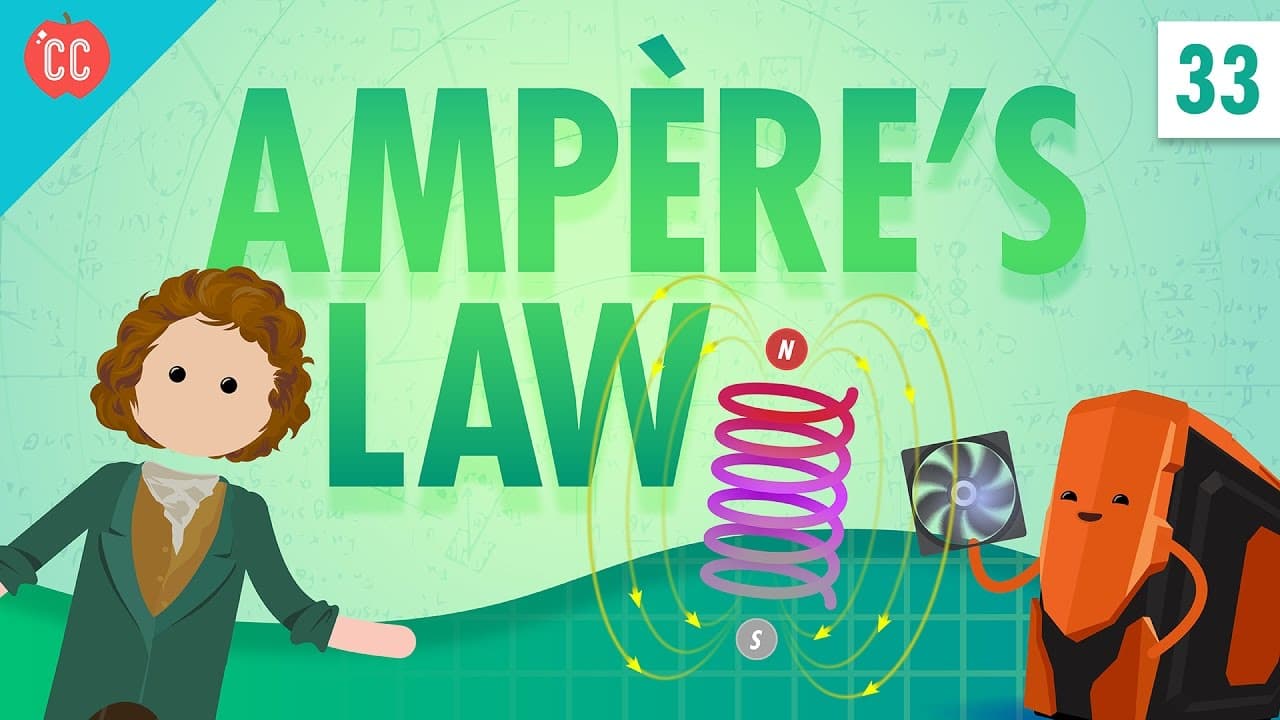
How Does Ampère's Law Relate Current and Magnetic Fields?, Crash Course Physics #33
TL;DR
Ampère's Law relates the total magnetic field along a loop to the enclosed current multiplied by the magnetic constant, μ₀. For a long straight wire, the field strength is μ₀ times the enclosed current divided by 2πr. The law also explains forces between parallel wires, magnet-like coils, and turning current loops. Read on to see how these results follow from the equation.
Transcript
It was the autumn of 1820. Hans Christian Oersted had just discovered the connection between electricity and magnetism. Meanwhile, a French physicist named André-Marie Ampère was experimenting with some wires, trying to learn more about the connection between currents and the magnetic fields they create. He took two parallel wires, ran a current th... Read More
Key Insights
- ⚡️ Ampère's Law, discovered by André-Marie Ampère, is one of the fundamental laws of electromagnetism. It explains the force between two parallel wires running currents in the same or opposite directions.
- 🔁 Wrapping a current-carrying wire into a coil creates a magnet, with a north pole at one end and a south pole at the other. This concept is crucial for understanding the behavior of solenoids.
- 🔄 When a loop of wire is placed in a magnetic field, it experiences a torque that causes it to turn. This principle is the basis for electric motors, which convert electrical energy into mechanical work.
- 🧲 Ampère's Law allows for the calculation of the strength of magnetic fields and currents in various situations. It involves integrating the magnetic field along a loop and relates it to the enclosed current.
- ⚙️ Understanding Ampère's Law is essential for explaining the attraction and repulsion of parallel wires, as well as the behavior of solenoids and the operation of electric motors.
- 📏 The strength of the magnetic field along a circle surrounding a long straight wire is equal to the magnetic constant multiplied by the enclosed current, divided by 2π times the radius.
- ➗ Ampère's Law can be expressed mathematically as the integral of the magnetic field, B, times the cosine of theta, with respect to distance, equaling a constant multiplied by the current running through the loop.
- 🧠 Ampère's Law is a powerful tool that contributed to the development of electromagnetism and allowed for the practical application of electric motors in various devices. It revolutionized the field of physics.
Install to Summarize YouTube Videos and Get Transcripts
Explore YouTube Video Summarizer or Get YouTube Transcript Extractor
Questions & Answers
Q: What is Ampère's Law?
Ampère's Law says that the integral of the magnetic field B along a loop, multiplied by the cosine of theta and measured with respect to distance, equals μ₀ times the current enclosed by the loop. In simpler terms, the magnetic-field contributions around the loop add up to the enclosed current multiplied by the magnetic constant.
Q: What does each part of the Ampère's Law equation represent?
B is the magnetic-field strength at each point along the loop, theta is the angle between the magnetic field and the loop at that point, and ds represents an infinitely small section of the loop. The integral adds all those small magnetic-field contributions around the loop.
Q: When is Ampère's Law valid?
The equation applies to any loop surrounding a current, not only a circle. It remains applicable regardless of how many wires there are or how they are arranged or shaped, as long as the current is constant.
Q: What is the magnetic constant μ₀?
The transcript identifies μ₀ as the magnetic constant. Its value is 4 times π times 10 to the −7th newtons per amperes squared.
Q: How do you use Ampère's Law for a long straight wire?
Choose a circular loop around the wire, where the magnetic field is parallel to the circle and has the same strength at every point. Theta is therefore 0, its cosine is 1, and integrating around the loop gives B multiplied by the circumference, 2πr.
Q: What is the magnetic field around a long straight wire?
For a long straight wire, B equals the magnetic constant multiplied by the enclosed current, divided by 2πr. The field becomes stronger when the current increases and decreases as the distance from the wire increases.
Q: Why do parallel current-carrying wires attract or repel each other?
Each current-carrying wire produces a magnetic field circling the wire. Ampère found that two parallel wires attract when their currents run in the same direction and repel when their currents run in opposite directions.
Q: How do current-carrying coils and loops behave in magnetic fields?
A current-carrying wire wrapped into a coil acts like a magnet inside, with a north pole at one end and a south pole at the other. A loop carrying current turns when placed in a magnetic field, and this behavior helps explain how motors work.
Summary & Key Takeaways
-
Ampère's Law, discovered by André-Marie Ampère, explains the relationship between currents and magnetic fields.
-
Parallel wires with currents in the same direction attract each other, while wires with currents in opposite directions repel each other.
-
Coils of current-carrying wire act as magnets, with a north and south pole at each end, and can create torque, which is how electric motors work.
Read in Other Languages (beta)
Share This Summary 📚
Summarize YouTube Videos and Get Video Transcripts with 1-Click
Try YouTube Summary with ChatGPT & Claude or YouTube Transcript Generator
Explore More Summaries from CrashCourse 📚





Summarize YouTube Videos and Get Video Transcripts with 1-Click
Try YouTube Summary with ChatGPT & Claude or YouTube Transcript Generator