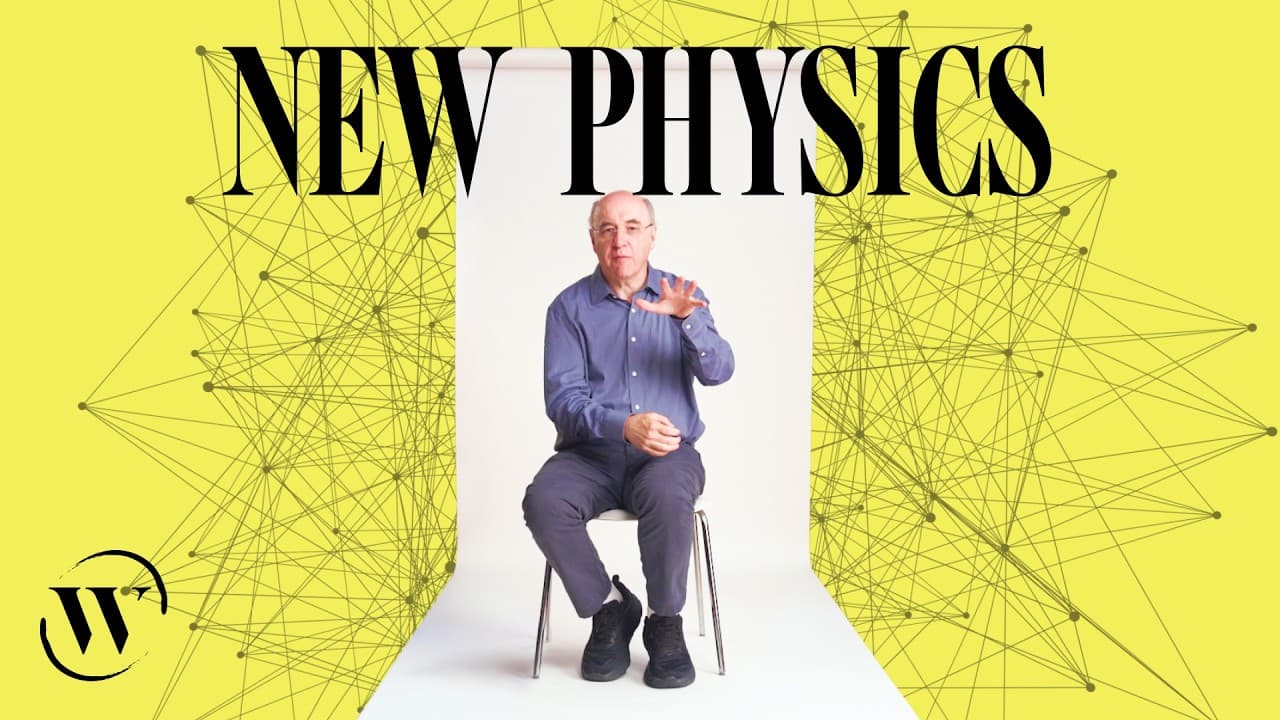
How Does Computation Explain the Universe?
TL;DR
Simple computational rules can generate behavior as complicated as anything, suggesting that the universe may arise from repeated updates to a network of atoms of space. Because different complete computational systems can emulate one another, computation offers a common framework for investigating physics, mathematics, evolution, machine learning, biology, free will, and the limits of scientific prediction.
Transcript
I had long been interested in kind of, what fundamentally is there underneath physics? What is the sort of foundational things that create our physical universe? What rules could those be? I at first thought when the rules are simple enough, the behavior one will get will always be correspondingly simple. But I started doing actual computer experim... Read More
Key Insights
- Twentieth-century physics is dominated by general relativity, quantum mechanics, and statistical mechanics, whose central thermodynamic insight is that systems tend to become more random over time. These frameworks formalized broad physical principles but did not explain every apparently arbitrary feature of the universe.
- Traditional theoretical physics often works by observing the world and reverse engineering it with mathematical ideas. Wolfram instead explores the possible behavior of simple programs, looking for systems whose generated behavior resembles the physical universe we observe.
- Computation is the process of applying rules and determining their consequences. The rules may describe arithmetic, symbolic operations, cellular states, or changes to a network, while the resulting sequence of transformations constitutes the computation.
- Ruliology is Wolfram's term for the basic study of rules and their consequences. Computation provides a familiar metaphor through modern computers, but ruliology focuses more generally on what simple rules produce, regardless of the particular mechanism implementing them.
- Cellular automata are systems in which rows of cells update from one step to the next according to local rules. A cell's new color can depend on its previous color and the colors of neighboring cells, creating a directly visible computation.
- Simple rules can produce arbitrarily complicated behavior. Wolfram reached this conclusion through computer experiments, treating the computer like a telescope for exploring a computational universe rather than assuming that simple rules would always create correspondingly simple results.
- The universe is pictured as a network of atoms of space that evolves through repeated rewriting. Under this proposal, a local piece of the network matching one configuration is replaced by another configuration according to simple computational rules.
- Different models of computation are equivalent in their ability to emulate one another. A Turing machine can emulate a cellular automaton, a cellular automaton can emulate a Turing machine, and combinators can emulate a register machine despite their different outward structures.
Install to Summarize YouTube Videos and Get Transcripts
Explore YouTube Video Summarizer or Get YouTube Transcript Extractor
Questions & Answers
Q: How does computation explain the universe?
Computation explains the universe, in Wolfram's account, as the repeated application of simple rules. His current picture describes a network of atoms of space that is progressively rewritten whenever a local piece matches a specified pattern. The striking point is that very simple update rules can generate behavior of enormous complexity, potentially providing a foundational mechanism beneath the familiar theories of physics.
Q: What does Stephen Wolfram mean by computation?
Computation means following rules and observing the consequences. A computer applies built-in machine instructions through programs, but the idea extends beyond ordinary hardware. Rules can govern arithmetic, black-and-white cells, symbolic operations, or network transformations. The computation is the behavior that unfolds as those rules are repeatedly applied, whether the original rules are simple or elaborate.
Q: What is ruliology and what does it study?
Ruliology is Wolfram's name for the basic science of rules and their consequences. It examines what happens when rules, especially simple ones, are applied repeatedly. Although computation is a useful metaphor because people understand computers and programs, ruliology is intended as the more general study of rule-driven behavior across systems, including arithmetic processes, cellular automata, and proposed models of physical space.
Q: How does a cellular automaton work?
A cellular automaton consists of a row of cells whose states can be represented as black or white. Each new row is generated from the preceding row by examining each cell and nearby cells, then consulting a rule that determines the cell's next color. Repeating this local procedure creates a visible pattern that records the system's computation over successive steps.
Q: Why can simple computational rules create complex behavior?
Simple rules can create complex behavior because repeated application may generate patterns far less obvious than the rules themselves. Wolfram discovered this through computer experiments after initially expecting simple rules to produce simple outcomes. Cellular automata made the result visually clear: elementary local updates can yield behavior that is as complicated as anything, so complexity does not require a complicated underlying rule.
Q: What are the limits of traditional theoretical physics?
Traditional physics successfully developed general relativity, quantum mechanics, and statistical mechanics, but Wolfram argues that it did not fully reveal the structure beneath them. Proposed ideas such as supersymmetry and string theory did not connect with the experimental observations discussed in the interview. Physics also retained apparently arbitrary facts, including why muons resemble electrons while being 206 times heavier.
Q: Why are different models of computation considered equivalent?
Different models are considered equivalent because each can reproduce the operations of the others despite using very different ingredients. A cellular automaton can emulate a Turing machine, and a Turing machine can emulate a cellular automaton. Combinators can likewise emulate a register machine. The comparison resembles running the same software on different computer hardware, where implementation details differ but the program's effective operation remains the same.
Q: What broader questions does the computational approach address?
The computational approach reaches beyond foundational physics into mathematics, machine learning, biology, evolution, thermodynamics, free will, and artificial intelligence. The description connects computational irreducibility with scientific limits and free will, presents evolution and machine learning as using the same trick, and links the limits of human minds with the second law. Wolfram sees one computational perspective unlocking questions that have persisted for a century or more.
Summary & Key Takeaways
-
Wolfram argues that twentieth-century physics produced powerful formal theories of space-time, gravity, quantum mechanics, and statistical mechanics, yet left many features of the universe unexplained. Instead of reverse engineering reality exclusively through mathematics, he explores a computational universe of simple programs and compares their behavior with observed physical phenomena.
-
Computation means applying rules and observing their consequences. Cellular automata demonstrate the central surprise: rules governing simple black-and-white cells can produce patterns of extraordinary complexity. This discovery challenges the intuition that simple foundations must yield simple outcomes and supports the search for a compact computational basis beneath known physics.
-
Different computational models, including cellular automata, Turing machines, combinators, and register machines, can emulate one another despite their contrasting forms. Wolfram connects this computational perspective with questions about evolution, machine learning, scientific predictability, thermodynamics, free will, artificial intelligence, mathematics, biology, and a proposed theory of the universe's underlying structure.
Read in Other Languages (beta)
Share This Summary 📚
Summarize YouTube Videos and Get Video Transcripts with 1-Click
Try YouTube Summary with ChatGPT & Claude or YouTube Transcript Generator
Explore More Summaries from The Well 📚

Summarize YouTube Videos and Get Video Transcripts with 1-Click
Try YouTube Summary with ChatGPT & Claude or YouTube Transcript Generator