How Can Least Squares Optimize Advertising and Lighting?
TL;DR
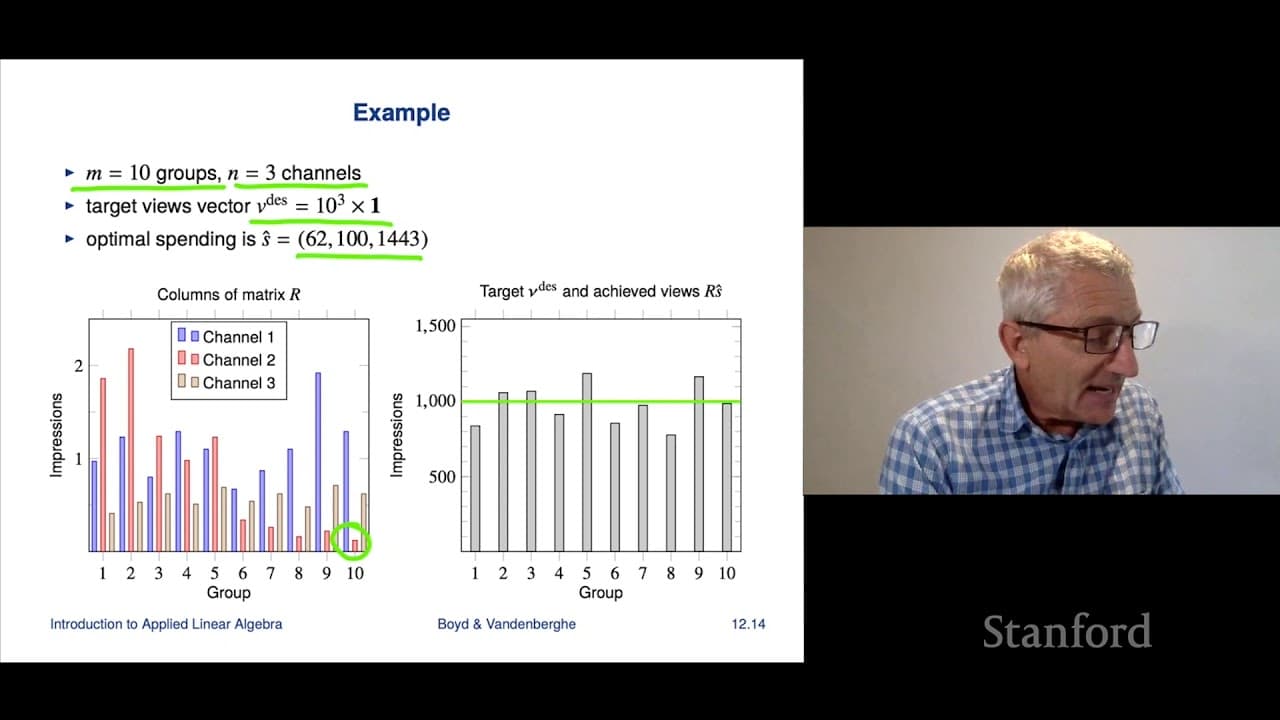
Least squares can efficiently optimize advertising budgets across various demographic groups by determining the best spending strategies on different channels. In lighting, it helps achieve uniform illumination by adjusting lamp power levels, ensuring effective light distribution across a designated area.
Transcript
we're now going to look at some simple but reasonably practical applications of least squares we're going to see a lot more before the course is over but just to give you some very simple ones obviously these are simplified and you can be you can be much more sophisticated in these these applications it's just to give you a flavor okay so the first... Read More
Key Insights
- 👥 Least squares can be used to allocate advertising spending efficiently across different demographic groups and advertising channels.
- 💁 The reach matrix provides information on the effectiveness of each advertising channel in reaching specific target demographics.
- ✊ Least squares can optimize the power levels of lamps to achieve uniform illumination in a region.
- 🎯 The target values in both applications can be systematically approached using least squares to minimize deviations.
- 🥺 The solutions provided by least squares can lead to improved advertising strategies and uniform illumination in real-world scenarios.
- 👥 The size of the matrices involved can vary depending on the number of demographic groups and advertising channels.
- 👻 Least squares provides a general framework for optimization problems, allowing for flexibility in applications.
Install to Summarize YouTube Videos and Get Transcripts
Explore YouTube Video Summarizer or Get YouTube Transcript Extractor
Questions & Answers
Q: How can least squares be applied to advertising purchases?
Least squares can be used to determine the optimal allocation of advertising spending across different channels to maximize impressions in target demographic groups. By using reach matrices and spending vectors, a solution can be found that minimizes the deviation from the desired target views.
Q: What does the reach matrix represent in advertising applications?
The reach matrix represents the number of views per dollar spent on each advertising channel for different demographic groups. Each row of the matrix corresponds to a specific demographic group, and each column represents an advertising channel. It provides information on the efficiency of each channel in reaching the target audience.
Q: How can least squares be used in illuminating a region?
Least squares can be applied to optimize the power levels of lamps at varying heights to achieve uniform illumination in a region. By using matrix algebra, the illumination levels at each pixel or region can be calculated based on the power levels of each lamp. The goal is to find the power levels that minimize the deviation from the desired target illumination.
Q: What are the advantages of using least squares in these applications?
Least squares provides a systematic and mathematical approach to finding the optimal solutions. It takes into account various factors, such as target views in advertising and desired illumination levels, to minimize the deviation from the desired targets. It can be applied to complex scenarios with multiple variables and dimensions.
Summary & Key Takeaways
-
The first application discussed involves advertising purchases where target views or impressions are desired in different demographic groups. Matrix algebra is used to determine the optimal spending on advertising channels to maximize impressions.
-
The second application involves illuminating a region using multiple lamps at different heights. Least squares is used to optimize the power levels of each lamp in order to achieve uniform illumination across the region.
-
In both applications, the goal is to find the best solution that minimizes the deviation from the desired target values using least squares methodology.
Read in Other Languages (beta)
Share This Summary 📚
Summarize YouTube Videos and Get Video Transcripts with 1-Click
Try YouTube Summary with ChatGPT & Claude or YouTube Transcript Generator
Explore More Summaries from Stanford Online 📚



Summarize YouTube Videos and Get Video Transcripts with 1-Click
Try YouTube Summary with ChatGPT & Claude or YouTube Transcript Generator