How to Use Identity Operators in Python
TL;DR
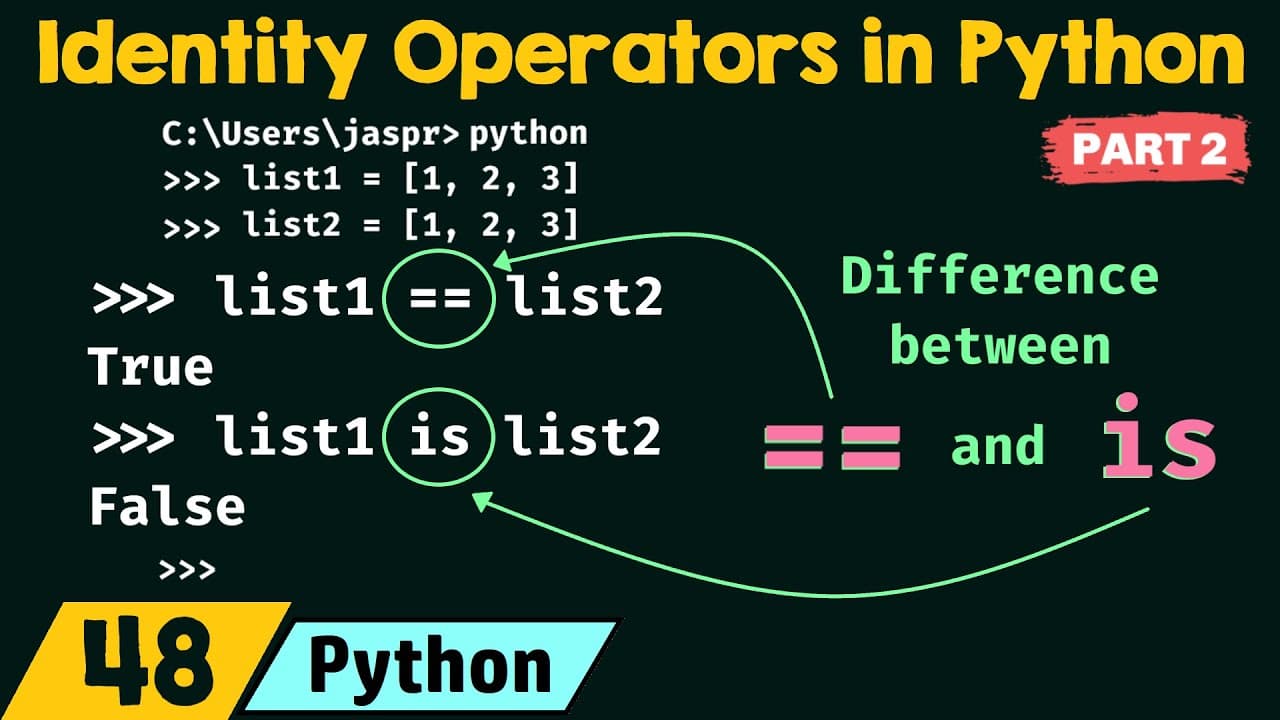
Identity operators in Python, 'is' and 'is not', are used to compare the IDs of objects, not their values. 'Is' returns true if two variables point to the same object, while 'is not' returns true if they point to different objects. This is different from the equality operator '==', which compares values.
Transcript
in the last presentation I have introduced you to the concept of identity operators and I have also explained the functionality of the ID function now in this presentation we will continue our discussion on identity operators we will understand identity operators in details so without any further delay let's get started the first topic of this pres... Read More
Key Insights
- The 'is' operator checks if two variables point to the same object by comparing their IDs.
- The 'is not' operator checks if two variables point to different objects by comparing their IDs.
- Equality operator '==' compares the values of two objects, not their IDs.
- Immutable objects like strings and integers share memory locations for identical values.
- Mutable objects like lists do not share memory locations, even if their values are identical.
- Python allocates the same memory location to immutable objects to optimize memory usage.
- Lists are mutable, so Python allocates different memory locations to avoid unintended side effects.
- The ID function can be used to check the memory address of an object in Python.
Install to Summarize YouTube Videos and Get Transcripts
Explore YouTube Video Summarizer or Get YouTube Transcript Extractor
Questions & Answers
Q: How do identity operators work in Python?
Identity operators in Python, 'is' and 'is not', are used to compare the memory addresses of objects. The 'is' operator returns true if two variables point to the same object, meaning they have the same memory address. Conversely, 'is not' returns true if the variables point to different objects with different memory addresses.
Q: What is the difference between 'is' and '==' in Python?
In Python, 'is' checks if two variables point to the same object by comparing their memory addresses, whereas '==' checks if the values of two objects are equal. 'Is' is used for identity comparison, while '==' is used for value comparison, making them suitable for different use cases.
Q: Why do strings and integers share memory locations in Python?
Strings and integers in Python are immutable, meaning they cannot be changed after creation. To optimize memory usage, Python assigns the same memory location to identical strings and integers. This allows efficient memory management, as identical immutable objects can share the same space without risk of modification.
Q: Why don't lists share memory locations in Python?
Lists in Python are mutable, meaning their contents can be changed. To prevent unintended side effects where changes to one list affect another, Python assigns different memory locations to lists, even if their contents are identical. This ensures that operations on one list do not impact others inadvertently.
Q: How can you check the memory address of an object in Python?
In Python, you can check the memory address of an object using the ID function. By passing an object to the ID function, it returns a unique identifier that represents the object's memory address. This is useful for understanding how Python manages memory allocation for different types of objects.
Q: What happens when you compare two lists with 'is' in Python?
When you compare two lists with 'is' in Python, it checks if both lists have the same memory address. Since lists are mutable, Python typically allocates separate memory locations for each list, even if their contents are identical. As a result, 'is' will usually return false for two identical lists.
Q: When should you use 'is' instead of '==' in Python?
You should use 'is' in Python when you need to check if two variables reference the exact same object, meaning they have the same memory address. This is useful in scenarios where object identity is important, such as checking for singleton instances or ensuring two variables point to the same mutable object.
Q: Can you modify strings and integers in Python?
No, strings and integers in Python are immutable, meaning they cannot be modified after they are created. Any operation that appears to change a string or integer actually creates a new object with the new value. This immutability allows Python to safely share memory locations for identical strings and integers.
Summary & Key Takeaways
-
Identity operators in Python, 'is' and 'is not', are used to compare the memory addresses (IDs) of objects. 'Is' returns true when two variables point to the same object, while 'is not' returns true when they point to different objects. The equality operator '==' compares values, not memory addresses.
-
Immutable objects like strings and integers share memory locations for identical values, allowing Python to optimize memory usage. In contrast, mutable objects like lists are given separate memory locations, even if their values are identical, to prevent unintended changes from affecting multiple variables.
-
Using the ID function, you can determine the memory address of an object. This helps in understanding how Python handles memory allocation for different types of objects, ensuring that changes to mutable objects do not inadvertently affect others with the same value.
Read in Other Languages (beta)
Share This Summary 📚
Summarize YouTube Videos and Get Video Transcripts with 1-Click
Try YouTube Summary with ChatGPT & Claude or YouTube Transcript Generator
Explore More Summaries from Neso Academy 📚



Summarize YouTube Videos and Get Video Transcripts with 1-Click
Try YouTube Summary with ChatGPT & Claude or YouTube Transcript Generator