How to Draw Free Body Diagrams for Forces
TL;DR
To draw free body diagrams, identify all forces acting on an object, including weight, normal force, tension, and friction. Ensure that the lengths of arrows represent the magnitudes of these forces accurately. Different situations, such as constant velocity or acceleration, affect how to represent these forces and their relationships.
Transcript
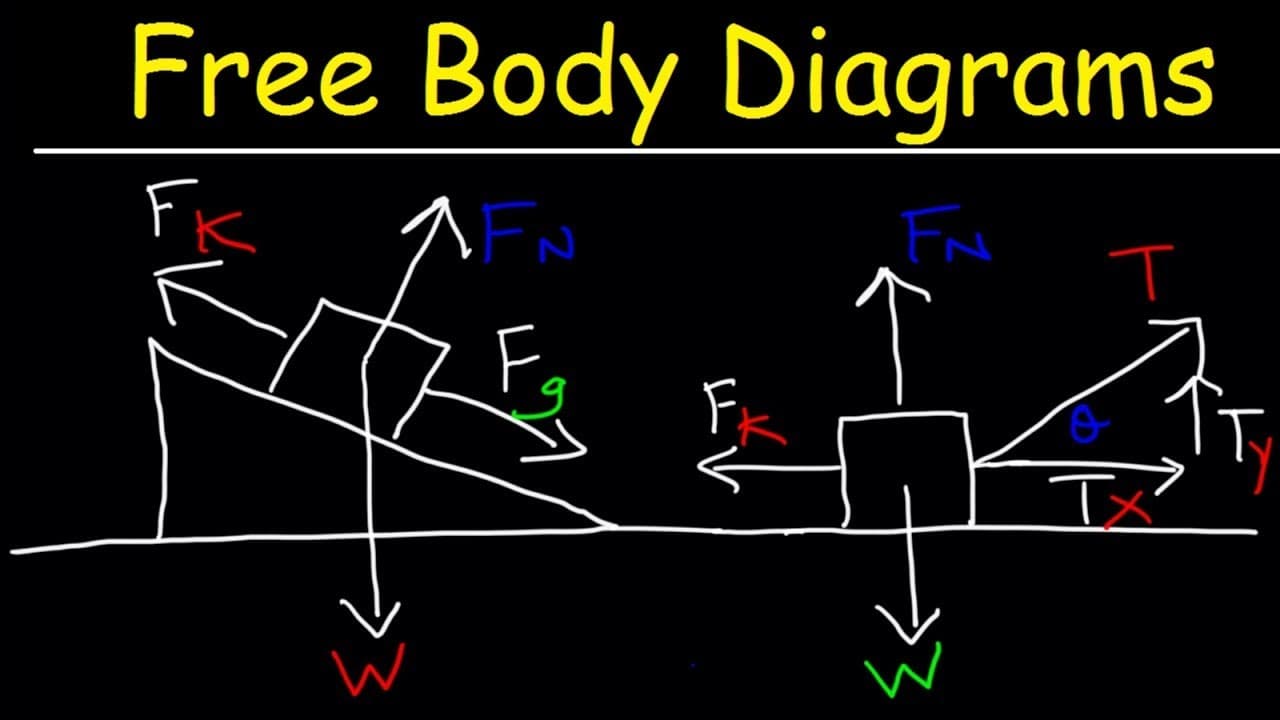
in this video we're going to talk about how to draw free body diagrams so let's start with this problem let's draw the free body diagram for each of the following situations so for part a we have a box that is resting on a table how can we draw the free body diagram for that a free body diagram is a picture that shows all of the forces acting on an... Read More
Key Insights
- 🥶 Free body diagrams are essential tools in analyzing and understanding the forces acting on an object.
- 🥶 Understanding the concepts of weight force, normal force, and tension force is crucial in drawing accurate free body diagrams.
- 🖐️ Friction plays a significant role in determining the motion of objects on inclined surfaces.
- 👮 The relationship between the forces and accelerations can be determined using Newton's second law.
- ❓ Different situations require different considerations, such as constant velocity or constant acceleration, when calculating tensions or accelerations.
Install to Summarize YouTube Videos and Get Transcripts
Explore YouTube Video Summarizer or Get YouTube Transcript Extractor
Questions & Answers
Q: What is a free body diagram?
A free body diagram is a visual representation that shows all the forces acting on an object.
Q: What forces are present in a free body diagram for an object resting on a table?
The weight force and the normal force are present. The weight force is equal to the mass of the object multiplied by the gravitational acceleration, and the normal force is equal to the weight force.
Q: How do you determine the tension force in a free body diagram when an object is hanging from a rope?
In situations where the object is hanging at constant velocity or acceleration, the tension force in the rope is equal to the weight force of the object.
Q: How do you calculate the tension force when an object is being pulled upward with a constant acceleration?
In this situation, the tension force is greater than the weight force. It is calculated by adding the weight force and the product of the mass and acceleration.
Q: What forces are present in a free body diagram for an object sliding on a frictionless horizontal surface at constant speed?
Only the weight force and the normal force are present. There are no forces in the horizontal direction because there is no net force.
Q: What forces are present in a free body diagram for an object being pushed or pulled at constant speed on a horizontal surface with friction?
The normal force, weight force, and friction force are present. The friction force is equal to the kinetic friction coefficient multiplied by the normal force.
Q: How do you calculate the acceleration of an object sliding down a frictionless incline?
The acceleration can be calculated by taking the product of the gravitational acceleration and the sine of the angle of the incline.
Q: How do you determine the tension force when pulling a block up an incline against friction at constant velocity?
In this situation, the tension force in the rope is equal to the product of the kinetic friction coefficient, the weight force, and the cosine of the angle of the incline.
Summary & Key Takeaways
-
The video explains the concept of a free body diagram, which shows all the forces acting on an object. It discusses the weight force and the normal force, which are present in all situations.
-
It provides examples of drawing free body diagrams for objects resting on a table, hanging from a rope, being pulled upward or downward at constant velocity or acceleration, and sliding on a frictionless incline.
-
The video also covers examples of objects sliding on a frictionless horizontal surface at constant speed and being pushed or pulled at constant speed or acceleration on a horizontal surface with friction.
Read in Other Languages (beta)
Share This Summary 📚
Summarize YouTube Videos and Get Video Transcripts with 1-Click
Try YouTube Summary with ChatGPT & Claude or YouTube Transcript Generator
Explore More Summaries from The Organic Chemistry Tutor 📚





Summarize YouTube Videos and Get Video Transcripts with 1-Click
Try YouTube Summary with ChatGPT & Claude or YouTube Transcript Generator