How to Calculate Voltage Gain of a Transistor Amplifier
TL;DR
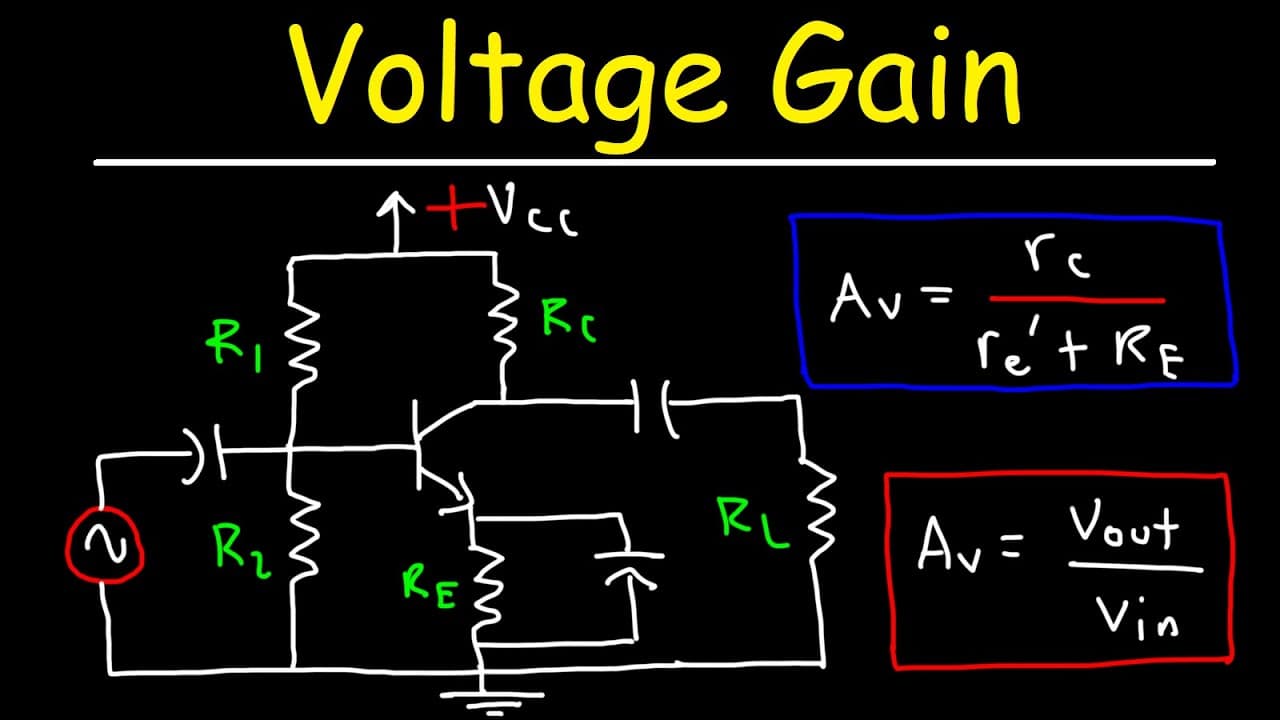
To calculate the voltage gain of a transistor amplifier, use the formula Vgain = (Rc || Load Resistor) / (Re + Rc). The ac emitter resistance is derived from 25mV divided by the emitter current, and incorporating a bypass capacitor can increase gain but may lead to distortion.
Transcript
in this video we're going to talk about how to calculate the voltage gain of this npn transistor amplifier so here's the formula that we need to calculate it the voltage gain is equal to the ac collector resistance divided by the sum of the ac emitter resistance and the emitter resistor capital re well to calculate the ac collector resistance it's ... Read More
Key Insights
- ⚡ The voltage gain of an NPN transistor amplifier can be calculated using the formula Vgain = (Rc || Load Resistor) / (Re + Rc).
- 😀 The ac emitter resistance is equal to the ac collector resistance, which is the parallel combination of Rc and the load resistor.
- ⚾ The base current is calculated using the formula Vcc - Vbe / (Rb + (beta + 1) * Re).
- ⌛ The emitter current is calculated as beta + 1 times the base current.
- 😀 The ac emitter resistance is calculated as 25mV / emitted current.
- 😀 Adding a bypass capacitor across the emitter resistor decreases the overall ac emitter resistance, increasing the voltage gain but potentially introducing distortion.
- ⚡ The voltage gain can also be approximated as Rc / Re when the emitter resistor is significantly larger than the ac emitter resistance and the load resistor is high or infinity.
Install to Summarize YouTube Videos and Get Transcripts
Explore YouTube Video Summarizer or Get YouTube Transcript Extractor
Questions & Answers
Q: How is the voltage gain of an NPN transistor amplifier calculated?
The voltage gain is calculated by dividing the ac collector resistance by the sum of the ac emitter resistance and the emitter resistor (Vgain = (Rc || Load Resistor) / (Re + Rc)).
Q: How is the ac emitter resistance calculated?
The ac emitter resistance is calculated by dividing 25mV by the emitter current (AcEmitterResistance = 25mV / Ie).
Q: How is the base current calculated?
The base current is calculated using the formula Vcc - Vbe / (Rb + (beta + 1) * Re), where Vcc is the collector supply voltage, Vbe is the voltage between the base and the emitter, Rb is the base resistor, beta is the transistor's beta value, and Re is the emitter resistor.
Q: What is the impact of adding a bypass capacitor on the voltage gain?
Adding a bypass capacitor across the emitter resistor decreases the overall ac emitter resistance, thereby increasing the voltage gain of the circuit. However, it may introduce distortion due to variations in the base current.
Summary & Key Takeaways
-
The voltage gain of an NPN transistor amplifier is calculated using the formula Vgain = (Rc || Load Resistor) / (Re + Rc).
-
The ac emitter resistance is equal to the ac collector resistance, which can be found by combining Rc and the load resistor.
-
The base current is calculated using the formula Vcc - Vbe / (Rb + (beta + 1) * Re).
-
The emitter current is calculated as beta + 1 times the base current.
-
The ac emitter resistance is calculated as 25mV / emitted current.
-
The voltage gain is calculated using the ac emitter resistance and the emitter resistor.
Read in Other Languages (beta)
Share This Summary 📚
Summarize YouTube Videos and Get Video Transcripts with 1-Click
Try YouTube Summary with ChatGPT & Claude or YouTube Transcript Generator
Explore More Summaries from The Organic Chemistry Tutor 📚


Summarize YouTube Videos and Get Video Transcripts with 1-Click
Try YouTube Summary with ChatGPT & Claude or YouTube Transcript Generator