How Do You Solve the Related Rates Shadow Problem?
TL;DR
Solve the related rates shadow problem by using similar triangles and implicit differentiation: a six-foot man walking three feet per second away from a 21-foot street light has a shadow length increasing at 1.2 feet per second, while the shadow’s tip moves at 4.2 feet per second. Read on to see how the proportions and derivatives produce both rates.
Transcript
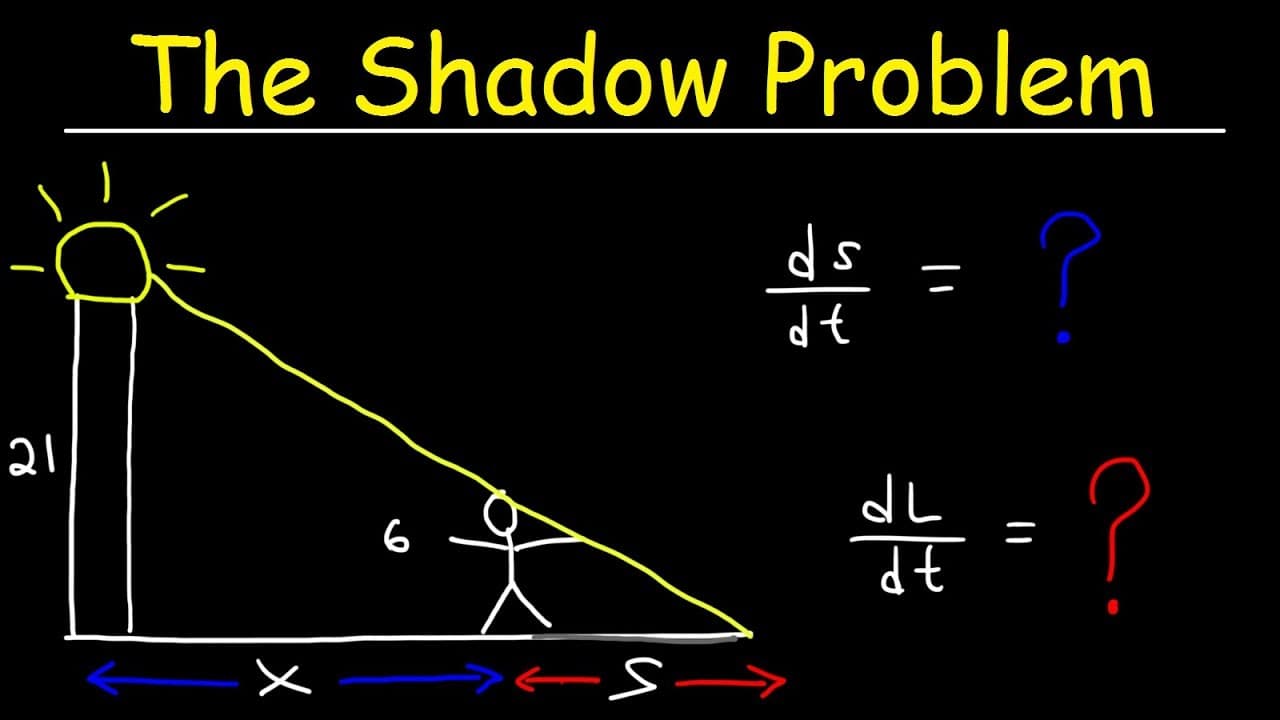
in this lesson we're going to focus on the shadow problem in related rates so we have a six foot man and he walks at a rate of three feet per second away from a street light and his street light is 21 feet tall now let's draw a picture so let's say that's the ground and here is the street light now let's say this is the person now let's draw a line... Read More
Key Insights
- ☠️ Implicit differentiation is a useful technique for solving related rate problems.
- 😫 Similar triangles play a crucial role in setting up proportions to relate different lengths.
- ☠️ The rate of change of the shadow's length is mathematically related to the rate of change of the distance between the man and the light.
- ☠️ Differentiating implicitly allows us to find the rates of change for various components in the problem.
Install to Summarize YouTube Videos and Get Transcripts
Explore YouTube Video Summarizer or Get YouTube Transcript Extractor
Questions & Answers
Q: How do you solve the related rates shadow problem?
Draw two similar right triangles: a large triangle with height 21 and base x + s, and a small triangle with height 6 and base s. Set up the proportion 21/(x + s) = 6/s, simplify it, and differentiate with respect to time.
Q: What do x, s, and l represent in the shadow problem?
The variable x is the distance between the man and the street light, while s is the length of his shadow. The variable l is the distance from the street light to the shadow’s tip, so l = x + s.
Q: What similar-triangle equation relates the man, street light, and shadow?
The similar triangles give the proportion 21/(x + s) = 6/s. Cross-multiplying and simplifying produces 15s = 6x.
Q: Why is dx/dt positive three feet per second?
The man walks away from the street light at three feet per second, so x increases by three feet each second. Therefore, dx/dt = 3 feet per second.
Q: How fast is the shadow’s length changing?
Differentiate 15s = 6x with respect to time to obtain 15(ds/dt) = 6(dx/dt). Substituting dx/dt = 3 gives ds/dt = 6/5, so the shadow length increases at 1.2 feet per second.
Q: How fast is the tip of the shadow moving?
Because l = x + s, the tip’s rate is dl/dt. Using 21/l = 6/s and differentiating gives 21(ds/dt) = 6(dl/dt); substituting ds/dt = 6/5 produces dl/dt = 21/5, or 4.2 feet per second.
Q: What is the difference between ds/dt and dl/dt?
The quantity ds/dt measures how quickly the shadow itself changes length. The quantity dl/dt measures how quickly the shadow’s tip moves away from the street light.
Q: Do the man’s distances of eight feet and ten feet affect the calculated rates?
No; the lesson states that those distance values are irrelevant for this problem. The derived rates are 1.2 feet per second for the shadow’s length and 4.2 feet per second for its tip.
Summary & Key Takeaways
-
A man, six feet tall, walks at a rate of three feet per second away from a 21-foot-tall street light.
-
Part A: As the man moves eight feet from the light, the length of his shadow changes at a rate of 1.2 feet per second.
-
Part B: When the man is ten feet from the light, the tip of his shadow moves at a rate of 4.2 feet per second.
Read in Other Languages (beta)
Share This Summary 📚
Summarize YouTube Videos and Get Video Transcripts with 1-Click
Try YouTube Summary with ChatGPT & Claude or YouTube Transcript Generator
Explore More Summaries from The Organic Chemistry Tutor 📚



Summarize YouTube Videos and Get Video Transcripts with 1-Click
Try YouTube Summary with ChatGPT & Claude or YouTube Transcript Generator