How Can GPS Time Spoofing Disrupt Infrastructure?
TL;DR
GPS time spoofing can quietly shift a receiver’s clock by transmitting a dominant signal and gradually moving its code phase. Because finance, telecom, electric power, cloud computing, and embedded networks depend on precise synchronization, organizations must understand their true timing sources, trace every transfer path, bound uncertainty, and protect synchronization mechanisms against manipulation and outages.
Transcript
All right. Good afternoon, everyone. Uh, my name is Mike Labro. I'm an engineer at Booz Allen Hamilton. Um, primarily a consulting firm, but, uh, we do have a number of, um, engineers and support a number of technical services. Uh, and so, um, I represent one of those groups that looks a lot at what are called position, navigation, and timing techn... Read More
Key Insights
- Precise time is necessary for fairness and event ordering because synchronized timestamps help systems determine when actions occurred and which action came first. Greater measurement precision produces a more reliable account of closely spaced events, especially in technical environments operating at microsecond or nanosecond scales.
- Trusted timestamps are essential for forensic investigation even when synchronization is not required to execute the original transaction. Investigators need clocks aligned to a common reference so they can reconstruct failures, compare records across systems, and determine the sequence of events after something goes wrong.
- UTC is an averaged timescale derived from atomic clocks at laboratories around the world, so it is not available as a real-time measurement. Precision requirements therefore reference particular realizations, commonly UTC-NIST or UTC-USNO in the United States, rather than an instantaneous global UTC clock.
- Clock accuracy describes how close a clock is to its required standard, while stability describes how consistently it maintains that closeness. Both characteristics matter because a clock can momentarily match its reference yet drift outside the permitted error range as it continues operating.
- Time traceability is the documented path from the clock generating a timestamp to the edge application using it. Every node and network segment must have known or bounded uncertainty so users can estimate the possible error contained in the final timestamp.
- GPS satellites contain atomic clocks that are steered toward UTC-USNO through uploaded clock corrections. Their signals can then supply timing receivers and services such as NTP and PTP, which disseminate time more widely to applications without their own GPS receivers.
- Financial institutions may misunderstand their underlying timing dependency when they name NTP, PTP, or cellular service as the source of business-clock synchronization. Unless another common time reference is directly available, those intermediate technologies may themselves obtain time from GPS.
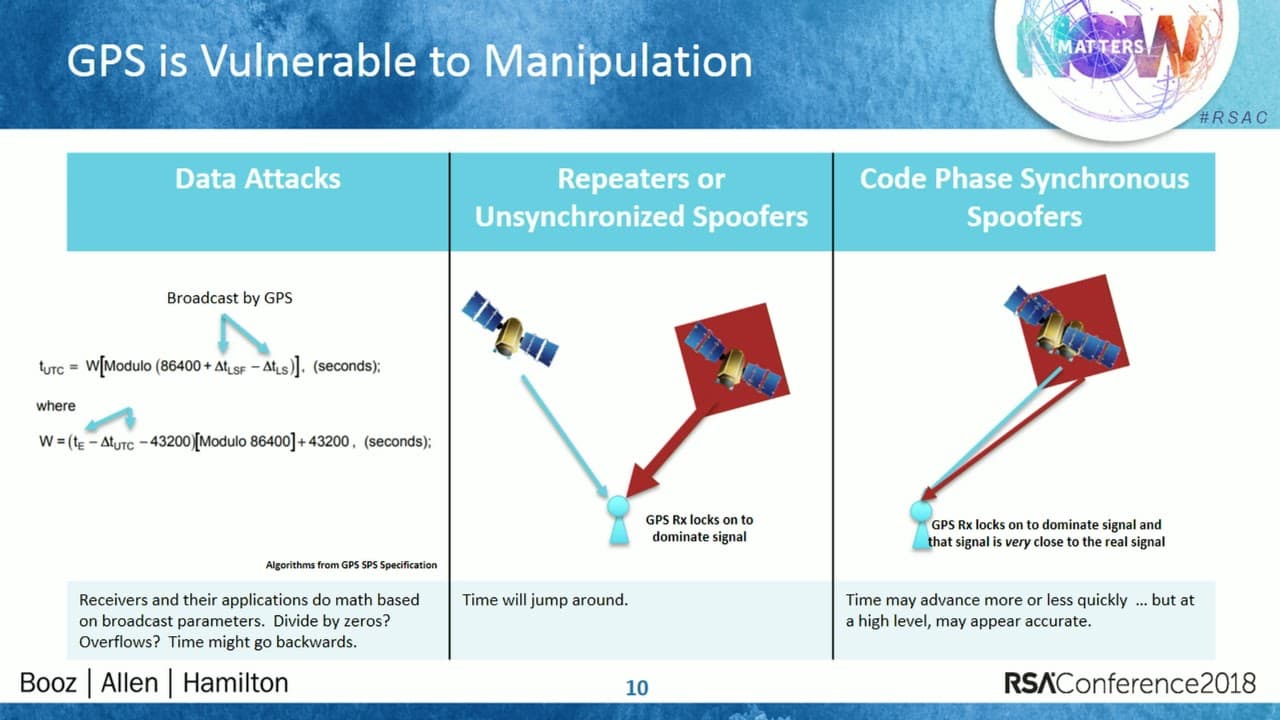
- GPS spoofing works by transmitting a signal strong enough to become dominant at a receiver. A targeted attacker can synchronize with legitimate GPS code-phase transmissions and then shift the counterfeit code phase slowly, causing the receiver to calculate and accept a false time.
Install to Summarize YouTube Videos and Get Transcripts
Explore YouTube Video Summarizer or Get YouTube Transcript Extractor
Questions & Answers
Q: Why do connected systems need precise time synchronization?
Connected systems need precise synchronization to determine when events occurred, establish their order, support fair processing, investigate failures, and enforce time-based security rules. The required precision varies by application. Ordinary clocks may display seconds or synchronize within milliseconds, while telecom, finance, power, cloud, and embedded systems can care about microseconds or even tens of nanoseconds.
Q: What is UTC, and why is it not measured in real time?
UTC is a coordinated timescale calculated by averaging contributions from several atomic clocks located at laboratories around the world. Because those measurements must be collected and combined, a definitive UTC result can be produced weeks after the measured period. Precision systems therefore refer to specific local realizations such as UTC-NIST or UTC-USNO when they require an operational timing reference.
Q: What is the difference between clock accuracy and stability?
Clock accuracy is how close a clock remains to a specified reference or permitted timing boundary. Clock stability is how consistently the clock maintains that relationship over time. A clock can initially be close to the standard but drift afterward, so systems with strict synchronization requirements must consider both the present error and the clock’s ability to remain within limits.
Q: What does time traceability mean in a synchronized network?
Time traceability is the complete path connecting the clock that generates a timestamp to the edge application that uses it. Each clock, network node, and transfer segment along that path must have a known or bounded uncertainty. Combining those uncertainties lets an operator understand the possible error in the timestamp and demonstrate compliance with a required synchronization limit.
Q: How does GPS transfer precise time to a receiver?
A GPS timing receiver generates local copies of the pseudorandom sequences transmitted by satellites and aligns those copies with the received radio signals. The satellite and receiver positions are known, and radio propagation delay can be related to distance. The precision of the code alignment determines the precision of the receiver’s calculated timestamp, meaning time is measured rather than simply delivered as a data field.
Q: How can targeted GPS spoofing change a system clock?
A targeted spoofer can synchronize its counterfeit transmission with the legitimate GPS code phase, increase its signal until it becomes dominant, and then move the counterfeit code phase gradually. The receiver continues tracking what appears to be a valid signal but calculates a different time. Slow movement is important because it can avoid the abrupt, conspicuous behavior associated with simpler attacks.
Q: How is naive GPS spoofing different from advanced spoofing?
Naive spoofing can replace navigation-message fields with manipulated parameters or broadcast an unsynchronized simulated constellation. These actions may cause obvious effects, such as backward time, invalid mathematical operations, or other strange receiver behavior. Advanced targeted spoofing first aligns with legitimate GPS transmissions, captures the receiver with a dominant signal, and then slowly shifts code phase to create a less noticeable timing error.
Q: Why can NTP and PTP users still depend on GPS timing?
NTP and PTP can distribute timestamps through a network, but they do not necessarily represent the original source of those timestamps. GPS commonly transfers time from clocks steered toward UTC-USNO into receivers and timing servers, which then feed downstream applications. An organization that identifies only NTP or PTP may therefore overlook its deeper GPS dependency and misunderstand its exposure to outages or spoofing.
Summary & Key Takeaways
-
Precise synchronization supports fairness, event ordering, forensic investigation, and security across connected systems. Telecom, finance, electric power, cloud computing, and embedded networks may require accuracy measured in microseconds or tens of nanoseconds, making clock stability and a clear understanding of timing error essential to reliable operations.
-
Many systems ultimately receive time from GPS, even when organizations identify NTP, PTP, or cellular services as their immediate synchronization source. GPS satellites carry atomic clocks steered toward UTC-USNO, while downstream networks distribute timestamps to applications. Misunderstanding this dependency can leave institutions unprepared for outages, spoofing, or synchronization failures.
-
GPS timing receivers measure time by aligning locally generated pseudorandom sequences with signals transmitted by known satellites. An attacker can exploit this process by broadcasting a dominant counterfeit signal. Naive manipulation produces obvious errors, while targeted spoofing can slowly shift code phase and make a receiver accept an incorrect time without an abrupt change.
Read in Other Languages (beta)
Share This Summary 📚
Summarize YouTube Videos and Get Video Transcripts with 1-Click
Try YouTube Summary with ChatGPT & Claude or YouTube Transcript Generator
Explore More Summaries from RSAC Cybersecurity 📚





Summarize YouTube Videos and Get Video Transcripts with 1-Click
Try YouTube Summary with ChatGPT & Claude or YouTube Transcript Generator