How Does Thermodynamics Explain Energy Transfer?
TL;DR
The first law of thermodynamics states that the change in internal energy of a closed system is equal to the heat added minus the work done. This principle, alongside the second law of thermodynamics, explains why perpetual motion machines are impossible, as they violate the conservation of energy and the increase of entropy.
Transcript
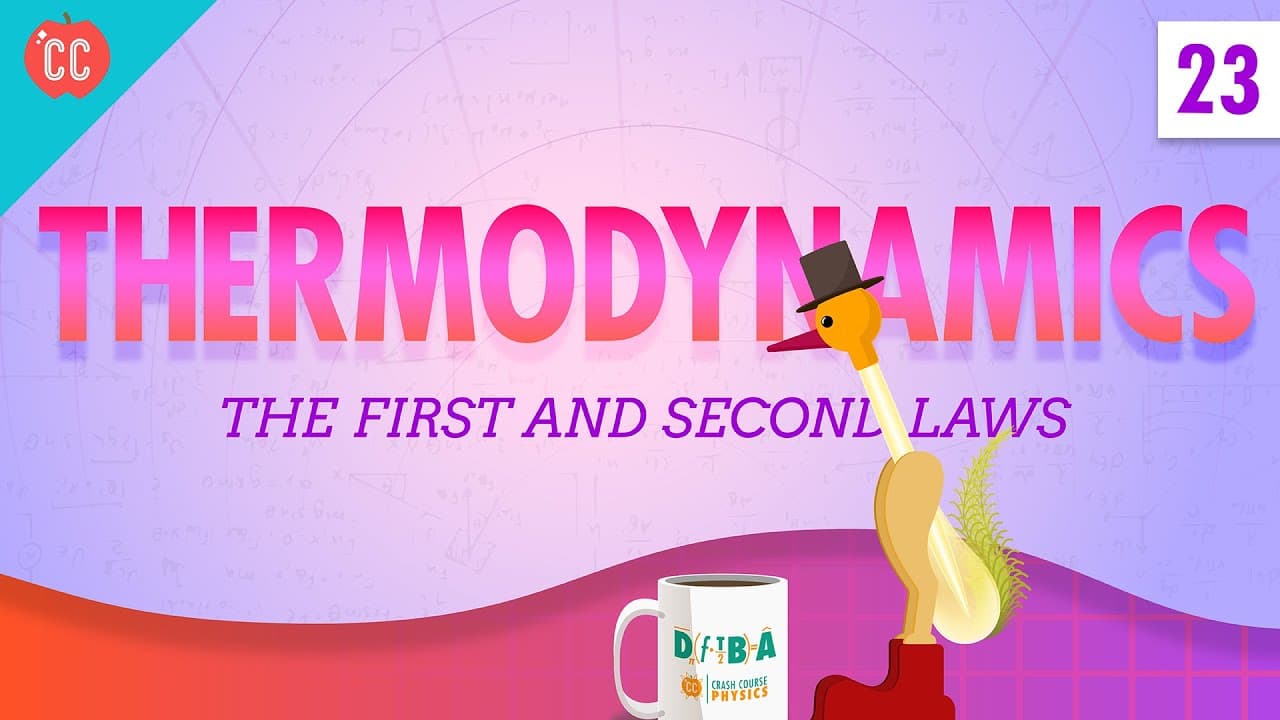
This little toy is called a Drinking Bird. You put a cup of water in front of it, and its head dunks into the cup. Eventually, the head bobs up again – but then it goes right back into the water. If you don’t know much about thermodynamics, the Drinking Bird might seem like it could go on forever, without an external source of energy powering it – ... Read More
Key Insights
- The first law of thermodynamics defines the change in internal energy as the sum of heat added and work done on or by the system.
- A closed system's energy conservation is illustrated by the first law, where no energy is lost or gained, only transformed.
- Perpetual motion machines are impossible due to the unavoidable energy loss through heat dissipation, as explained by the first law.
- The second law of thermodynamics explains that entropy, or disorder, in a closed system tends to increase over time.
- Entropy's increase is a probabilistic phenomenon, making systems move towards more disordered states.
- Isovolumetric processes maintain constant volume while altering heat, affecting pressure and temperature.
- Isobaric processes involve constant pressure with changing volume and temperature, allowing work to be done.
- Adiabatic processes occur without heat exchange, resulting in changes in internal energy through work alone.
Install to Summarize YouTube Videos and Get Transcripts
Explore YouTube Video Summarizer or Get YouTube Transcript Extractor
Questions & Answers
Q: How does the first law of thermodynamics define energy transfer?
The first law of thermodynamics defines energy transfer as the change in internal energy of a closed system, which is equal to the heat added to the system minus the work done by the system. This law embodies the principle of energy conservation, asserting that energy cannot be created or destroyed, only transformed from one form to another.
Q: Why are perpetual motion machines impossible?
Perpetual motion machines are impossible because they would violate the first and second laws of thermodynamics. The first law dictates energy conservation, meaning energy cannot be created from nothing, while the second law states that entropy, or disorder, always increases, leading to inevitable energy loss through heat dissipation, preventing perpetual operation.
Q: What role does entropy play in thermodynamics?
Entropy measures the disorder or randomness of a system, and in thermodynamics, it plays a crucial role by dictating that systems naturally progress towards increased disorder. This tendency is due to probabilistic reasons, where more disordered states are statistically more likely, aligning with the second law of thermodynamics that states entropy tends to increase over time.
Q: What is an isovolumetric process in thermodynamics?
An isovolumetric process, also known as an isochoric process, occurs when the volume of a system remains constant while its heat content changes. In this scenario, the pressure and temperature of the system can vary, but no work is done since the volume does not change, making it a process of pure energy transformation through heat exchange.
Q: How does an isobaric process allow work to be done?
In an isobaric process, the pressure remains constant while the volume and temperature of the system change. This allows the system to perform work, as the volume change can move a piston or perform other mechanical actions. The work done is calculated as the product of the system's pressure and the change in volume, demonstrating energy transformation.
Q: What distinguishes an isothermal process from other thermodynamic processes?
An isothermal process is characterized by a constant temperature throughout the process, achieved by connecting the system to a large heat reservoir. Unlike other processes, the internal energy remains unchanged, and any heat added is entirely converted into work. This requires slow changes to allow heat exchange, distinguishing it from processes like adiabatic ones where no heat is exchanged.
Q: What happens during an adiabatic process?
During an adiabatic process, no heat is exchanged with the surroundings, meaning the system is thermally insulated. Any change in internal energy is solely due to work done on or by the system, leading to changes in temperature and pressure. This process is common in rapid gas expansions or compressions, where heat exchange is negligible due to the speed of the process.
Q: How does entropy relate to heat flow between systems?
Entropy is directly related to heat flow, as heat transfer between systems leads to an increase in their combined entropy. When heat flows from a warmer system to a cooler one, it results in a more disordered state, increasing entropy. This aligns with the second law of thermodynamics, which states that such heat flow is spontaneous and leads to greater disorder.
Summary & Key Takeaways
-
The first law of thermodynamics states that the change in internal energy of a system equals the heat added minus the work done. This principle highlights energy conservation within a closed system, where energy can neither be created nor destroyed, only transformed. The Drinking Bird toy exemplifies these laws, relying on external energy sources to operate.
-
The second law of thermodynamics introduces the concept of entropy, describing the natural tendency for systems to evolve towards greater disorder. Entropy increases as heat flows from warmer to cooler systems, preventing perpetual motion machines. This law underscores the probabilistic nature of thermodynamic processes, where more disordered states are more likely.
-
Various thermodynamic processes demonstrate these laws: isovolumetric processes keep volume constant while changing heat, isobaric processes maintain pressure with variable volume and temperature, isothermal processes hold temperature constant, and adiabatic processes occur without heat exchange. Each process illustrates different aspects of energy transformation and conservation.
Read in Other Languages (beta)
Share This Summary 📚
Summarize YouTube Videos and Get Video Transcripts with 1-Click
Try YouTube Summary with ChatGPT & Claude or YouTube Transcript Generator
Explore More Summaries from CrashCourse 📚

Summarize YouTube Videos and Get Video Transcripts with 1-Click
Try YouTube Summary with ChatGPT & Claude or YouTube Transcript Generator