What Is Linear Regression and How Does Gradient Descent Work?
TL;DR
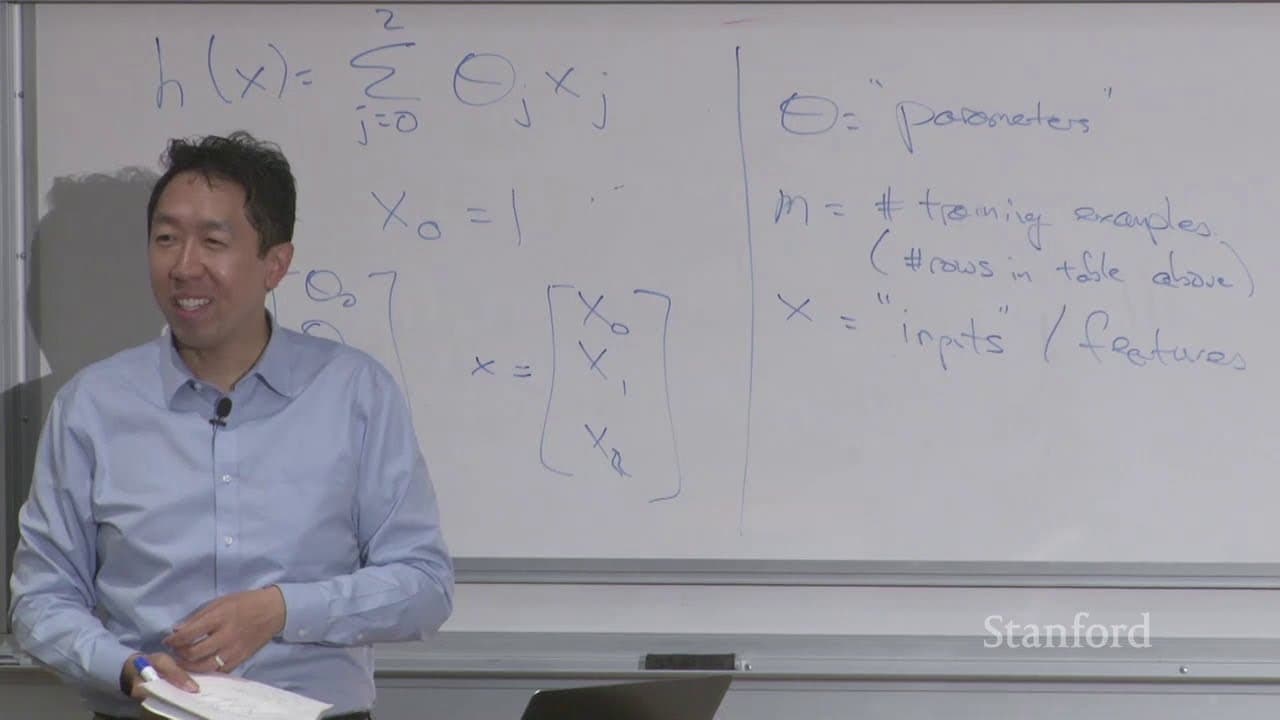
Linear regression is a supervised learning algorithm that predicts continuous values, like housing prices, by fitting a linear model to input features. Gradient descent is an iterative method used to minimize the cost function, adjusting parameters to reduce the difference between predicted and actual values. Stochastic gradient descent updates parameters after each training example, leading to faster convergence on large datasets.
Transcript
Morning and welcome back. So what we'll see today in class is the first in-depth discussion of a learning algorithm, linear regression, and in particular, over the next, what, hour and a bit you'll see linear regression, batch and stochastic gradient descent is an algorithm for fitting linear regression models, and then the normal equations, um, uh... Read More
Key Insights
- 👀 Linear regression is a simple and widely used learning algorithm for supervised learning regression problems, such as predicting house prices. It is motivated by the need to map input features (e.g., house size) to an output value (e.g., house price).
- 🏠 A linear regression algorithm is trained using a dataset of houses and their prices. The goal is to find the parameters (theta) that minimize the sum of squared differences between the predicted prices and the true prices.
- 🔵 Gradient descent is an iterative algorithm used to minimize the cost function J(theta). It updates the parameters theta by taking small steps in the direction that reduces J(theta). There are two types of gradient descent algorithms: batch gradient descent, which calculates the derivative using the entire training set, and stochastic gradient descent, which calculates the derivative using a single training example.
- 🔂 Stochastic gradient descent is often used when the dataset is large, as it allows for faster convergence by updating the parameters theta using a single training example at a time.
- 😕 The choice of learning rate (alpha) is an important decision in gradient descent. If the learning rate is too large, it may overshoot the minimum, but if it is too small, it may require many iterations to converge to the minimum.
- 🔢 The normal equation is a closed-form solution to find the optimal value of theta in a single step without using gradient descent. It can only be applied to linear regression and avoids the need for iterations. The normal equation formula can be derived by taking the derivative of J(theta) and setting it to zero.
- 🔍 The normal equation is computationally efficient when the number of features (n) is small. However, for large datasets, stochastic gradient descent is preferred because it offers faster computation due to updating parameters with just one training example at a time.
Install to Summarize YouTube Videos and Get Transcripts
Explore YouTube Video Summarizer or Get YouTube Transcript Extractor
Questions & Answers
Q: What is the difference between batch gradient descent and stochastic gradient descent?
Batch gradient descent considers the entire training dataset to update the parameters, while stochastic gradient descent updates the parameters using one training example at a time. The former can be slow for large datasets, while the latter provides faster progress but with more oscillations.
Q: How does linear regression differ from classification problems?
Linear regression is used for predicting continuous values, while classification problems involve predicting discrete or categorical values.
Summary & Key Takeaways
-
Linear regression is a simple learning algorithm used for supervised learning regression problems.
-
The goal of linear regression is to find the best-fitting line that minimizes the sum of squared differences between predicted and actual values.
-
Gradient descent is an iterative algorithm used to update the parameters of a learning algorithm in order to minimize the cost function.
-
Stochastic gradient descent is a variation of gradient descent that updates the parameters after considering one training example at a time.
Read in Other Languages (beta)
Share This Summary 📚
Summarize YouTube Videos and Get Video Transcripts with 1-Click
Try YouTube Summary with ChatGPT & Claude or YouTube Transcript Generator
Explore More Summaries from Stanford Online 📚
Summarize YouTube Videos and Get Video Transcripts with 1-Click
Try YouTube Summary with ChatGPT & Claude or YouTube Transcript Generator