How Does GDPR Affect Companies Outside Europe?
TL;DR
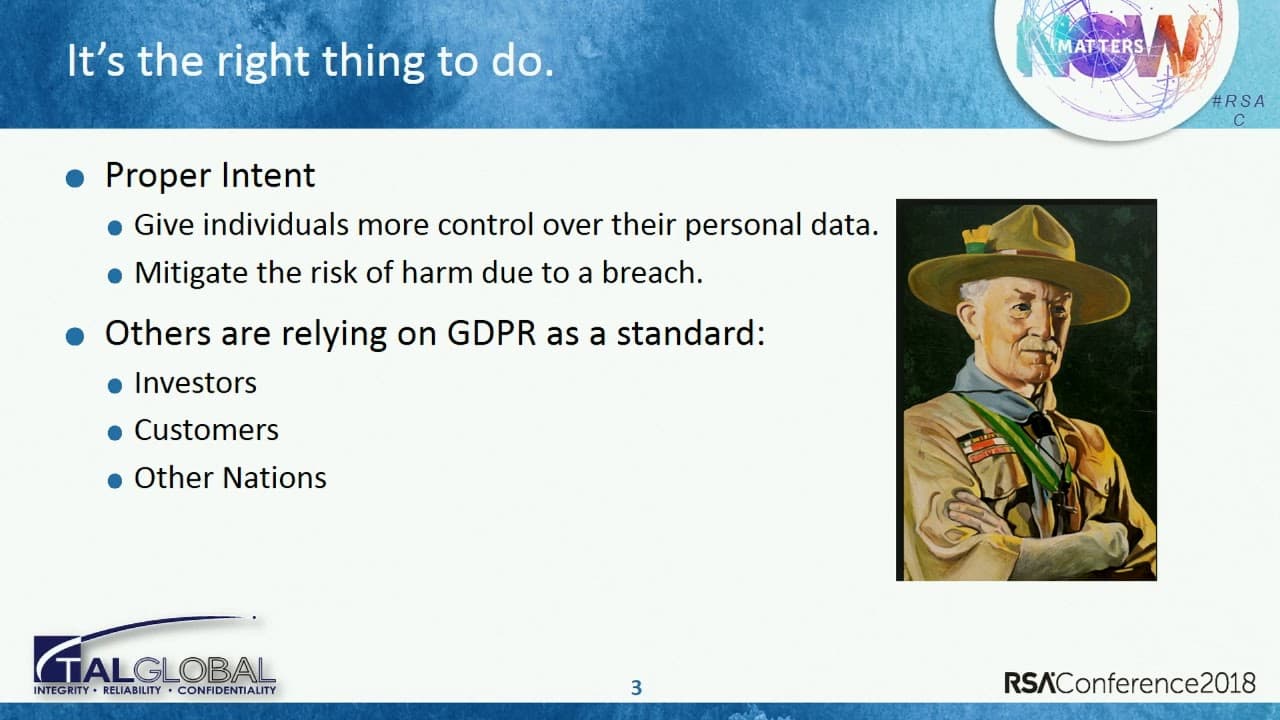
GDPR can affect a company outside Europe when its activities appear directed toward an EU market, such as publishing marketing materials in Italian. Compliance also matters beyond formal jurisdiction because clients, investors, and business partners may treat it as a measure of responsible privacy and security practices, while individual member states can add requirements that demand local planning.
Transcript
One of the reasons that, uh, I'm kind of excited and interested in the GDPR is that I had the, uh, privilege and opportunity to serve on the NATO staff in Sarajevo. And as a, uh, lieutenant colonel, I was the deputy commander of the Combined Joint Information Campaign Task Force, and for you RSA people, CJICTF, that was the acronym. That was the, u... Read More
Key Insights
- GDPR is presented as a philosophy for integrating data privacy and information security into daily operations, not merely a regulation to address once. Organizations should translate its principles into recurring decisions, policies, contracts, and working practices rather than treating compliance as a single deadline-driven project.
- A company outside Europe can become subject to GDPR-related scrutiny by directing its activities toward an EU market. In the hypothetical example, an Italian-language website created for a Toronto company could be viewed as evidence that the organization is promoting its services specifically to people in Italy.
- GDPR compliance can matter even when revenue thresholds or direct enforcement concerns are not the immediate issue. The speaker's US-based international security services company had already encountered contracts requiring GDPR compliance because it served multinational clients, showing how commercial relationships can transmit privacy obligations.
- Investors and prospective customers can use GDPR readiness as a yardstick for evaluating a company. A small US security vendor described compliance as important because of its industry and its intention to expand from domestic customers to customers in Europe.
- European GDPR implementation can vary by country because the common framework forms a basis that member states may supplement with national nuances. Understanding the main regulation therefore does not automatically prepare an organization for every requirement affecting its offices, employees, or operations across Europe.
- Employee-monitoring data can receive different treatment across national jurisdictions. The presentation cites a discussion in which productivity information, such as calls per hour in a call center, was treated as sensitive by one country but not by two others, making local analysis important.
- Large monetary fines are not the only GDPR-related business risk. An audience member notes that authorities may be able to shut down a business, and the speaker agrees that headline penalty figures do not capture the full range of challenges organizations should evaluate.
- Visual tools can make GDPR requirements easier to discuss with executives and operational teams. The speaker recommends first sketching a simplified flow diagram on paper, then translating it into a mind map using tools such as MindMeister or MindX, both of which offered free versions.
Install to Summarize YouTube Videos and Get Transcripts
Explore YouTube Video Summarizer or Get YouTube Transcript Extractor
Questions & Answers
Q: How can GDPR affect a company outside Europe?
GDPR can affect a company outside Europe when its conduct appears to target an EU market or when commercial partners require compliant practices. The presentation gives a hypothetical Toronto company whose Italian-language website could be interpreted as promoting services in Italy. It also describes a US international security services company that had already handled GDPR-compliant contracts because it served multinational clients.
Q: Can a translated website create GDPR exposure?
A translated website can create potential exposure when the language and surrounding circumstances indicate an intention to pursue customers in an EU country. In the presentation's hypothetical case, a Toronto company publishes its marketing website in Italian. An Italian authority could argue that the company is directing commercial efforts toward Italy and is therefore covered by Italy's national implementation of GDPR.
Q: Why should companies follow GDPR even without EU offices?
Companies without EU offices may still benefit from following GDPR principles because clients, investors, and prospective business partners can treat privacy readiness as evidence of responsible operations. Compliance can also support later expansion into Europe. The speaker argues that GDPR codifies broadly useful principles and should be considered part of sound privacy and information security practice, not merely a geographic obligation.
Q: Is GDPR compliance a one-time project?
GDPR compliance should not be treated as a one-time project completed when the regulation becomes effective. The presentation characterizes GDPR as a philosophy for integrating privacy and information security into day-to-day operations. That approach requires organizations to keep applying its principles to policies, contracts, marketing choices, employee practices, management discussions, and changing business plans rather than checking a single compliance box.
Q: Why do national GDPR differences matter?
National differences matter because the shared European framework provides a basis that individual member states may supplement with their own nuances and requirements. The presentation notes that understanding the roughly three-hundred-page regulation does not automatically prepare a global organization for every local rule. Companies must therefore coordinate with their offices and teams while examining the requirements relevant to each country where activities may occur.
Q: How can GDPR affect employee monitoring?
GDPR-related treatment of employee-monitoring information may vary between countries. The presentation uses productivity measurement in a call center, including the number of calls per hour, as an example. It reports that such data was treated as sensitive by one country but not by two others. Organizations should therefore avoid assuming that one monitoring policy will satisfy every national environment.
Q: What GDPR risks exist beyond large fines?
Large financial penalties are not the only possible GDPR concern. During the session, an audience member raises the possibility that authorities could shut down a business, and the speaker agrees that the frightening headline numbers are not the complete picture. Organizations should also consider contractual requirements, regulatory attention, operational disruption, differing national rules, and the possibility of becoming an enforcement example.
Q: How should security teams explain GDPR to management?
Security teams can make GDPR more understandable by converting the regulation into visual and operational materials. The speaker suggests annotating a copy of the regulation, drawing a simplified flow diagram or mind map on paper, and then moving it into software such as MindMeister or MindX. These materials can support discussions with management, team members, and general counsel, who share responsibility for addressing the issues.
Summary & Key Takeaways
-
GDPR should be treated as an operating philosophy for privacy and information security, not as a one-time compliance event tied to its May 25, 2018 effective date. Its principles can influence contracts, investor evaluations, expansion plans, and everyday business decisions even when an organization is located outside the EU.
-
Organizations can unintentionally create exposure by directing commercial activity toward Europe. In the first hypothetical case, a Toronto company publishes an Italian-language website despite having no offices in non-English-speaking countries. An authority could interpret that marketing choice as an effort to promote services in Italy and apply the relevant national implementation.
-
Understanding the core regulation is necessary but may not be sufficient across Europe. The twenty-eight member states and three EEA countries can introduce national nuances, including different treatment of employee-monitoring information. The presentation recommends annotated regulations, diagrams, mind maps, internal collaboration, and careful planning with management, security teams, and general counsel.
Read in Other Languages (beta)
Share This Summary 📚
Summarize YouTube Videos and Get Video Transcripts with 1-Click
Try YouTube Summary with ChatGPT & Claude or YouTube Transcript Generator
Explore More Summaries from RSAC Cybersecurity 📚






Summarize YouTube Videos and Get Video Transcripts with 1-Click
Try YouTube Summary with ChatGPT & Claude or YouTube Transcript Generator