How to Turn Korean Thoughts into Natural English

TL;DR
Translate Korean ideas into natural English by recalling complete patterns quickly instead of mapping every word literally. Useful patterns include “I hope it isn’t anything serious,” “Don’t tell me you lost it again,” “I like it here,” and “Could you please make sure Kim gets this?” The lesson also compares neutral, emotional, and context-dependent alternatives.
Transcript
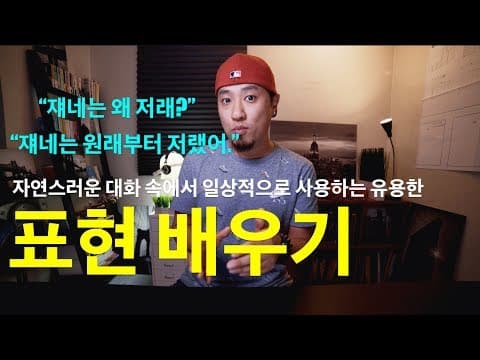
네. 이번 영상에서는요. 그동안 여러분이 영어 뇌를 열심히 잘 키워 왔는지를 확인하는 시간을 좀 가져 볼게요. 제가 여덟 가지의 내용을 얘기를 좀 준비해 왔는데요. 뭐 약간 긴 문장도 있데 대부분이 짧게 끝나는 문장들이에요. 그러니까 뭐 오래 걸리진 않을 것 같은데이 문장들을 보고 제가 그 자막으로도 띄어 놓을게요. 보고 그리고 제가 한번 한국어 그러니까 다 한국어로 먼저 듣고 보고 그러자마자 한 3, 4천 내에 이거를 영어로 어떻게 얘기해야 되지? 일단 뭐가 튀어나오는지를 한번 스스로 발견해 보세요. 지금부터 첫 번째 거부터 시작할게요. 첫 번째요. 잘 들으세요. [한숨][헉 소리] 별 일 아니야 될 텐데. 별 일 아... Read More
Key Insights
- “I hope it isn’t anything serious” expresses the hope that an unidentified situation is not a major problem. Removing “anything” gives “I hope it isn’t serious,” which better fits a case where the thing being discussed is already known and only its severity remains uncertain.
- “Don’t tell me you lost it again” naturally conveys the surprised or frustrated Korean sense of asking whether someone has lost something yet again. The same “Don’t tell me” pattern can introduce other unwelcome repetitions, including “Don’t tell me this happened again.”
- “I like it here” is a concise way to say that someone likes being, living, or working in the current place. “I liked it there” shifts the location and time, while “I like this place” more explicitly identifies the location as a particular place.
- “Everyone here treats me nice” expresses that all the people in the current location behave kindly toward the speaker. “Everyone here treats me real nice” adds emphasis, and the compact phrase “everyone here” corresponds naturally to the Korean idea of all the people in this place.
- “Could you please make sure Kim gets this?” emphasizes ensuring that an item reaches Kim. “Could you please give this to Kim?” is also presented as a correct and complete option, but the “make sure” version highlights the importance of successful delivery.
- “I feel like I’ve been patient enough” presents exhausted patience in a comparatively neutral way. Alternatives include “I’ve been patient long enough” and “I’ve been more than patient,” with optional additions such as “with him” or “with her” to identify the person involved.
- “I’ve had enough” is a more emotional way to say that patience has run out. “I’m not putting up with it anymore” is still more direct, while expressions using “patient,” such as “I feel like I’ve been patient enough,” retain a more neutral tone.
- “You know how” introduces a situation already familiar to both people, and “What if” proposes a response. The bathroom example first recalls walls collecting mold every summer, then suggests hiring a contractor and putting a window there as a possible course of action.
Install to Summarize YouTube Videos and Get Transcripts
Explore YouTube Video Summarizer or Get YouTube Transcript Extractor
Questions & Answers
Q: How can I say “I hope it is nothing serious” naturally?
Use “I hope it isn’t anything serious” when you do not yet know what the problem is and want to express hope that it is nothing significant. You can say “I hope it isn’t serious” when the subject is already known and the remaining concern is how severe its condition may be. The word “anything” helps preserve the sense of an unidentified problem.
Q: How do I express surprise that someone lost something again?
Say “Don’t tell me you lost it again.” The phrase “Don’t tell me” communicates surprised or frustrated disbelief about an unwelcome possibility, while “again” shows that the event has happened before. The same structure can be adapted to another repeated event, as in “Don’t tell me this happened again” or “Don’t tell me that happened again.”
Q: What is the difference between “I like it here” and “I like this place”?
“I like it here” broadly expresses satisfaction with being in the current location and can include liking life or work there without naming those activities. “I like this place” points more clearly to the location as a particular place. The negative version, “I don’t like this place. Let’s go,” likewise focuses directly on the place itself.
Q: How can I say that everyone in a place treats me well?
The lesson recommends “Everyone here treats me nice” for the Korean idea that all the people in the current place are kind to the speaker. For stronger emphasis, it also gives “Everyone here treats me real nice.” In both versions, “everyone here” efficiently represents the people in that location, and “treats me nice” describes their behavior toward the speaker.
Q: How do I ask someone to make sure an item reaches Kim?
Say “Could you please make sure Kim gets this?” The optional word “that” can be included, producing “Could you please make sure that Kim gets this?” The lesson also accepts “Could you please give this to Kim?” as a correct expression. The version with “make sure” especially emphasizes ensuring that Kim actually receives the item.
Q: How can I say that I have been patient long enough?
A neutral option is “I feel like I’ve been patient enough.” You can replace “feel like” with “think,” or say “I feel like I’ve been patient long enough.” Another alternative is “I feel like I’ve been more than patient.” Add “with him” or “with her” when you want to identify the person whose behavior has tested your patience.
Q: What can I say when I will not tolerate something anymore?
“I think I’ve had enough” expresses that you have reached the limit of what you can tolerate, and “I’ve had enough” states the feeling more directly. “I’m not putting up with it anymore” is an even more explicit refusal to continue tolerating the situation. For a more neutral tone, use “I feel like I’ve been patient enough.”
Q: How do I ask what someone did to make people angry?
Use “What did he do that got people so mad?” or replace “he” with “she” when appropriate. The phrase beginning with “that” connects the person’s action to the resulting anger without requiring a literal translation of the Korean linking expression. “So angry” can also replace “so mad” while preserving the central question about what caused the reaction.
Q: How do I introduce a shared problem before suggesting a solution?
Begin with “You know how” to mention a situation both people already recognize, then use “What if” to introduce a proposal. The lesson’s example recalls that the bathroom walls collect mold every summer, then asks, “What if we hired a contractor and just put a window in there?” The expanded version adds “right?” and “Well, I was thinking” between those parts.
Summary & Key Takeaways
-
The lesson tests whether eight Korean prompts immediately trigger natural English expressions. Learners are asked to read and hear each Korean sentence, then notice what English comes to mind within a few seconds. The suggested answers emphasize short, reusable sentence patterns rather than literal, word-by-word translation from Korean into English.
-
Several examples show how small wording choices change meaning or emphasis. “Anything” suits an unknown problem in “I hope it isn’t anything serious,” while “I hope it isn’t serious” fits something already identified. Similarly, “I like it here” expresses general satisfaction, whereas “I like this place” points more directly to the location itself.
-
The later expressions cover careful delivery, exhausted patience, causes of anger, and proposing a home improvement. The lesson introduces “make sure,” several versions of “I’ve been patient enough,” a question linked with “that,” and a two-part pattern combining “You know how” with “What if” to establish shared context and suggest action.
Read in Other Languages (beta)
Share This Summary 📚
Summarize YouTube Videos and Get Video Transcripts with 1-Click
Try YouTube Summary with ChatGPT & Claude or YouTube Transcript Generator
Explore More Summaries from 라이브 아카데미 📚





Summarize YouTube Videos and Get Video Transcripts with 1-Click
Try YouTube Summary with ChatGPT & Claude or YouTube Transcript Generator