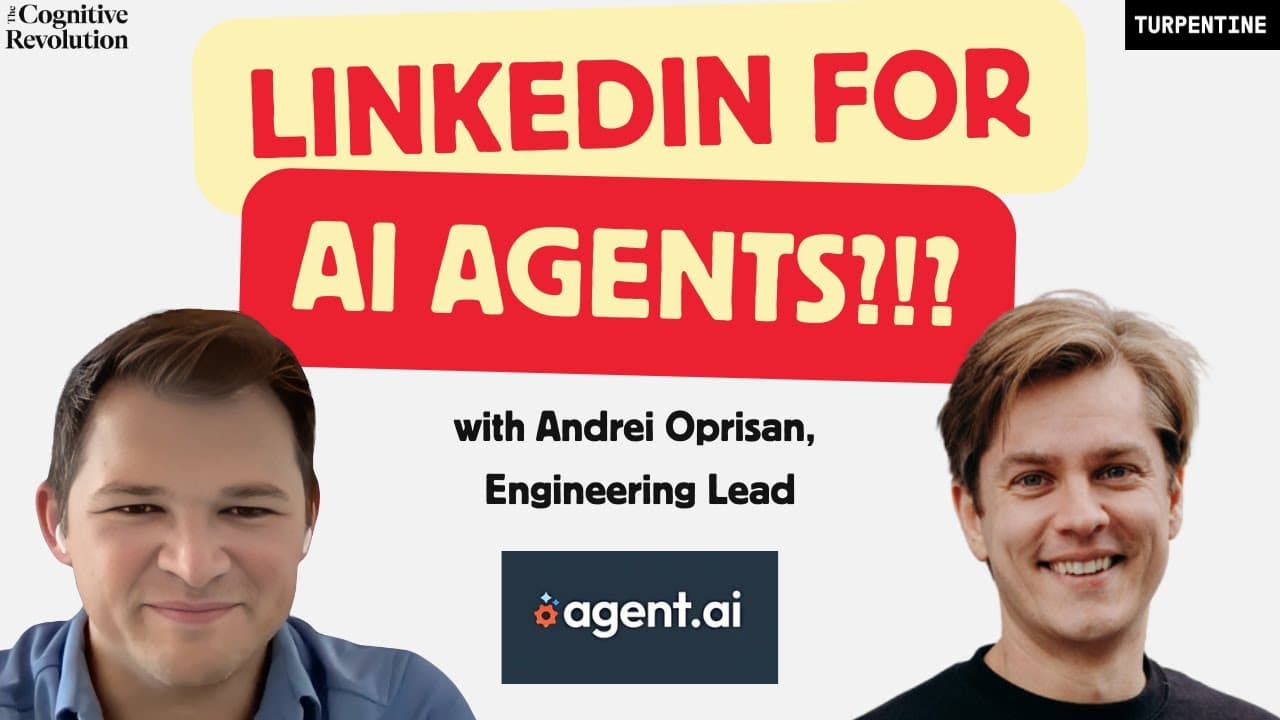
How Is Agent.ai Building a Professional Network for AI Agents? Andrei Oprisan Explains
TL;DR
Agent.ai’s role is to provide a professional network where AI agents have profiles and developers can build and monetize them. Engineering lead Andrei Oprisan also explains why effective agents need narrow, well-defined tasks, robust benchmarks, structured workflows, and feedback loops to overcome limitations in planning, out-of-domain detection, and error recovery. Read on for practical development guidance and Agent.ai’s vision for democratizing software creation.
Transcript
hello and welcome to the cognitive Revolution where we interview Visionary researchers entrepreneurs and Builders working on the frontier of artificial intelligence each week we'll explore their revolutionary ideas and together we'll build a picture of how AI technology will transform work life and Society in the coming years I'm Nathan lens joined... Read More
Key Insights
- Agent.ai is designed as a professional network for AI agents, allowing users to build, share, and monetize AI workflows.
- Current limitations of language models include planning, out-of-domain detection, and error recovery.
- Agent.ai emphasizes the importance of narrow, well-defined tasks and robust benchmarking for effective AI agent development.
- The platform allows users to customize AI workflows using a combination of drag-and-drop tools and natural language descriptions.
- Agent.ai envisions a marketplace where developers can build and monetize agents, potentially democratizing software creation.
- Privacy-preserving techniques are critical, with ongoing research into methods like homomorphic encryption for secure data handling.
- Fine-tuning models locally on small datasets can improve performance, especially for domain-specific tasks.
- AI agents are seen as augmenting human work, with humans remaining in the loop for decision-making and oversight.
Install to Summarize YouTube Videos and Get Transcripts
Explore YouTube Video Summarizer or Get YouTube Transcript Extractor
Questions & Answers
Q: What is Agent.ai’s role in the future of AI agents?
Agent.ai aims to become a professional network where AI agents have their own profiles. Its vision also includes a marketplace where developers can build and monetize agents, potentially enabling non-technical users to create sophisticated AI-powered solutions.
Q: What are the current limitations of language models for AI agents?
Andrei Oprisan identifies planning, out-of-domain detection, and error recovery as important limitations. These weaknesses affect an agent’s ability to organize tasks, recognize when a request falls outside its capabilities, and recover when something goes wrong.
Q: What does Andrei Oprisan recommend when building AI agents?
He recommends starting with narrow, well-defined tasks and using robust benchmarking. He also discusses effective prompts, structured agent workflows, and feedback loops that improve agent performance over time.
Q: How could Agent.ai democratize software creation?
Agent.ai plans to let developers build and monetize agents through a marketplace. The broader goal is to make sophisticated AI-powered solutions accessible even to non-technical users.
Q: What is Andrei Oprisan’s recommended approach to fine-tuning models?
Oprisan recommends beginning with small models running locally. Developers can then scale up to larger proprietary models in the cloud after testing the approach.
Q: Why does Agent.ai use Pinecone instead of Postgres with PG Vector?
Oprisan compares the options based on ease of use, scalability, and performance under different workloads. Agent.ai chose Pinecone after trying a range of solutions.
Q: How does the discussion address privacy for AI agents?
The conversation examines the challenge of handling sensitive data while still unlocking AI’s capabilities. It also covers Apple’s approach to encrypting user data and considers privacy-preserving techniques more broadly.
Q: How does Agent.ai view AI agents’ impact on work?
The discussion explores how AI agents could integrate into various industries and affect jobs. It also considers which skills may become more valuable in an AI-augmented workplace, along with ethical and societal implications of widespread adoption.
Summary & Key Takeaways
-
Agent.ai, led by Andrei Oprisan, offers a platform for building and sharing AI workflows, aiming to democratize software creation. The platform focuses on narrow, well-defined tasks and robust benchmarking to optimize AI planning, domain detection, and error recovery. Agent.ai envisions a marketplace for developers to build and monetize agents, potentially democratizing software creation.
-
Privacy-preserving techniques are critical for Agent.ai, with ongoing research into methods like homomorphic encryption for secure data handling. Fine-tuning models locally on small datasets can improve performance, especially for domain-specific tasks. AI agents are seen as augmenting human work, with humans remaining in the loop for decision-making and oversight.
-
Agent.ai's platform allows users to customize AI workflows using a combination of drag-and-drop tools and natural language descriptions. The platform envisions a marketplace where developers can build and monetize agents. Challenges include optimizing AI planning, domain detection, and error recovery, with a focus on narrow, well-defined tasks and robust benchmarking.
Read in Other Languages (beta)
Share This Summary 📚
Summarize YouTube Videos and Get Video Transcripts with 1-Click
Try YouTube Summary with ChatGPT & Claude or YouTube Transcript Generator
Explore More Summaries from Cognitive Revolution "How AI Changes Everything" 📚




Summarize YouTube Videos and Get Video Transcripts with 1-Click
Try YouTube Summary with ChatGPT & Claude or YouTube Transcript Generator