How to Properly Use A, An, and The in English
TL;DR
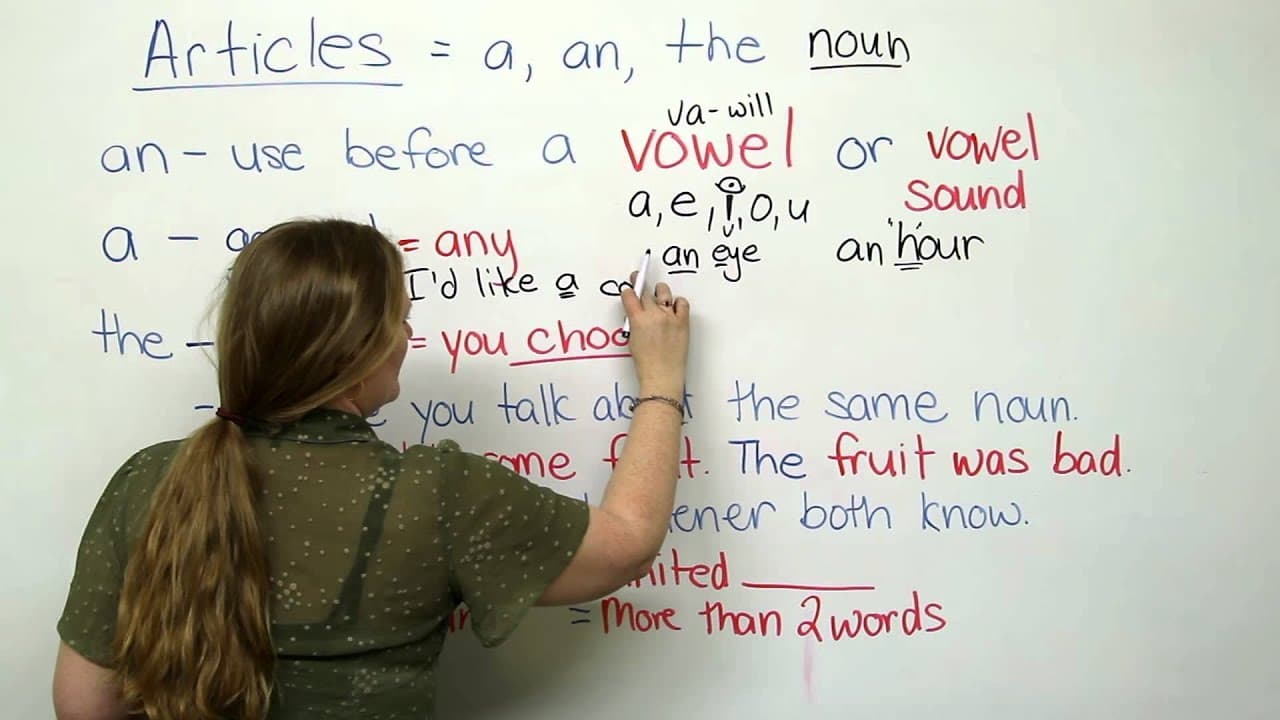
Use 'a' or 'an' for general singular nouns and 'the' for specific or previously mentioned nouns. 'An' precedes a singular noun that starts with a vowel sound, while 'a' is used for general nouns. Remember, 'the' indicates specificity when both the speaker and listener understand which noun is referred to.
Transcript
Hello, and welcome to the next video. Today, I'm going to teach you about a very difficult, confusing, fun, maybe, grammar point called "articles". Really? Yeah. Articles are confusing. There are many, many rules in English about articles. I do not have the time, the energy to teach you all of them, but I'll do my best. Okay? What are articles, fir... Read More
Key Insights
- 📢 The English articles (a, an, the) are used before nouns to convey specificity and generalization.
- 👂 "An" is used before singular nouns beginning with a vowel or a vowel sound.
- 💁 "A" is used before singular nouns in a general form, similar to the word "any."
- 📢 "The" is used for specific nouns when the speaker and listener both know which noun is being referred to.
- 🏝️ "The" is also used with certain country names and countries made up of small islands.
- 📢 Uncountable nouns do not take an article, except when referring to the same noun again in a sentence.
- 🖐️ Articles play a crucial role in English grammar, helping to clarify the meaning and context of nouns.
Install to Summarize YouTube Videos and Get Transcripts
Explore YouTube Video Summarizer or Get YouTube Transcript Extractor
Questions & Answers
Q: How do you use “a,” “an,” and “the” in English?
Use “a” or “an” before a general singular noun when you do not mean a specific one. Use “an” before a vowel or vowel sound, while “the” identifies something specific, already mentioned, or known to both the speaker and listener.
Q: When should you use “an” before a noun?
Use “an” before a singular noun beginning with a vowel, such as “an ice cream.” It also comes before a vowel sound, as in “an hour,” because the “h” is silent.
Q: What is the difference between “a” and “an”?
Both articles are used with general singular nouns. The lesson’s key distinction is that “an” comes before a vowel or vowel sound, while “a” is used in examples such as “a cookie,” “a muffin,” and “a Kleenex.”
Q: What does “a” mean before a singular noun?
“A” presents a singular noun in a general sense and can be understood as similar to “any.” Saying “I’d like a muffin” means you want one muffin but do not care which particular muffin you receive.
Q: When should you use “the” before a noun?
Use “the” when referring to something specific rather than any example of that noun. It is also used when the speaker and listener both know which noun is meant, such as “the school” when both attend the same school.
Q: Why is “the” used when a noun is mentioned again?
The lesson teaches that a repeated noun takes “the” because it now refers to the same, specific thing mentioned earlier. For example: “I bought some fruit. The fruit was bad.”
Q: Do uncountable nouns take an article?
The lesson says an uncountable noun normally takes no article when first introduced, as in “I bought some fruit.” If the same noun is mentioned again, it becomes specific and takes “the”: “The fruit was bad.”
Q: When is “the” used with country names?
The lesson uses “the” with names containing “United,” including the United States, the United Kingdom, and the United Arab Emirates. It also teaches using “the” for country names with more than two words and for places made up of small islands, such as the Philippines.
Summary & Key Takeaways
-
Articles (a, an, the) come before nouns and are essential in English grammar.
-
"An" is used before singular nouns beginning with a vowel or a vowel sound.
-
"A" is used before singular nouns in a general form, similar to the word "any."
-
"The" is used for specific nouns, when both the speaker and listener know which noun is being referred to.
Read in Other Languages (beta)
Share This Summary 📚
Summarize YouTube Videos and Get Video Transcripts with 1-Click
Try YouTube Summary with ChatGPT & Claude or YouTube Transcript Generator
Explore More Summaries from English with Ronnie · EnglishLessons4U with engVid 📚



Summarize YouTube Videos and Get Video Transcripts with 1-Click
Try YouTube Summary with ChatGPT & Claude or YouTube Transcript Generator