What Is Religious Freedom and What Are Its Limits?
TL;DR
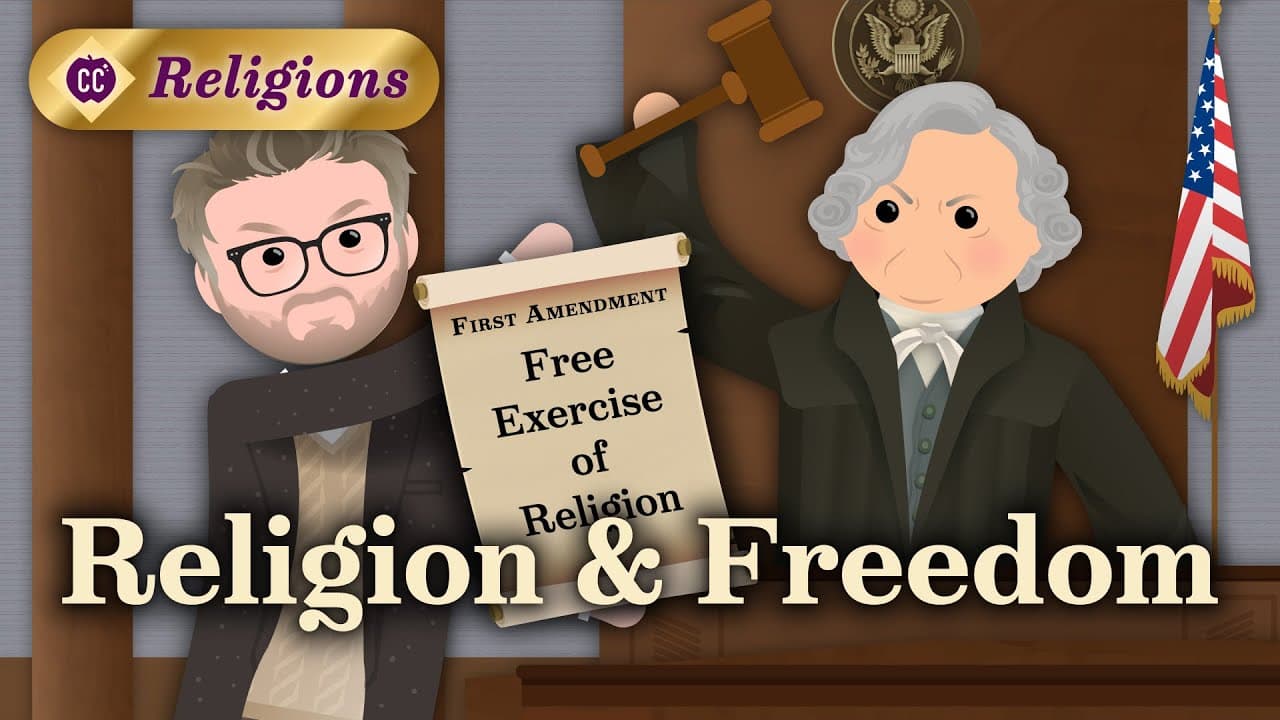
Religious freedom is a constitutional right in the U.S. that allows individuals to believe and practice their faith without interference. However, its limits are complex, as the belief-action dichotomy protects beliefs but not actions that violate the law. Supreme Court rulings have often fluctuated, impacting how this freedom interacts with other rights like healthcare access and non-discrimination.
Transcript
Hi, I'm John Green, and I am a lifelong learner. That's right, we've got new merch at Complexly.store. Welcome to Crash Course Religions. So listen, today we’re talking about religious freedom and to do that we’re going to have to talk about drugs. Like, is peyote, for instance, a sacred substance or an illegal drug? Peyote is an edible type of ... Read More
Key Insights
- Religious freedom is a constitutional right in the U.S., but its definition and limits are complex and often debated.
- The belief-action dichotomy established that religious belief is protected, but actions violating the law are not.
- The Sherbert v. Verner case introduced the 'compelling interest' standard for government interference in religious practices.
- The Religious Freedom Restoration Act aimed to strengthen religious freedom claims but added complexity to legal interpretations.
- Supreme Court rulings have varied, with recent decisions favoring religious freedom claims more often, sometimes clashing with other rights.
- Religious freedom has historically been used both to protect minority rights and to uphold the dominance of certain religions.
- The U.S. struggles with balancing religious freedom with national security, as seen in cases involving Muslim-majority countries.
- Religious freedom is a global concept, with historical precedents in various cultures, but achieving a perfect balance remains elusive.
Install to Summarize YouTube Videos and Get Transcripts
Explore YouTube Video Summarizer or Get YouTube Transcript Extractor
Questions & Answers
Q: What is the belief-action dichotomy in religious freedom?
The belief-action dichotomy is a legal precedent established by the Supreme Court in the 1879 Reynolds case. It differentiates between the protection of religious beliefs and religious actions. While individuals are free to hold any religious beliefs, actions based on those beliefs are not exempt from laws. This means that while one can believe in practices like polygamy, actually practicing them can be illegal if they violate existing laws.
Q: How did the Sherbert v. Verner case impact religious freedom?
The Sherbert v. Verner case in the 1960s was pivotal for religious freedom in the U.S. The Supreme Court ruled that denying unemployment benefits to a Seventh-day Adventist who refused to work on her Sabbath violated her religious freedom. This case introduced the 'compelling interest' standard, requiring the government to have a significant reason to restrict religious practices. It shifted the focus from merely protecting beliefs to also accommodating religious actions.
Q: What is the Religious Freedom Restoration Act (RFRA)?
The Religious Freedom Restoration Act (RFRA), passed in 1993, was designed to protect religious freedom by requiring the government to demonstrate a 'compelling interest' before restricting religious practices. It aimed to strengthen religious freedom claims and ensure that laws do not unduly burden religious exercise. However, it added complexity to legal interpretations and has been the basis for various Supreme Court cases involving conflicts between religious rights and other rights.
Q: How have recent Supreme Court rulings affected religious freedom?
Recent Supreme Court rulings have increasingly favored religious freedom claims, especially with more conservative justices on the bench. For instance, in 2014, the court sided with Hobby Lobby, allowing them to deny birth control coverage based on religious beliefs. Similarly, a baker was allowed to refuse service to a same-sex couple on religious grounds. These decisions have sparked debates on balancing religious freedom with other rights like healthcare access and non-discrimination.
Q: What challenges does religious freedom face globally?
Globally, religious freedom faces challenges in balancing the rights of various religious groups and individuals. While many cultures have historical precedents for religious freedom, achieving a perfect balance remains difficult. Issues arise when religious freedom conflicts with national security, as seen in travel bans on Muslim-majority countries. Additionally, religious nationalism can lead to the dominance of one religion, marginalizing others. These complexities make universal religious freedom elusive.
Q: How has religious freedom been used historically?
Historically, religious freedom has served dual purposes: protecting minority rights and maintaining the dominance of certain religions. In the U.S., religious freedom was foundational but not uniformly applied, with restrictions on African American religious practices in the South. Globally, religious freedom has ancient roots, like Emperor Ashoka's edicts in India. However, it has also been a tool for oppression when certain religions gain preferential treatment, highlighting the ongoing struggle for balance.
Q: What is the significance of the 'compelling interest' standard?
The 'compelling interest' standard, established in the Sherbert v. Verner case, is significant because it requires the government to justify restrictions on religious practices with a substantial reason. This standard shifted legal interpretations from merely protecting religious beliefs to accommodating religious actions, unless the government can demonstrate a compelling reason otherwise. It has influenced numerous court cases and remains a critical aspect of religious freedom debates in the U.S.
Q: Why is achieving perfect religious freedom challenging?
Achieving perfect religious freedom is challenging due to the diverse and often conflicting nature of religious beliefs and practices. Defining what constitutes religion and its limits is complex, as seen in varying Supreme Court rulings. Balancing religious rights with other rights, like non-discrimination and national security, adds further complexity. Historical and cultural differences also influence interpretations, making a universally accepted definition of religious freedom difficult to attain.
Summary & Key Takeaways
-
Religious freedom in the U.S. is a constitutional right but defining its limits is complex. The belief-action dichotomy protects beliefs but not actions that break the law. The Sherbert case introduced 'compelling interest' as a standard for government interference.
-
The Religious Freedom Restoration Act aimed to clarify religious freedom claims, but Supreme Court rulings have varied, often favoring religious claims. Recent cases have highlighted conflicts between religious freedom and other rights, such as access to healthcare and non-discrimination.
-
Historically, religious freedom has been used to protect minority rights and uphold dominant religions. The U.S. continues to struggle with balancing religious freedom with national security, as seen in cases involving Muslim-majority countries. Achieving perfect religious freedom remains challenging.
Read in Other Languages (beta)
Share This Summary 📚
Summarize YouTube Videos and Get Video Transcripts with 1-Click
Try YouTube Summary with ChatGPT & Claude or YouTube Transcript Generator
Explore More Summaries from CrashCourse 📚






Summarize YouTube Videos and Get Video Transcripts with 1-Click
Try YouTube Summary with ChatGPT & Claude or YouTube Transcript Generator