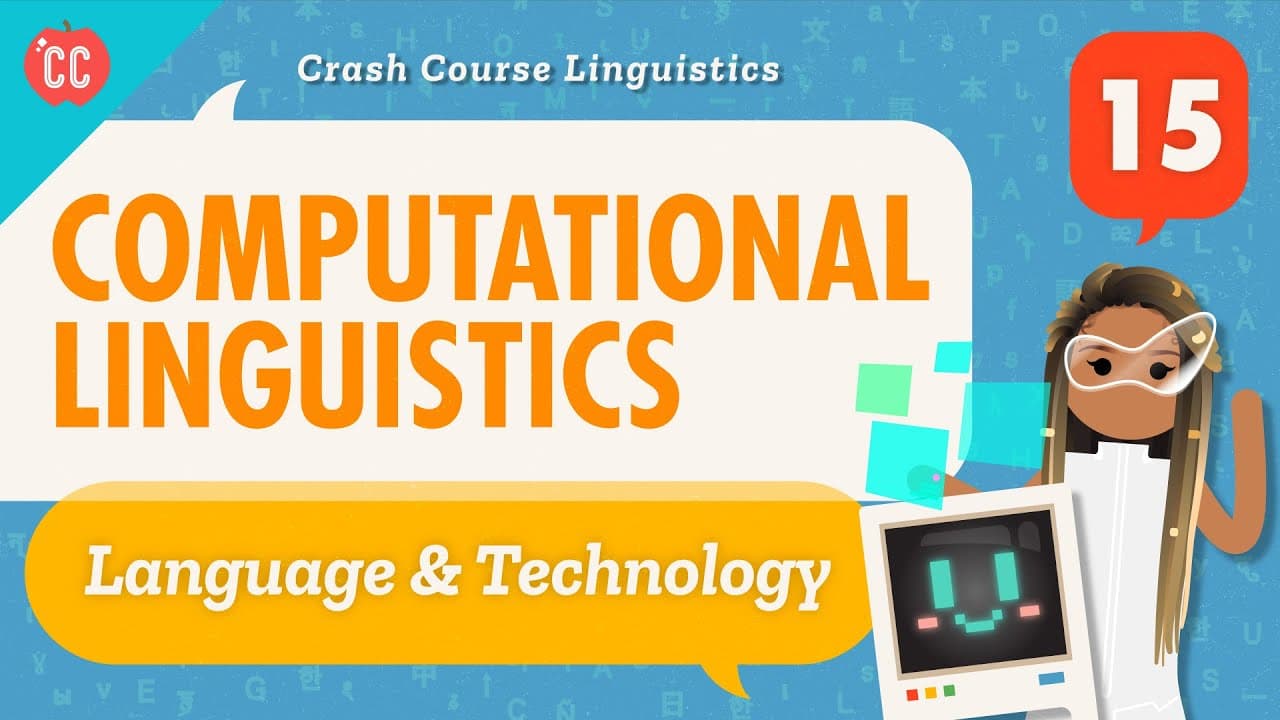
Computational Linguistics: Crash Course Linguistics #15
TL;DR
Computational linguistics, also called natural language processing, programs computers to process human language despite challenges such as recognizing word boundaries, meanings, context, accents, and emotion. NLP powers search engines, spam filters, spell checkers, predictive text, and voice-activated home systems. Its workflow can span speech-to-text, meaning analysis, task execution, text generation, and speech synthesis. Read on to understand each stage and why signed-language translation requires more than gloves.
Transcript
Hi, I'm Taylor and welcome to Crash Course Linguistics! Computers are pretty great, but they can only do stuff that humans tell them to do. Counterintuitively, this means that the more automatic a human skill is, the more difficult it is for us to teach to computers. It's easy for us to teach a computer to calculate millions of digits of pi, or pla... Read More
Key Insights
- 🎰 Computers struggle to process human language because the skills that are easy for humans are difficult for machines.
- 💁 Natural language processing involves several steps, including transforming text into digital form, determining word meanings and relationships, and producing a useful output.
- ❓ NLP can be achieved through supervised or unsupervised learning, but biases in the training data can affect the results.
- 👨🔬 Addressing bias in NLP is an active area of research and requires ethical consideration.
- 🤘 Language technology for signed languages is under-developed, and gloves cannot accurately translate signed languages due to the complexity of grammar and vocabulary.
Install to Summarize YouTube Videos and Get Transcripts
Explore YouTube Video Summarizer or Get YouTube Transcript Extractor
Questions & Answers
Q: What is computational linguistics or natural language processing?
Computational linguistics, also called natural language processing or NLP, is the programming of computers to process human language. It supports tasks such as search, translation, predictive text, spell checking, spam filtering, and voice-activated systems.
Q: Why is human language difficult for computers to process?
Computers handle tasks like learning many new words more easily than understanding across typos and accents or detecting whether someone is sad, angry, or joking. Language is also not a single task, so machines need different systems for recognizing text, interpreting meaning, performing an action, and producing an understandable response.
Q: What are the main steps in natural language processing?
First, a computer receives digital text directly or converts speech, handwriting, or physical text into it. It then determines word meanings and relationships, performs a useful task such as answering a question or translating, and re-encodes the result into natural human language or speech.
Q: How does NLP convert physical language into digital text?
NLP can use speech-to-text, handwriting recognition, or optical character recognition. During conversion, the system must identify word and sentence boundaries and distinguish meaningful marks, such as the dot of an i or a period, from dirt.
Q: How does a computer determine the meaning of words?
The computer analyzes both word meanings and the relationships between words. Context can help it distinguish “bank” from “blank,” a river bank from a financial bank, and common nouns from proper nouns.
Q: What can an NLP system do after interpreting language?
After determining approximately what was said, the system can answer a question, translate the content into another language, or find directions between two places. Each task requires a different system, and its abstract output may be represented as a mathematical equation or lines of code before being converted back into human language.
Q: Why is NLP divided into reusable subtasks?
Dividing NLP into steps lets programmers reuse components across different applications. For example, one English text-to-speech system could read aloud answers, English translations, and directions, while captioners may use only speech-to-text and screen readers only text-to-speech.
Q: Why can’t sign-language translation gloves accurately translate ASL?
The gloves recognize handshapes, but signed-language grammar also uses facial expressions and movements of the hands and arms relative to the body. They detect only the 26 letters of the manual alphabet, miss core vocabulary, and provide signs-to-speech output without enabling communication from speech back into a format accessible to Deaf and Hard of Hearing people.
Summary & Key Takeaways
-
NLP is the process of programming computers to process human language and is used in various applications such as search engines, voice-activated home systems, and spell checkers.
-
NLP involves several steps, including transforming physical text into digital text, determining word meanings and relationships, and producing a useful output in natural human language.
-
NLP can be achieved through supervised learning using matched data or unsupervised learning using non-parallel data, but biases in the training data can impact the results.
Read in Other Languages (beta)
Share This Summary 📚
Summarize YouTube Videos and Get Video Transcripts with 1-Click
Try YouTube Summary with ChatGPT & Claude or YouTube Transcript Generator
Explore More Summaries from CrashCourse 📚





Summarize YouTube Videos and Get Video Transcripts with 1-Click
Try YouTube Summary with ChatGPT & Claude or YouTube Transcript Generator