What Are the Risks of Voting by Mail and Election Fraud?
TL;DR
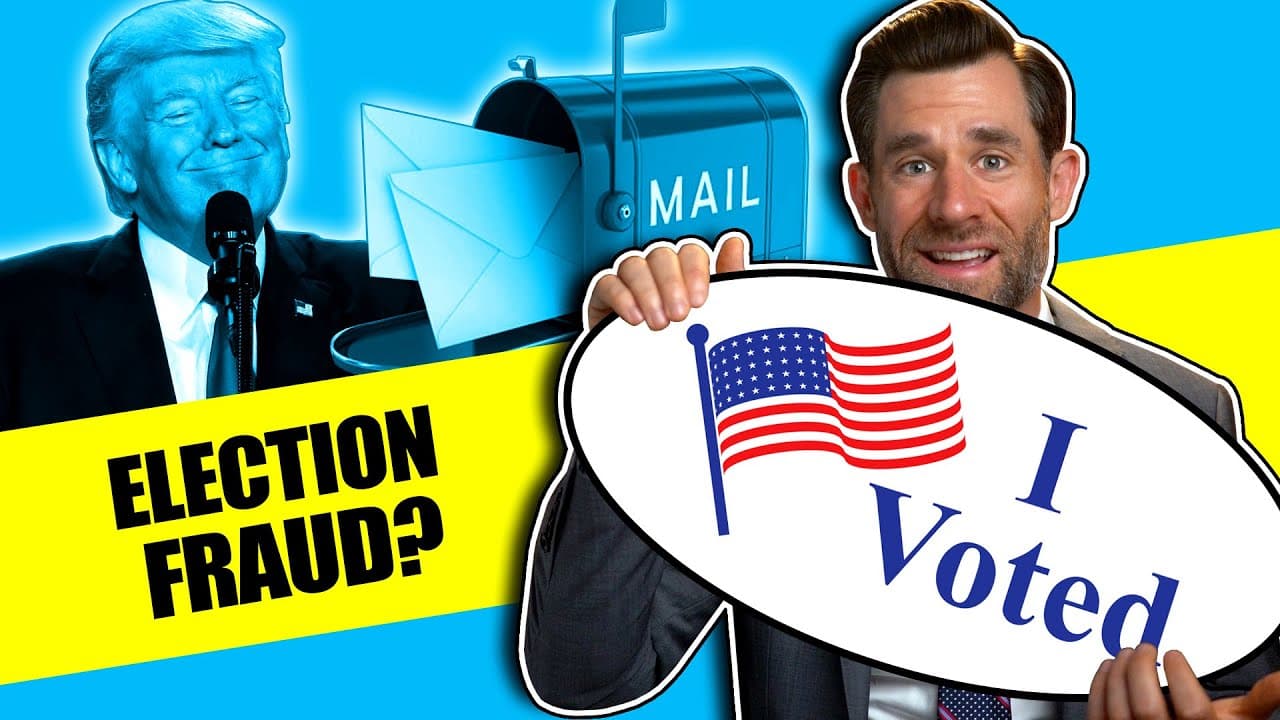
Voting by mail is largely secure, with fraud instances being extremely rare, around 0.0006% of ballots cast. President Trump's concerns about widespread voter fraud lack substantial evidence and seem to be more about voter suppression tactics. Election regulations are primarily determined by states, and while there are issues regarding mail delivery, the actual risks of fraud in mail-in voting are minimal.
Transcript
- Thanks to Mack Weldon for keeping Legal Eagle in the air and helping me look fly. President Trump caused quite a stir when he tweeted that the election should be delayed because Democrats were about to commit mass voter fraud by encouraging people to vote by mail. Now I've already covered the possibility of election delays in my video, "Can the P... Read More
Key Insights
- 👮 Election regulations and procedures are primarily determined by state and local governments, with Congress having the authority to pass federal laws for congressional elections.
- 🔒 While election security is a concern, federal laws regulating security procedures for paper and electronic ballots are limited. States have their own security protocols, and experts argue for federal regulation to ensure uniformity.
- 💌 Claims of widespread voter fraud in mail-in ballots are not supported by significant evidence. Instances of fraud are extremely rare, and mail-in voting has been implemented successfully in several states.
- 🇺🇸 Voter suppression tactics, such as restrictive voting requirements or purging eligible voters, have a long history in the United States. Protection against voter suppression is crucial to ensure fair elections.
- 📫 Changes to the U.S. Postal Service, such as reducing overtime for postal workers, may impact the timely delivery of mail-in ballots and raise concerns about voter suppression tactics.
- 💌 The President's campaign lawsuits against mail-in voting measures in various states highlight concerns of voter suppression rather than addressing actual voter fraud.
- 👮 The official outcome of the presidential election is determined through a canvass of votes, certification of results, and the meeting of the electoral college. The President's claims of needing immediate results are not supported by federal or state law.
Install to Summarize YouTube Videos and Get Transcripts
Explore YouTube Video Summarizer or Get YouTube Transcript Extractor
Questions & Answers
Q: Can the President unilaterally change election procedures through executive order?
No, the President does not have the constitutional authority to make unilateral changes to the election system. Election procedures are largely governed by federal statutes and state laws.
Q: How secure are mail-in ballots and absentee ballots?
Mail-in and absentee ballots have security measures in place, such as voter registration, barcode tracking, signature verification, and strict protocols. Instances of fraud are minimal, comprising a small fraction of all votes cast.
Q: What is the difference between voter fraud and voter suppression?
Voter fraud refers to illegal actions committed by individual voters, such as double voting or voting under false identities. Voter suppression involves government or individual efforts to prevent or discourage eligible voters from registering or voting.
Q: Is mail-in voting a widespread practice?
Mail-in voting has been implemented successfully in states like Oregon, Washington, Utah, and Colorado. It has gained support from politicians on both sides of the aisle, particularly during the COVID-19 pandemic.
Summary & Key Takeaways
-
President Trump's recent comments on voting by mail have raised concerns about voter suppression rather than canceling or postponing elections.
-
State and local governments have the authority to regulate elections, but Congress can pass federal laws that override state regulations.
-
Voting by mail and voting by absentee ballot are essentially the same, and they have been encouraged to ensure voter safety during the COVID-19 pandemic.
Read in Other Languages (beta)
Share This Summary 📚
Summarize YouTube Videos and Get Video Transcripts with 1-Click
Try YouTube Summary with ChatGPT & Claude or YouTube Transcript Generator
Explore More Summaries from LegalEagle 📚





Summarize YouTube Videos and Get Video Transcripts with 1-Click
Try YouTube Summary with ChatGPT & Claude or YouTube Transcript Generator