Why Do Language Models Work So Well?
TL;DR
Language models excel due to their ability to learn from vast amounts of data through next word prediction, effectively performing massive multi-task learning. As models scale with more data and compute, they exhibit emergent abilities, improving performance on complex tasks. Understanding the driving force of exponentially cheaper compute helps anticipate the future trajectory of AI development.
Transcript
So again, I'm very happy to have Jason here. So he's an AI researcher based in San Francisco, currently working at OpenAI. He was previously a research scientist at Google Brain, where he popularized key ideas in LLMS such as chain of thought prompting, instruction tuning, as well as emergent phenomena. He's also a good friend of mine and he's been... Read More
Key Insights
- Next word prediction is a form of massive multi-task learning, enabling language models to learn various tasks from large datasets.
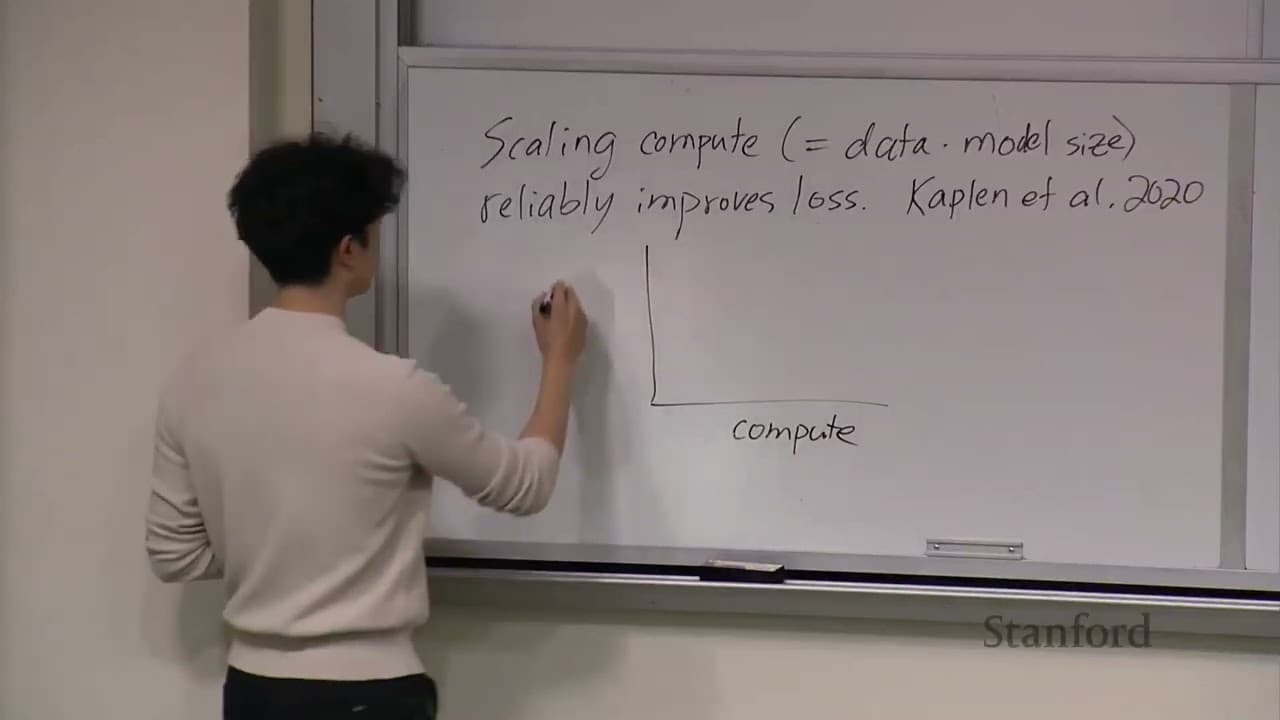
- Scaling compute and model size reliably improves model performance, as demonstrated by predictable decreases in loss.
- Individual tasks within language models can show emergent abilities, improving suddenly as model size increases.
- Emergent abilities are often unpredictable, with tasks showing no improvement until a certain model size is reached.
- Inverse scaling can occur, where larger models perform worse on specific tasks due to complex interactions between subtasks.
- Plotting scaling curves helps researchers understand the potential for further improvements in model performance.
- Exponential decreases in compute costs have been a dominant force driving AI advancements, enabling larger and more capable models.
- Understanding historical developments in transformer architectures helps predict future AI research directions.
Install to Summarize YouTube Videos and Get Transcripts
Explore YouTube Video Summarizer or Get YouTube Transcript Extractor
Questions & Answers
Q: How do language models learn multiple tasks?
Language models learn multiple tasks through next word prediction, which serves as a form of massive multi-task learning. By training on large datasets, models encounter various sentence structures and contexts, allowing them to learn grammar, semantics, world knowledge, and even specific tasks like sentiment analysis or translation. This training method enables models to generalize across numerous tasks, improving their overall capabilities.
Q: What causes emergent abilities in language models?
Emergent abilities in language models occur when individual tasks show sudden improvements as the model size increases. These abilities are often unpredictable, as smaller models may perform poorly on certain tasks until reaching a critical size, where performance dramatically improves. This phenomenon is linked to the model's capacity to learn complex relationships and subtasks within the data, which becomes possible with larger architectures and more compute.
Q: Why is scaling important in AI research?
Scaling is crucial in AI research because it allows models to achieve better performance by leveraging larger datasets and more compute power. As models scale, they exhibit improved capabilities and can tackle more complex tasks. The exponential decrease in compute costs has facilitated this scaling, enabling researchers to experiment with larger architectures and more data, leading to breakthroughs in AI capabilities, such as emergent abilities.
Q: How do scaling laws relate to language model performance?
Scaling laws describe the relationship between compute, model size, and performance, suggesting that as compute increases, model performance improves predictably. These laws help researchers anticipate how changes in model size or training data will impact performance, guiding the development of more capable models. However, while overall performance improves smoothly, individual tasks may exhibit emergent abilities, showing sudden improvements at specific model sizes.
Q: What is the role of inverse scaling in language models?
Inverse scaling refers to scenarios where larger language models perform worse on specific tasks compared to smaller models. This counterintuitive behavior can occur due to complex interactions between subtasks within the model. For example, a larger model may prioritize certain learned heuristics over others, leading to decreased performance on tasks that require different reasoning strategies. Understanding these interactions helps researchers refine model architectures and training approaches.
Q: Why is plotting scaling curves useful in AI research?
Plotting scaling curves is useful in AI research because it provides insights into how model performance changes with varying amounts of data and compute. By examining these curves, researchers can identify trends, such as the point at which additional data or compute yields diminishing returns. This information helps guide decisions about model architecture, training strategies, and resource allocation, ensuring efficient use of computational resources for maximum performance gains.
Q: How has compute cost influenced AI advancements?
The exponential decrease in compute costs has been a major driving force behind AI advancements, enabling researchers to train larger models on more data. This trend has allowed for the development of more complex and capable models, which can perform a wider range of tasks with greater accuracy. As compute becomes cheaper, researchers can explore new architectures and training methods, pushing the boundaries of what AI systems can achieve.
Q: What insights can be gained from studying transformer history?
Studying the history of transformer architectures provides insights into the evolution of AI research and the factors that have driven progress. By understanding the motivations behind key developments and how they became less relevant with increased compute, researchers can identify patterns and anticipate future trends. This historical perspective helps connect past and present advancements, offering a unified view that aids in projecting where the field is heading.
Summary & Key Takeaways
-
Language models achieve remarkable performance by leveraging next word prediction as a massively multi-task learning approach. This allows models to learn various tasks from large datasets, improving their capabilities as they scale.
-
As compute and model size increase, language models exhibit emergent abilities, where individual tasks improve suddenly. This phenomenon highlights the unpredictable nature of model scaling and its impact on task performance.
-
The exponential decrease in compute costs has been a driving force in AI research, enabling larger models and more complex tasks. Understanding the historical context of transformer architectures helps anticipate future developments.
Read in Other Languages (beta)
Share This Summary 📚
Summarize YouTube Videos and Get Video Transcripts with 1-Click
Try YouTube Summary with ChatGPT & Claude or YouTube Transcript Generator
Explore More Summaries from Stanford Online 📚






Summarize YouTube Videos and Get Video Transcripts with 1-Click
Try YouTube Summary with ChatGPT & Claude or YouTube Transcript Generator