Products
Features
YouTube Video Summarizer
Summarize YouTube videos
Web & PDF Highlighter
Highlight web pages & PDFs
Chat with PDF
Ask any PDF questions with AI
Ask AI Clone
Chat with your highlights & memories
Audio Transcriber
Transcribe audio files to text
Glasp Reader
Read and highlight articles
Kindle Highlight Export
Export your Kindle highlights
Idea Hatch
Hatch ideas from your highlights
Integrations
Obsidian Plugin
Notion Integration
Pocket Integration
Instapaper Integration
Medium Integration
Readwise Integration
Snipd Integration
Hypothesis Integration
Apps & Extensions
Chrome Extension
Safari Extension
Edge Add-ons
Firefox Add-ons
iOS App
Android App
Discover
Discover
Ideas
Discover new ideas and insights
Articles
Curated articles and insights
Books
Book recommendations by great minds
Posts
Essays and notes from readers
Quotes
Inspiring quotes collection
Videos
Curated videos and summaries
Explore Glasp
Glasp Newsletter
Weekly insights and updates
Glasp Talk
Interview series with great minds
Glasp Blog
Latest news and articles
Glasp Use Cases
Learn how others use Glasp
Build & Support
Glasp API
Access Glasp's API for developers
MCP Connector
Connect Glasp to Claude & ChatGPT
Community
Glasp Reddit Community
Students
Student discount and benefits
FAQs
Frequently Asked Questions
AboutPricing
DashboardLog inSign up

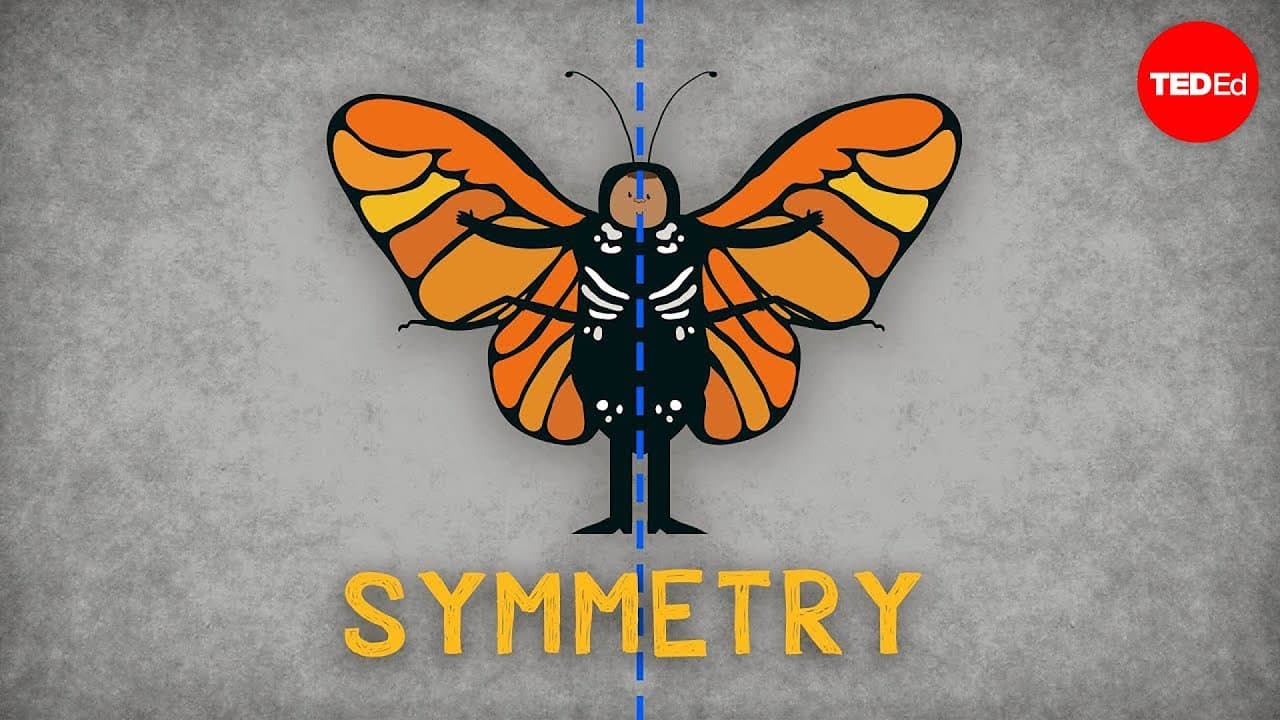
What Is Symmetry and Why Is It Important in Science?
703.5K views
•
May 13, 2014
by
TED-Ed
YouTube video player
What Is Symmetry and Why Is It Important in Science?

TL;DR

Symmetry is a property of an object that remains unchanged under specific transformations, crucial in fields like math, science, and biology. Different types of symmetry include rotational and bilateral symmetry, which can inform us about evolutionary relationships and the structure of living organisms.

Transcript

When you hear the word symmetry, maybe you picture a simple geometric shape like a square or a triangle, or the complex pattern on a butterfly's wings. If you are artistically inclined, you might think of the subtle modulations of a Mozart concerto, or the effortless poise of a prima ballerina. When used in every day life, the word symmetry represe... Read More

Key Insights

  • 🍃 Symmetry is a transformation that leaves an object unchanged.
  • 🅰️ Different objects can have different types of symmetry, such as rotational, bilateral, or radial symmetry.
  • 🔬 Symmetry is not only aesthetically pleasing but also essential for understanding and analyzing complex systems in math, science, and biology.
  • 🤕 Bilateral symmetry is prevalent in animals and is often associated with mobility and the development of a head.
  • ❓ The study of symmetries can provide insights into the evolutionary relationships between different organisms.
  • 🌲 Body symmetries can help biologists reconstruct the tree of life and understand the divergence of different branches.
  • 🖐️ Symmetry is a fundamental concept in mathematics and plays a significant role in fields such as physics, chemistry, and crystallography.

Install to Summarize YouTube Videos and Get Transcripts

Explore YouTube Video Summarizer or Get YouTube Transcript Extractor

Questions & Answers

Q: What is the definition of symmetry?

Symmetry is a property of an object that remains unchanged when transformed through a specific operation.

Q: What are the different types of symmetry?

There are various types of symmetry, including rotational symmetry, bilateral symmetry, and radial symmetry.

Q: Why do mathematicians and scientists care about symmetries?

Symmetries play a crucial role in areas such as physics, chemistry, crystallography, and pattern recognition, helping scientists understand and analyze complex systems.

Q: How can the study of symmetries help in understanding evolutionary relationships?

By analyzing the presence or absence of symmetry in different organisms, biologists can infer evolutionary relationships, such as shared ancestry or divergence.

Summary & Key Takeaways

  • Symmetry is the property of an object that remains unchanged under a transformation.

  • Different types of symmetries include rotational symmetry and bilateral symmetry.

  • Symmetry is essential in math, science, and biology for various applications and analyses.


Read in Other Languages (beta)

English

Share This Summary 📚

Summarize YouTube Videos and Get Video Transcripts with 1-Click

Download browser extensions on:

Try YouTube Summary with ChatGPT & Claude or YouTube Transcript Generator

Explore More Summaries from TED-Ed 📚
The myth of King Midas and his golden touch - Iseult Gillespie thumbnail
The myth of King Midas and his golden touch - Iseult Gillespie
TED-Ed
The myth of Hercules: 12 labors in 8-bits - Alex Gendler thumbnail
The myth of Hercules: 12 labors in 8-bits - Alex Gendler
TED-Ed
Why you procrastinate even when it feels bad thumbnail
Why you procrastinate even when it feels bad
TED-Ed
Can you solve the fish riddle? -  Steve Wyborney thumbnail
Can you solve the fish riddle? - Steve Wyborney
TED-Ed
Can you solve the penniless pilgrim riddle? - Daniel Finkel thumbnail
Can you solve the penniless pilgrim riddle? - Daniel Finkel
TED-Ed
History vs. Genghis Khan - Alex Gendler thumbnail
History vs. Genghis Khan - Alex Gendler
TED-Ed

Summarize YouTube Videos and Get Video Transcripts with 1-Click

Download browser extensions on:

Try YouTube Summary with ChatGPT & Claude or YouTube Transcript Generator

Apps & Extensions

  • Chrome Extension
  • Safari Extension
  • Edge Add-ons
  • Firefox Add-ons
  • iOS App
  • Android App

Key Features

  • YouTube Video Summarizer
  • Web & PDF Summarizer
  • Web & PDF Highlighter
  • Chat with PDF
  • Ask AI Clone
  • Audio Transcriber
  • Glasp Reader
  • Kindle Highlight Export
  • Idea Hatch

Integrations

  • Obsidian Plugin
  • Notion Integration
  • Pocket Integration
  • Instapaper Integration
  • Medium Integration
  • Readwise Integration
  • Snipd Integration
  • Hypothesis Integration

More Features

  • APIs
  • MCP Connector
  • Blog & Post
  • Embed Links
  • Image Highlight
  • Personality Test
  • Quote Shots

Company

  • About us
  • Blog
  • Community
  • FAQs
  • Job Board
  • Newsletter
  • Pricing
Terms

•

Privacy

•

Guidelines

© 2026 Glasp Inc. All rights reserved.