How Do Economics and Operations Research Interact?
TL;DR
Microeconomics and operations research interact through their shared use of mathematical reasoning to understand choices and improve decisions under constraints, risk, and imperfect information. Kenneth Arrow’s career connected both fields, from wartime flight planning and Stanford’s Operations Research Department to foundational research in general equilibrium, welfare theory, flexibility, learning, climate change, healthcare, and public policy.
Transcript
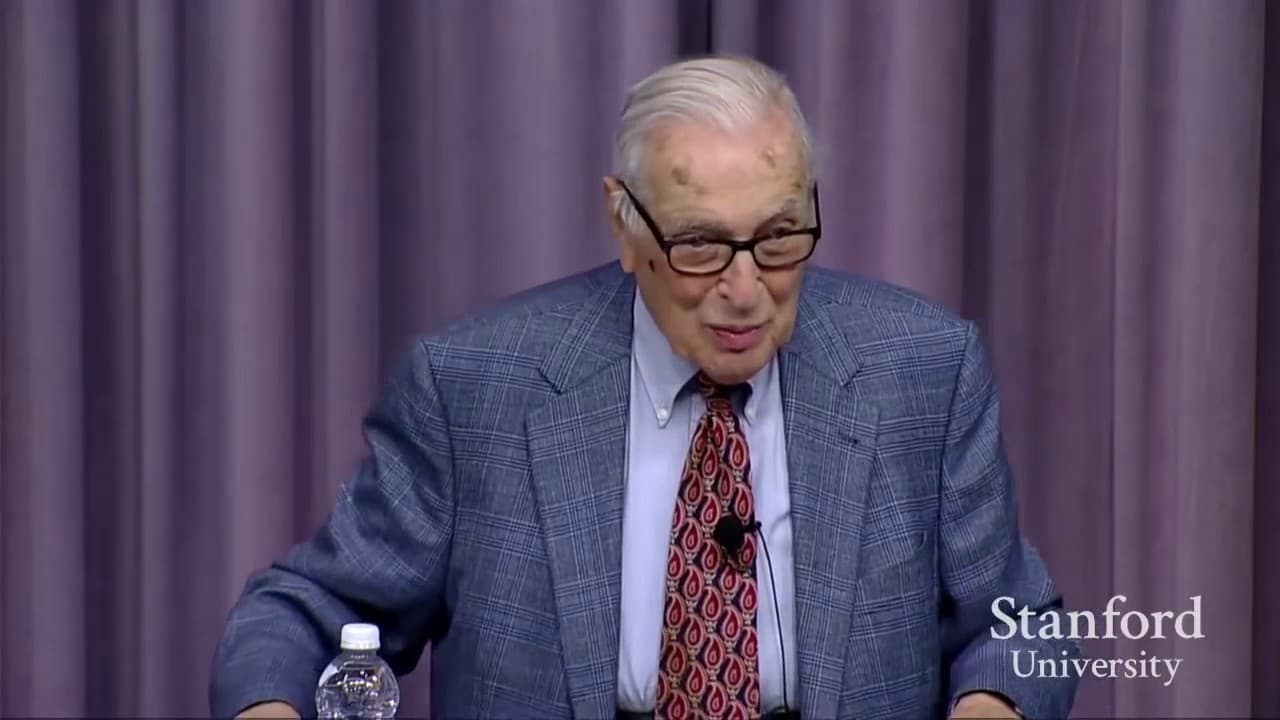
Good evening. I'm Jim Plummer, the Dean of the Engineering School, and I'd like to welcome all of you here this evening. Uh, we're here, of course, to celebrate, um, a very, very distinguished person that we're just, um, delighted and honored to have, and I'll introduce, uh, him in just a moment. But let me just begin by noting that the auditorium ... Read More
Key Insights
- Kenneth Arrow’s career connected microeconomics and operations research through mathematical approaches to individual behavior, organizational choices, resource allocation, and better decision-making. His Stanford appointments in economics, statistics, and operations research reflected that unusually broad intellectual position.
- Economic insecurity shaped Arrow’s early career planning. Growing up during the Great Depression led him to value security and flexibility, meaning preparation for alternative occupations when future employment conditions could not be known with confidence.
- Arrow initially intended to become a high school mathematics teacher because it appeared secure and comparatively well paid. He changed direction after learning that qualified applicants from the 1933 examination were still waiting for positions in 1940.
- Mathematical economics redirected Arrow from his original plan to pursue graduate work in statistics. A course in the subject, combined with the possibility of a graduate fellowship in economics, helped make economics the more attractive academic path.
- Operations research became part of Arrow’s work during the Second World War, when he served as a weather officer in the Army Air Corps. The field was expanding because military organizations needed efficient ways to deploy troops and materials.
- Arrow’s first published paper examined the optimal use of winds in flight planning. The research considered winds and the curvature of the Earth as factors in minimizing aircraft fuel consumption, and the lecture introduction says the work was still being used.
- General equilibrium theory and welfare theory were central to Arrow’s Nobel-recognized research. The introduction describes these theories as foundations for assessing business risk and evaluating government economic and welfare policies.
- Arrow applied economic theory to practical social and policy problems. The lecture introduction identifies racial discrimination, malaria drugs, climate change, innovation, and healthcare among his subjects, while also highlighting his research on decisions under imperfect information and the bearing of risk.
Install to Summarize YouTube Videos and Get Transcripts
Explore YouTube Video Summarizer or Get YouTube Transcript Extractor
Questions & Answers
Q: How did Kenneth Arrow connect economics and operations research?
Kenneth Arrow connected the fields through mathematical analysis of choices, constraints, risk, and resource allocation. His career included appointments in economics, statistics, and Stanford’s Operations Research Department, one of the departments later merged into Management Science and Engineering. His work ranged from wartime flight planning to general equilibrium, welfare theory, imperfect information, climate change, healthcare, innovation, and government policy.
Q: Why did Kenneth Arrow decide to study economics?
Kenneth Arrow originally entered graduate study intending to concentrate on statistics. His direction changed after he took a course in mathematical economics and encountered the possibility of receiving a graduate fellowship in economics. His earlier plan to teach high school mathematics had already become impractical because people who passed the 1933 teacher examination were still waiting for jobs in 1940.
Q: How did the Great Depression influence Kenneth Arrow’s career?
The Great Depression made economic security an important concern for Kenneth Arrow because his father moved from a comfortable position to living from hand to mouth. Arrow therefore considered careers that offered dependable employment and also valued flexibility, which meant preparing for different occupations because the future was uncertain. These concerns initially led him toward high school mathematics teaching and later toward graduate study.
Q: What was Kenneth Arrow’s first published research paper about?
Kenneth Arrow’s first published paper was titled “On the Optimal Use of Winds for Flight Planning.” It grew from his work as a weather officer in the Army Air Corps during the Second World War. The research considered how winds and the curvature of the Earth could be used to minimize aircraft fuel consumption, and the Stanford introduction states that the work was still used.
Q: What was Kenneth Arrow’s role at Stanford Engineering?
Kenneth Arrow joined Stanford in 1949 as an acting assistant professor in economics and statistics. He later became one of the founders and early faculty members of the Operations Research Department, which was eventually merged with other departments to form Management Science and Engineering. This institutional role, together with his research, explains why Stanford recognized an economist as a School of Engineering hero.
Q: Why did Kenneth Arrow receive the Nobel Prize in economics?
Kenneth Arrow received the Nobel Prize in economics with Sir John Hicks in 1972 for pioneering contributions to general equilibrium theory and welfare theory. The Stanford introduction says these theories underlie assessments of business risk and government economic and welfare policies. It also notes that, forty years afterward, Arrow remained the youngest person ever to have received the award.
Q: What practical problems did Kenneth Arrow study?
Kenneth Arrow applied economic theory to subjects with direct social, technological, and policy importance. The Stanford introduction lists the economics of racial discrimination, malaria drugs, climate change, innovation, and healthcare among the areas he examined. It also highlights his work on decision-making with imperfect information and on bearing risk, showing how his theoretical research addressed real choices and public concerns.
Q: How did Kenneth Arrow influence students and economic research?
Kenneth Arrow was described as an inspirational teacher whose influence extended beyond his own publications. According to the Stanford introduction, five of his former students later received Nobel Prizes. He also continued discussing future research with doctoral students, answering questions about his current work, promising ideas, and their topics, which illustrates a mentoring style centered on active intellectual exchange and forward-looking inquiry.
Summary & Key Takeaways
-
Kenneth Arrow’s path into economics began with mathematical talent, financial insecurity during the Great Depression, and an unsuccessful plan to become a high school mathematics teacher. Graduate study became the practical alternative, while a mathematical economics course and the prospect of an economics fellowship redirected him from statistics toward economics.
-
Military service interrupted Arrow’s graduate work and introduced him to operations research. As a weather officer in the Army Air Corps, he studied how winds and the Earth’s curvature could reduce aircraft fuel use. That work produced his first published paper, which the introduction says remained relevant to flight planning.
-
Arrow joined Stanford in 1949 and later became an early faculty member in its Operations Research Department, now represented within Management Science and Engineering. His research joined mathematical theory with practical concerns, including equilibrium, welfare, risk, imperfect information, discrimination, malaria drugs, climate change, innovation, healthcare, and government policy.
Read in Other Languages (beta)
Share This Summary 📚
Summarize YouTube Videos and Get Video Transcripts with 1-Click
Try YouTube Summary with ChatGPT & Claude or YouTube Transcript Generator
Explore More Summaries from Stanford Online 📚
Summarize YouTube Videos and Get Video Transcripts with 1-Click
Try YouTube Summary with ChatGPT & Claude or YouTube Transcript Generator