Biological Polymers: Crash Course Organic Chemistry #49
TL;DR
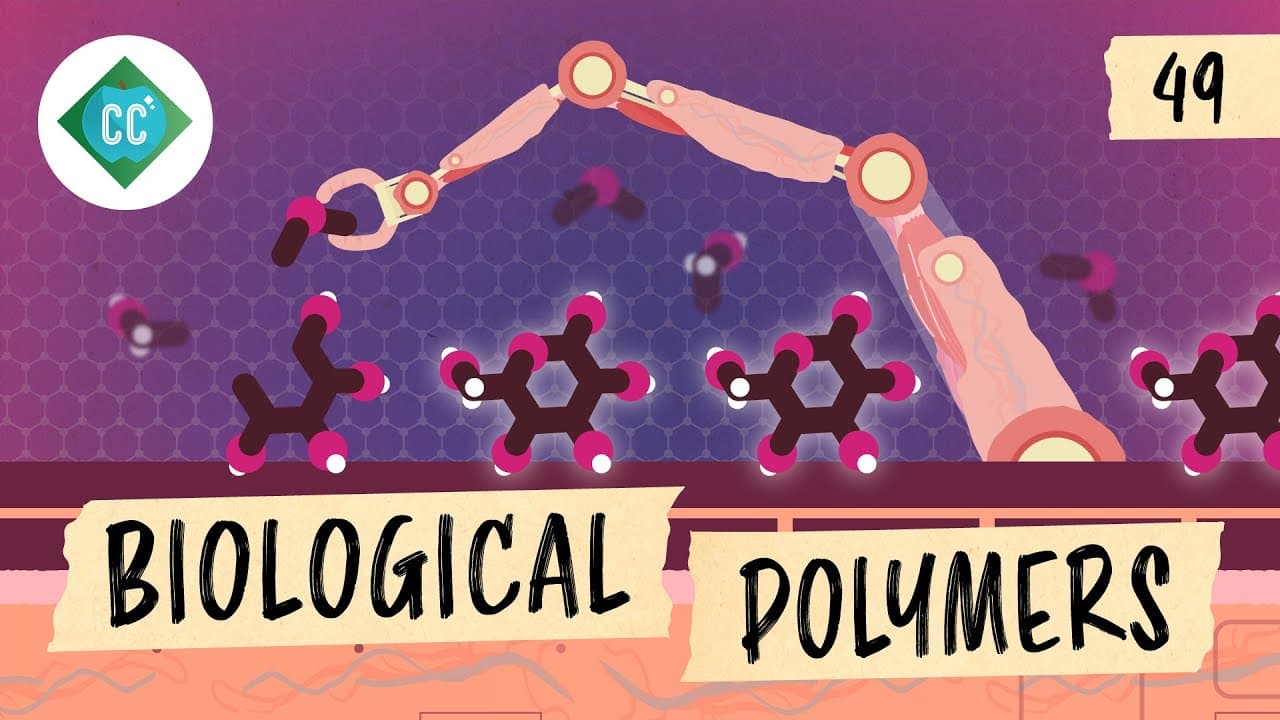
Our bodies are like self-regulating factories that use various biological polymers, such as lipids, carbohydrates, nucleotides, and proteins, to perform essential functions.
Transcript
You can review content from Crash Course Organic Chemistry with the Crash Course App, available now for Android and iOS devices. Hi! I’m Deboki Chakravarti and welcome to Crash Course Organic Chemistry! Imagine a huge factory that makes plushies. The factory is completely automatic, so when there’s enough material around, production begins. If we s... Read More
Key Insights
- 🖐️ Lipids play vital roles in cellular signaling, membrane formation, and energy storage.
- 💁 Carbohydrates provide energy storage in the form of disaccharides and polysaccharides and are important for plant and animal cells.
- 💁 Nucleotides are the building blocks of DNA and RNA, which carry genetic information and are involved in protein synthesis.
- ❓ Proteins have diverse functions, including enzyme catalysis, structural support, and cell signaling.
- ❓ Hydrophobic interactions, hydrogen bonding, ionic interactions, and disulfide bonds contribute to the stabilization of protein tertiary structure.
- 💁 DNA and RNA follow specific base pairing rules (A-T and G-C) and form double helices.
- 💁 The primary structure of proteins refers to the sequence of amino acids, while secondary structure involves the formation of alpha helices and beta sheets.
Install to Summarize YouTube Videos and Get Transcripts
Explore YouTube Video Summarizer or Get YouTube Transcript Extractor
Questions & Answers
Q: How do lipids contribute to energy storage in our bodies?
Lipids, such as triglycerides, are stored in fat cells and can be broken down to provide a significant amount of energy when needed, such as during periods of low food intake or prolonged physical activity.
Q: What is the difference between alpha-1,4-glycosidic and beta-1,4-glycosidic bonds in carbohydrates?
Alpha-1,4-glycosidic bonds result in the linear linkage of glucose molecules, as seen in maltose. Beta-1,4-glycosidic bonds create a bent conformation, as seen in lactose, due to the spatial arrangement of the hydroxyl groups.
Q: How do nucleotides polymerize to form DNA?
Nucleotides join together through an overall dehydration reaction, specifically between the phosphate of one nucleotide and the 3-prime hydroxyl group of another nucleotide's ribose sugar. This forms the backbone of DNA.
Q: What are the main interactions involved in protein tertiary structure?
Hydrophobic interactions, hydrogen bonding, ionic interactions, and disulfide bonds contribute to the stabilization of protein tertiary structure.
Summary & Key Takeaways
-
Lipids are important for cellular signaling, forming cell membranes, and long-term energy storage.
-
Carbohydrates provide energy storage in the form of disaccharides and polysaccharides like lactose, maltose, amylose, and glycogen.
-
Nucleotides are the building blocks of DNA and RNA, which carry encoded messages and help with protein production.
-
Proteins are diverse molecules that perform various functions in the body, including enzyme catalysis, structural support, and cell signaling.
Read in Other Languages (beta)
Share This Summary 📚
Summarize YouTube Videos and Get Video Transcripts with 1-Click
Try YouTube Summary with ChatGPT & Claude or YouTube Transcript Generator
Explore More Summaries from CrashCourse 📚



Summarize YouTube Videos and Get Video Transcripts with 1-Click
Try YouTube Summary with ChatGPT & Claude or YouTube Transcript Generator