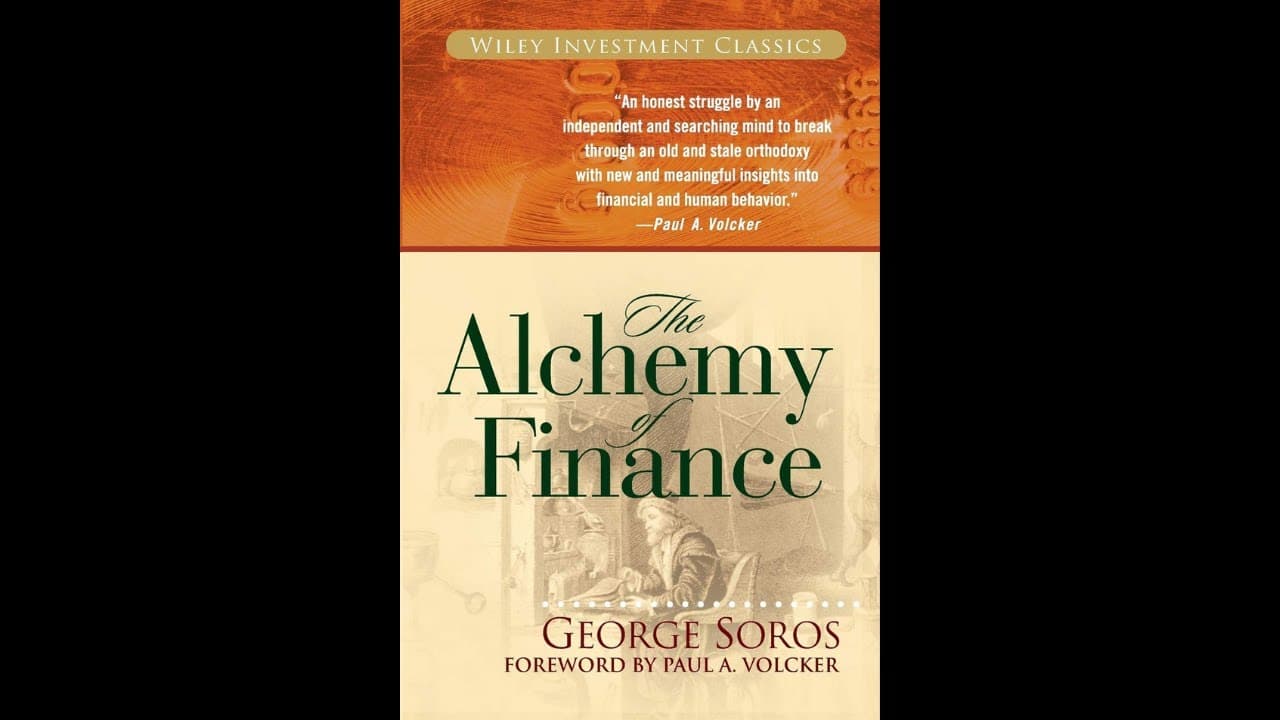
George Soros | The Alchemy Of Finance | Full Audiobook
TL;DR
George Soros’s theory of reflexivity says that market prices influence the fundamentals they appear to reflect, creating feedback loops between perceptions and reality. These loops can produce gradual booms, sudden busts, and unstable currency movements rather than equilibrium. Soros connects this framework to a fund that grew from about $4 million to nearly $2 billion, making the details worth reading on.
Transcript
the Alchemy of Finance reading the mind of the market by George Soros your reader is Grover Gardener introduction in a very real sense this book is my life's work it touches on many of my most abiding interests and it brings together the two main strands in my intellectual development one abstract and one practical the abstract came first ever sinc... Read More
Key Insights
- Reflexivity is a concept where market prices influence the fundamentals they are meant to reflect.
- The theory challenges the traditional view that markets naturally tend toward equilibrium.
- Boom and bust cycles are driven by the interaction between market prices and investor perceptions.
- Market participants' biases can shape economic outcomes, not just reflect them.
- Speculative capital flows can destabilize currency markets, leading to large fluctuations.
- Credit cycles exhibit an asymmetrical pattern, with gradual booms and sudden busts.
- Soros's investment success is partly attributed to understanding reflexivity in markets.
- Financial markets can be seen as a laboratory for testing hypotheses, similar to scientific methods.
Install to Summarize YouTube Videos and Get Transcripts
Explore YouTube Video Summarizer or Get YouTube Transcript Extractor
Questions & Answers
Q: What is George Soros’s theory of reflexivity in finance?
Reflexivity is the idea that market prices do not merely reflect economic fundamentals; they can also influence those fundamentals. Investors’ perceptions affect prices and economic outcomes, which then reshape those perceptions in an ongoing feedback loop.
Q: How does reflexivity create boom-and-bust cycles?
Investor perceptions and market conditions reinforce one another during a reflexive trend. This interaction can sustain a boom before reversing into a bust when expectations and conditions deteriorate.
Q: Why does Soros reject the idea that markets naturally reach equilibrium?
Soros argues that people act with imperfect understanding rather than perfect knowledge. Because participants’ perceptions help alter the situation they are trying to understand, equilibrium remains beyond reach in the real world.
Q: How does reflexivity affect currency markets?
Speculative capital flows can create self-reinforcing currency trends and large exchange-rate fluctuations. Because those flows respond to expectations about future rates, changes in investor perceptions can destabilize the market.
Q: Why are credit cycles asymmetrical?
Credit cycles commonly feature drawn-out, gradual booms followed by sudden busts. Expanding credit can raise economic activity and collateral values, encouraging further lending, while a slowdown can trigger falling collateral values, loan liquidations, and rapid contraction.
Q: How does reflexivity challenge traditional economic theory?
Traditional theory assumes rational behavior, perfect knowledge, and a tendency toward equilibrium. Soros argues that this elegant construction does not resemble a world where participants possess imperfect understanding and their perceptions affect events.
Q: What investment results does Soros describe in The Alchemy of Finance?
Soros says the hedge fund he started in 1969 grew from about $4 million at inception to nearly $2 billion. He also states that original investors saw their shares multiply 300-fold and that most of the growth was internally generated.
Q: Who wrote and narrated The Alchemy of Finance audiobook?
The Alchemy of Finance: Reading the Mind of the Market is by George Soros. The transcript identifies Grover Gardener as the reader.
Summary
In "The Alchemy of Finance: Reading the Mind of the Market" by George Soros, he discusses his life's work and the two main strands of his intellectual development - the abstract and the practical. Soros explores the limitations of economic theory and the concept of equilibrium, emphasizing the inherent bias and imperfect understanding of market participants. He introduces the idea of reflexivity, the interplay between the participants' thinking and the situation, and argues that financial markets operate in a non-equilibrium manner. Soros also discusses the connection between credit and collateral, as well as the reflexive relationship between regulators and the economy. He concludes by emphasizing that his book is not a practical guide to financial success, but rather an exploration of the complexities of financial markets and the need for a new understanding of the world we live in.
Questions & Answers
Q: How does Soros view economic theory and its approach to equilibrium?
Soros believes that economic theory's focus on equilibrium positions is deceptive and not applicable to the real world. While equilibrium is a useful concept, it is rarely observed in real-life market prices, which tend to fluctuate. The theory of perfect competition, based on the assumption of independently given supply and demand curves, is flawed because it does not account for the influence of participants' expectations and biases on market prices.
Q: Why does Soros argue that the assumption of perfect knowledge in economic theory is unrealistic?
Soros contends that perfect knowledge or even perfect information is unattainable in the real world. Participants in financial markets base their decisions on imperfect understandings of the situation, which are biased by their own perceptions. This inherent bias renders the assumption of perfect knowledge unrealistic and distorts economic analysis.
Q: What is reflexivity and how does it relate to financial markets?
Reflexivity refers to the interplay between the participants' thinking and the situation in which they participate. In financial markets, participants' perceptions and actions influence market prices, which, in turn, shape participants' expectations. There is a two-way connection between flawed perceptions and the actual course of events in financial markets, leading to a lack of correspondence between expectations and outcomes. This reflexive relationship challenges the idea of an equilibrium and contributes to market trends and fluctuations.
Q: How does Soros view the relationship between credit and collateral in financial markets?
Soros observes a reflexive connection between credit and collateral. Loans are based on the lender's estimation of the borrower's ability to repay, but the act of lending can also affect the value of the collateral. Credit expansion stimulates the economy and enhances collateral values, while credit contraction has a depressing influence. The connection between credit and economic activity is complex and variable, making it difficult to quantify. This reflexive interaction plays a crucial role in the dynamics of financial markets.
Q: What is the significance of the reflexive relationship between regulators and the economy?
Soros argues that regulators, as participants in the economy, have imperfect understanding and their actions can have unintended consequences. The relationship between regulators and the economy is reflexive and exhibits cyclical characteristics. The level of regulations tends to coincide with the level of credit expansion or contraction, and the interaction between the two cycles influences the shape and duration of both. This reflexive relationship challenges the assumptions of classical economics and highlights the complexities of macroeconomic developments.
Q: How does Soros differentiate his approach to investing from the prevailing wisdom?
Soros believes that markets are always biased and that market prices are always wrong in the sense that they present a distorted view of the future. While the prevailing view is that markets anticipate future developments accurately, Soros argues that present expectations are shaped by market participants' biases and perceptions, which influence the course of events. He takes a unique approach to investing, focusing on understanding and exploiting the reflexive processes in financial markets, rather than simply seeking to outperform the market averages.
Q: What does Soros believe is the relationship between financial markets and the real world?
Soros contends that financial markets operate as a laboratory for testing hypotheses about the real world. The prices and trends observed in financial markets reflect the participants' biases and expectations, which can influence the actual course of events. He challenges the notion that market prices mirror the state of affairs in the real world, arguing that valuation is a positive act that impacts the future by influencing market participants' behavior. Financial markets are not a reflection of a given reality but actively shape and influence the world we live in.
Q: How does Soros view the limitations of economic theory in understanding macroeconomic developments?
Soros argues that economic theory, with its focus on equilibrium and the assumption of perfect knowledge, is inadequate for understanding macroeconomic developments. Fluctuating exchange rates, large-scale capital movements, and the interplay between market developments and expectations challenge the assumptions of economic theory. He asserts that understanding macroeconomic processes requires considering the reflexive connections between market participants' thinking, market prices, and the actual course of events.
Q: What is Soros' view on the connection between credit cycles and regulatory cycles?
Soros suggests that credit cycles, characterized by periods of credit expansion and contraction, and regulatory cycles, characterized by the level of regulations, overlap in time. The relationship between the two cycles is reflexive and influences the shape and duration of both. The minimum of regulations tends to coincide with the maximum of credit expansion, and vice versa. However, the interaction between these cycles is unique and does not conform to regular or repetitive patterns. Soros acknowledges that the connection between credit cycles and regulatory cycles is tentative and requires further understanding.
Q: How does Soros believe the concept of reflexivity can contribute to a new understanding of the world?
Soros sees reflexivity as a fundamental force shaping historical processes and economic events. It connects facts to perceptions and perceptions to facts in a shoelace pattern. By recognizing the role of inherent bias and the interplay between participants' thinking and the situation, a new understanding of the world can be achieved. Soros believes that developing a theory of reflexivity could provide insights into the dynamics of financial markets, macroeconomic developments, and historical processes with thinking participants.
Q: What are the limitations of economic theory and the implications for understanding the real world?
Soros asserts that economic theory's focus on equilibrium and the assumption of perfect knowledge limit its relevance to the real world. Market prices are constantly changing and influenced by participants' biases and expectations. The assumption of independently given supply and demand curves fails to account for the reflexive relationship between market prices and participants' thinking. Understanding the real world requires a departure from hypothetical equilibrium and a focus on the process of change that can be observed in financial markets and other historical processes.
Takeaways
In "The Alchemy of Finance," George Soros challenges the traditional views of economic theory and its approach to equilibrium. He highlights the limitations of perfect knowledge assumptions and the inherently biased understanding of market participants. Soros introduces the concept of reflexivity, emphasizing the interplay between participants' thinking and the situation, which gives rise to market trends and fluctuations. He argues that financial markets operate in a non-equilibrium manner and play a crucial role in shaping economic and historical processes. Understanding the complexities of financial markets and macroeconomic developments requires a departure from traditional economic theory and a focus on the reflexive nature of market participants' thinking.
Summary & Key Takeaways
-
George Soros's theory of reflexivity suggests that market prices are not merely reflections of reality but actively shape it. This creates cycles of boom and bust, challenging traditional economic theories of equilibrium. Soros argues that market participants' biases influence economic outcomes, making financial markets inherently unstable.
-
In currency markets, speculative capital flows can lead to large fluctuations, destabilizing exchange rates. Soros emphasizes the importance of understanding reflexivity to navigate these markets effectively. His insights offer a new paradigm for financial trends and investment strategies.
-
Credit cycles exhibit an asymmetrical pattern, with gradual booms followed by sudden busts. Soros's success as an investor is partly due to his understanding of these dynamics. Financial markets, according to Soros, serve as a laboratory for testing hypotheses, similar to scientific methods.
Read in Other Languages (beta)
Share This Summary 📚
Summarize YouTube Videos and Get Video Transcripts with 1-Click
Try YouTube Summary with ChatGPT & Claude or YouTube Transcript Generator
Explore More Summaries from Investor Archive 📚


Summarize YouTube Videos and Get Video Transcripts with 1-Click
Try YouTube Summary with ChatGPT & Claude or YouTube Transcript Generator