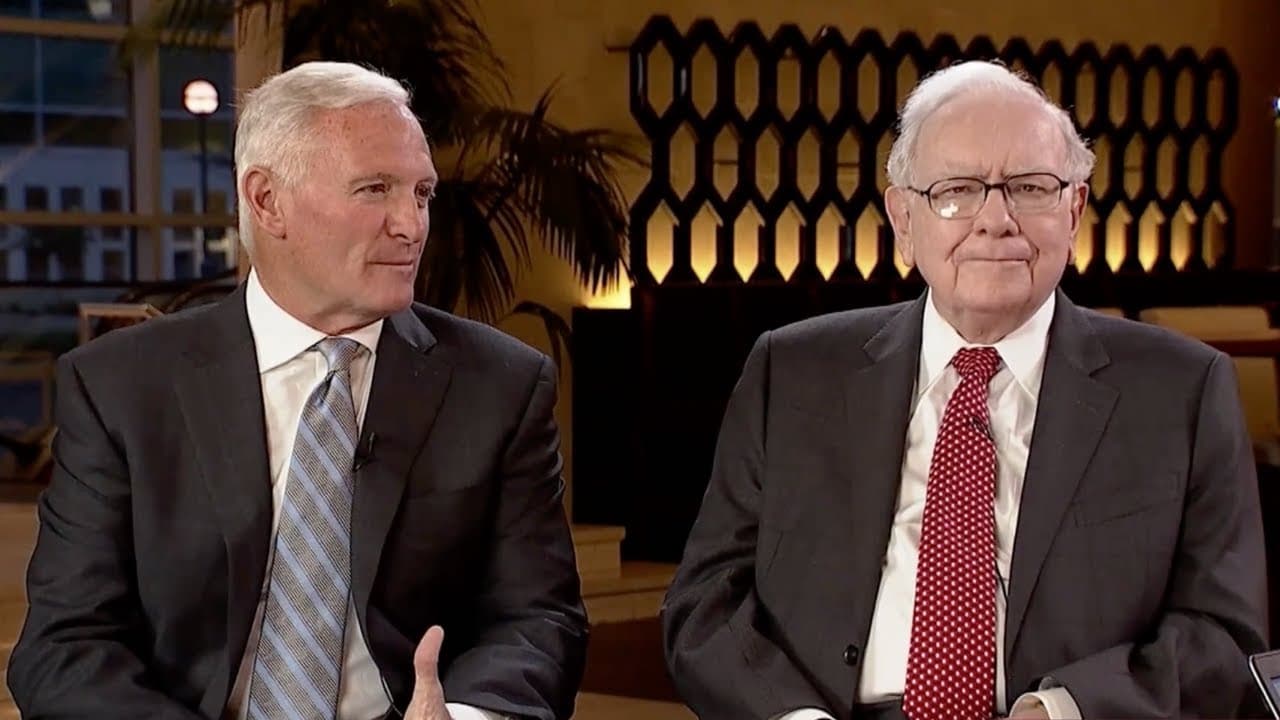
Warren Buffett On Pilot Flying J Deal & Wells Fargo Scandal | October 3, 2017
TL;DR
Low interest rates make stocks more attractive because investors compare expected business returns with yields on government bonds. Warren Buffett argues that stocks should outperform bonds over 30 years, while acknowledging that substantially higher rates would pressure stock valuations. Berkshire also adjusted the timing of gains and losses while awaiting a possible tax-rate change.
Transcript
we are here this morning with warren buffett the chairman and ceo of berkshire hathaway and warren we want to thank you very much for your time this morning thanks for having me you know we're just coming out of this story about las vegas and while unfortunately it seems that we as a nation are becoming more and more annual to hearing about shootin... Read More
Key Insights
- Interest rates are the primary yardstick for valuing financial assets because investors compare what an asset may return with available U.S. government bond yields. Lower rates reduce the gravitational pull on stock prices, while materially higher rates support lower equity valuations.
- Stocks are more attractive than bonds when the 10-year government yield is around 2.3 percent, according to Buffett's comparison. He states that, over 30 years, the S&P 500 should substantially outperform a 30-year bond yielding around 3 percent.
- A rise in the 10-year rate to 5 percent would likely make stocks somewhat cheaper. Buffett distinguishes between a modest increase of 100 basis points, which could leave stocks looking cheap, and an increase of 300 or 400 basis points, which would not.
- Buffett's investment process is based on buying businesses he likes rather than guessing short-term market movements. Although interest rates affect broad valuation standards, Berkshire cannot recall making ordinary investment decisions based on forecasts about the Federal Reserve.
- The Federal Reserve becomes exceptionally important during a financial panic because it possesses the power to stop a crisis from advancing. Buffett believed the Fed and other officials would act appropriately in the fall of 2008 to revive the country's economic machine.
- A 2 percent inflation objective offers bond savers little real return when the government borrows for 10 years at 2.3 percent. Buffett notes that this combination leaves investors with only a small return after accounting for the targeted decline in money's purchasing value.
- Tax-rate expectations can change the timing of investment sales even for Berkshire. A possible reduction in corporate or capital-gains rates encouraged consideration of realizing losses during October while deferring gains until the following year, when taxes might be lower.
- Tax-motivated selling can affect different stocks unevenly. Realizing losses may pressure shares that have performed badly, while deferring gains may reduce the number of sellers in highly appreciated stocks. Buffett says this consideration was an unusually rare factor at Berkshire.
Install to Summarize YouTube Videos and Get Transcripts
Explore YouTube Video Summarizer or Get YouTube Transcript Extractor
Questions & Answers
Q: How do low interest rates affect stock valuations?
Low interest rates generally support higher stock valuations because investors measure the expected return from businesses against the yield available from U.S. government securities. Buffett calls interest rates a gravitational force on asset prices. When the 10-year government yield is around 2.3 percent, stocks can look attractive, but a rise toward 5 percent would create a more demanding valuation environment.
Q: Why does Buffett expect stocks to outperform bonds?
Buffett expects stocks to outperform bonds over time because the government-bond yields discussed are low relative to the returns he expects from productive businesses. He says that, if he could hold a position for 30 years, he would prefer the S&P 500 over a 30-year bond yielding around 3 percent. His conclusion concerns long-term relative performance, not a short-term market forecast.
Q: What happens to stocks if the 10-year interest rate reaches 5 percent?
If the 10-year interest rate rose to 5 percent, Buffett believes stocks would probably become somewhat cheaper. Higher bond yields give investors a more attractive alternative and raise the return required from equities. He adds that stocks could still look cheap if rates rose only 100 basis points, but not if they increased by 300 or 400 basis points.
Q: Does Buffett invest based on Federal Reserve forecasts?
Buffett says Berkshire does not normally make investment decisions based on predictions about the Federal Reserve. He focuses on buying businesses he likes and does not attempt to guess the stock market. Investors who believe they can accurately forecast interest rates could act directly in the bond market, but Buffett does not claim that forecasting ability for himself.
Q: When does the Federal Reserve become most important?
The Federal Reserve becomes most important during a panic, when it has the authority and resources to prevent a financial crisis from worsening. Buffett describes the economic system in 2008 as a powerful machine in the hospital. He believed the Fed, alongside Bernanke, Paulson, and Geithner, would take the actions needed to help bring that machine out.
Q: Why did possible tax legislation affect Berkshire's selling decisions?
Possible tax legislation affected Berkshire because a lower future tax rate could make it costly to realize gains too early. Buffett gives the example of paying 35 percent on a gain now versus a possible 25 percent after waiting several months. Berkshire therefore considered taking losses sooner and delaying gains while watching whether legislation would change the applicable rates.
Q: How can anticipated tax cuts influence stock prices?
Anticipated tax cuts can influence stock prices by changing when investors choose to sell. Investors may realize losses before the end of the year, which can depress stocks that have already performed badly. They may also postpone selling appreciated holdings to defer gains, reducing current selling pressure in stocks with large increases. Buffett says this effect was operating at Berkshire.
Q: Why did Buffett think a tax bill might pass in 2017?
Buffett thought the probability of passage was higher than many people believed because health care legislation had failed and infrastructure action had not occurred. With Republicans controlling both houses and the presidency, he reasoned that they would not want their first year to end without completing a top priority. He described the proposal as a tax cut act, not a tax reform act.
Summary
In this video, Warren Buffet discusses various topics, including the recent shooting in Las Vegas, the market reaction to bad news, interest rates, the role of the Federal Reserve, taxes, and the current tax bill. He also talks about his confidence in Tim Sloan, CEO of Wells Fargo, and his views on the estate tax.
Questions & Answers
Q: What are Warren Buffet's thoughts on the recent shooting in Las Vegas?
Warren Buffet expresses his sympathy for the victims and praises the Las Vegas Metro Police for their quick response. He also acknowledges that there will always be a small percentage of people with dangerous intentions.
Q: Does Warren Buffet think current market valuations make sense?
According to Buffet, current market valuations make sense given the low interest rates. He explains that stocks are a better investment than bonds when interest rates are low.
Q: How does Warren Buffet view the impact of interest rates on the stock market?
Buffet sees interest rates as the most important factor in the stock market. He believes that over time, stocks will outperform bonds. However, he notes that interest rates have been lower for longer than expected, and the market is still waiting for them to rise.
Q: Does Warren Buffet think interest rates will continue to rise slowly over the next couple of years?
Buffet is unsure about the future direction of interest rates, but he believes that a move to a 5 percent rate would make stocks cheaper. However, he emphasizes that his investment strategy is focused on buying businesses he likes, rather than trying to guess the stock market or interest rate movements.
Q: Does Warren Buffet think the Federal Reserve's actions and interest rates are important for stock market investors?
Buffet believes that the Federal Reserve's actions and interest rates are important during times of panic and crisis, but are not as significant during normal times. He suggests that trying to predict the Fed's actions is not a productive investment strategy.
Q: Does Warren Buffet spend time thinking about who is running the Federal Reserve and its impact on stock prices?
Buffet does not spend time thinking about who is running the Federal Reserve, as he believes that the Fed is generally not that important for the stock market. However, he acknowledges that the Fed's actions can have a major impact during times of crisis.
Q: How does Warren Buffet view taxes and their impact on his investment decisions?
Buffet considers taxes when making investment decisions, especially when there are potential changes in tax rates. He explains that he may sell losses before the end of the year if there is a significant reduction in tax rates, as it can be beneficial to defer gains until the following year.
Q: Does Warren Buffet believe that current tax proposals will result in a tax cut or a tax reform?
Buffet believes that the current tax proposals are more about tax cuts than tax reform. He criticizes the elimination of the estate tax, arguing that it would allocate resources in a way that goes against what built America. He believes that dynastic wealth and inequality would increase as a result.
Q: What are Warren Buffet's thoughts on the corporate tax rate?
Buffet argues that the current corporate tax rate does not make companies uncompetitive globally since American businesses earn a high return on tangible equity. He also mentions that most companies do not pay the full tax rate due to various loopholes.
Q: What does Warren Buffet think a decrease in taxes would mean for the stock market?
According to Buffet, a decrease in taxes would increase corporate profits, which would likely result in higher stock prices. However, he affirms that the magnitude of the increase in earnings may not match the amount of the tax cut.
Takeaways
Warren Buffet believes that interest rates, taxes, and the actions of the Federal Reserve are important factors to consider when investing in the stock market. He emphasizes the importance of thinking long-term and buying good businesses. Buffet also expresses concerns about the concentration of wealth and the potential impact of tax cuts on inequality.
Summary & Key Takeaways
-
Buffett describes interest rates as a gravitational force on asset prices. With the 10-year U.S. government yield around 2.3 percent, he considers stocks more attractive than bonds. If that yield rose to 5 percent, stocks would likely become cheaper because investors would apply a more demanding valuation standard.
-
Buffett does not try to forecast short-term stock-market movements or make investment decisions based on routine Federal Reserve signals. He buys businesses he likes and focuses on long-term economics. He views the Fed as exceptionally important during a panic, citing its power to support the economic system during the fall of 2008.
-
Possible tax legislation affected Berkshire's behavior because lower future tax rates could reward delaying gains and realizing losses sooner. Buffett believed a tax cut had a meaningful chance of passing after health care and infrastructure efforts had not succeeded. He characterized the proposal as a tax cut rather than comprehensive tax reform.
Read in Other Languages (beta)
Share This Summary 📚
Summarize YouTube Videos and Get Video Transcripts with 1-Click
Try YouTube Summary with ChatGPT & Claude or YouTube Transcript Generator
Explore More Summaries from Investor Archive 📚
Summarize YouTube Videos and Get Video Transcripts with 1-Click
Try YouTube Summary with ChatGPT & Claude or YouTube Transcript Generator