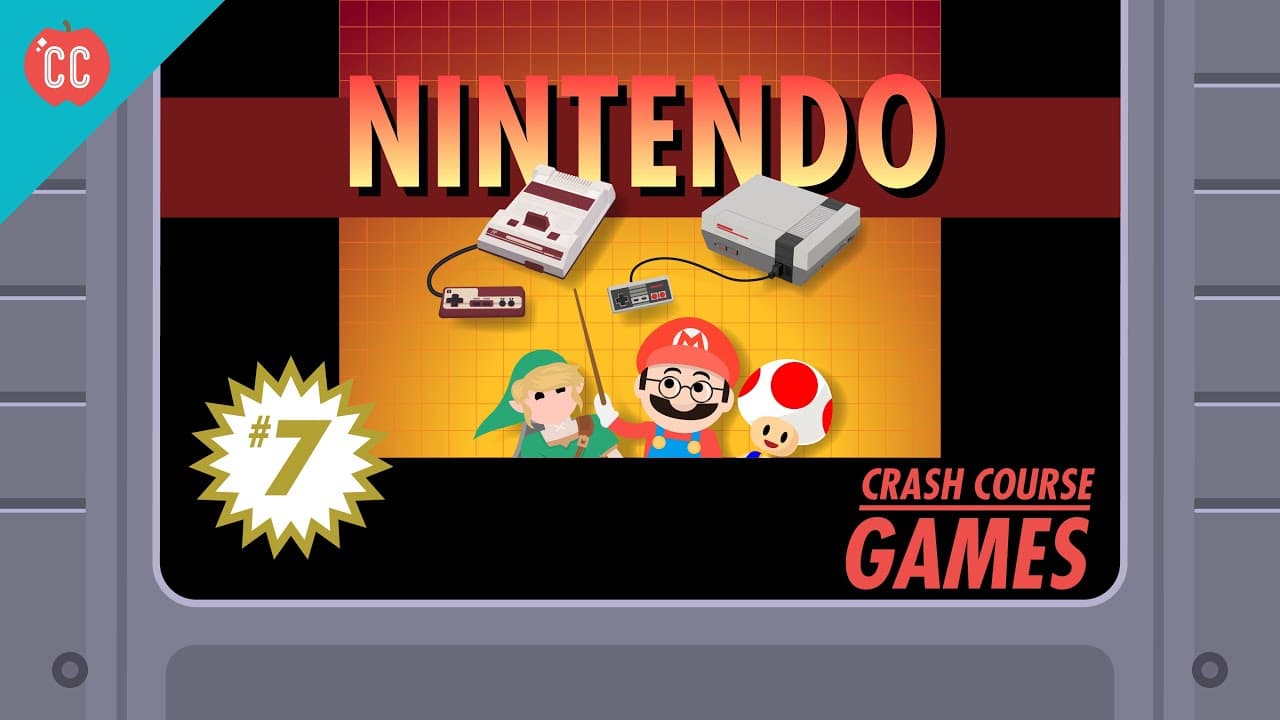
Nintendo and a New Standard for Video Games: Crash Course Games #7
TL;DR
Nintendo revived the video game industry in the 1980s with innovation and quality.
Transcript
Hi, I'm Andre Meadows and this is Crash Course Games. Today we're gonna talk about the second half of the 1980s, when the video game industry was reborn, largely due to the influence of Nintendo. Now, after the great North American video game crash in 1983, which was called "The Atari Shock" in Japan, the video game console industry in the United S... Read More
Key Insights
- Nintendo revitalized the video game industry after the 1983 crash by introducing the NES, emphasizing quality and innovation.
- Nintendo's strategic marketing and rebranding efforts helped distance the NES from the negative perceptions of past video game failures.
- The company's strict quality control measures, including the Seal of Quality, ensured that only high-quality games were released for the NES.
- Nintendo created a strong community and brand loyalty through initiatives like the Nintendo Fun Club and Nintendo Power magazine.
- Iconic games like Super Mario Bros., The Legend of Zelda, and Metroid set new standards for gameplay complexity and storytelling.
- Nintendo's innovative console design and accessories, like the NES Zapper and R.O.B., contributed to its widespread appeal.
- By 1989, Nintendo dominated the U.S. video game market with a 75-80% share, showcasing its successful market strategy.
- The introduction of open-world and exploratory gameplay in titles like The Legend of Zelda and Metroid offered players unprecedented freedom.
Install to Summarize YouTube Videos and Get Transcripts
Explore YouTube Video Summarizer or Get YouTube Transcript Extractor
Questions & Answers
Q: How did Nintendo manage to revive the video game industry after the 1983 crash?
Nintendo revived the video game industry by introducing the NES, which emphasized quality and innovation. They distanced the console from past failures by rebranding it as a 'Control Deck' and implementing strict quality controls through the Seal of Quality, ensuring only high-quality games were released.
Q: What were some of the key strategies Nintendo used to ensure the NES's success in the market?
Nintendo's strategies included rebranding the NES to avoid negative associations, marketing it in toy stores, and implementing strict quality controls. They fostered a community through the Nintendo Fun Club and Nintendo Power magazine, which helped build brand loyalty and engage players.
Q: How did Nintendo's game design differ from previous video games?
Nintendo's game design introduced complex narratives and open-world exploration, as seen in games like The Legend of Zelda and Metroid. These games offered players freedom to explore and engage with intricate storylines, setting new standards for gameplay depth and player engagement.
Q: What role did Nintendo Power magazine play in the company's success?
Nintendo Power magazine played a significant role by creating a community around Nintendo's games. It provided players with gameplay tips, news, and exclusive content, fostering loyalty and engagement. The magazine helped players connect with each other and the brand, enhancing Nintendo's market presence.
Q: In what ways did Nintendo ensure the quality of games released for the NES?
Nintendo ensured game quality through the Seal of Quality, which required third-party developers to adhere to strict standards. They limited the number of games developers could release yearly and used technology like the 10NES chip to control game compatibility, maintaining high-quality standards.
Q: What impact did games like Super Mario Bros. and The Legend of Zelda have on the gaming industry?
Games like Super Mario Bros. and The Legend of Zelda had a profound impact by introducing engaging characters, complex narratives, and expansive worlds. They set new benchmarks for game design, captivating players and demonstrating the potential of video games as a storytelling medium.
Q: How did Nintendo's approach to marketing differ from previous video game companies?
Nintendo's marketing approach involved rebranding the NES to avoid negative perceptions, emphasizing its role as a family-friendly entertainment system. They marketed it in toy stores rather than electronics stores and created engaging promotional materials, which helped build a positive and approachable brand image.
Q: What technological innovations did Nintendo introduce with the NES?
The NES introduced several technological innovations, such as front-loading cartridges, a sleek gray design, and accessories like the NES Zapper and R.O.B. These innovations, along with advanced graphics and sound capabilities, set the NES apart from previous consoles and contributed to its success.
Summary & Key Takeaways
-
Nintendo's introduction of the NES in the mid-1980s marked a pivotal moment in the video game industry, reviving it after a significant crash. The company emphasized quality and innovation, setting new standards for gaming.
-
Through strategic marketing and the introduction of iconic games, Nintendo created a loyal fanbase and dominated the U.S. market. Initiatives like Nintendo Power magazine fostered a strong community among players.
-
The NES's success was driven by its unique design, quality control measures, and groundbreaking games that offered complex narratives and open-world exploration, revolutionizing player engagement and expectations.
Read in Other Languages (beta)
Share This Summary 📚
Summarize YouTube Videos and Get Video Transcripts with 1-Click
Try YouTube Summary with ChatGPT & Claude or YouTube Transcript Generator
Explore More Summaries from CrashCourse 📚






Summarize YouTube Videos and Get Video Transcripts with 1-Click
Try YouTube Summary with ChatGPT & Claude or YouTube Transcript Generator