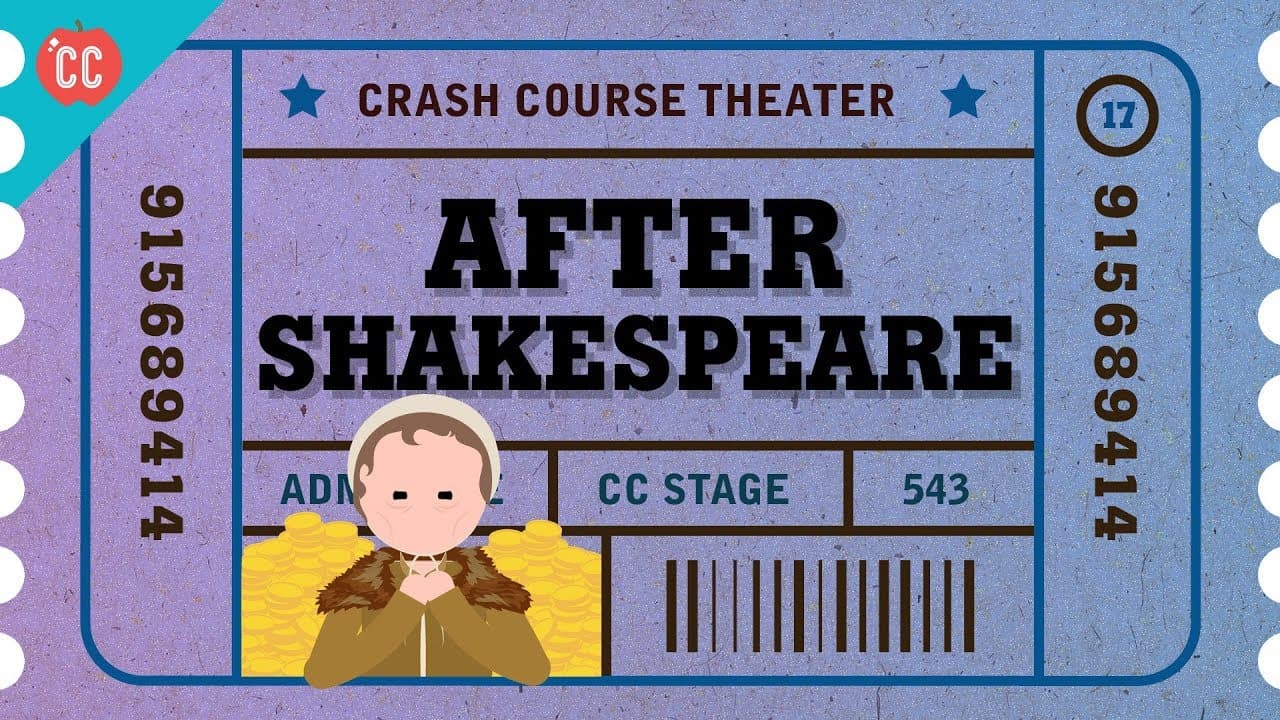
English Theater After Shakespeare: Crash Course Theater #17
TL;DR
English theater after Shakespeare developed through Ben Jonson’s skeptical city comedies, increasingly violent revenge tragedies, and elaborate Caroline court masques. Jonson’s Volpone uses animal-named characters to expose greed and deception, while Jacobean and Caroline tragedies favor lurid violence and moral darkness. Court masques brought nobles into sumptuous theatrical spectacles before Puritan opposition contributed to theater’s decline. Read on to see how these forms transformed English drama.
Transcript
Thanks to CuriosityStream for supporting PBS Digital Studios. Hey there, I'm Mike Rugnetta. This is Crash Course Theater and believe it or not, theater in England doesn't end with Shakespeare. Nope, it's going to take some buzzkill Protestants to shut down that iambic-pentama-party. But, we're going to meet them next time. Today we're going to look... Read More
Key Insights
- Ben Jonson, a contemporary of Shakespeare, is known for his witty, wordy plays, often filled with political satire and personal attacks, making them controversial.
- Jonson's 'Volpone' is a skeptical comedy about human nature, focusing on characters behaving like animals, highlighting greed and deception.
- Revenge tragedies, influenced by Seneca, became popular, characterized by violence, moral ambiguity, and meta-theatrical elements, with plays like 'The Revenger's Tragedy' and 'Tis Pity She's a Whore'.
- Shakespeare's 'Hamlet' elevated the revenge tragedy genre by exploring the moral dilemmas of revenge and making the audience empathize with the protagonist.
- Jacobean tragedies are noted for their extreme violence and dark themes, often seen as a critique of societal norms or simply for shock value.
- Court masques were elaborate performances for and by nobles, emphasizing existing power structures and featuring sumptuous costumes and scenery.
- Ben Jonson collaborated with Inigo Jones on court masques, combining Jonson's writing with Jones's innovative stage designs, although they eventually disagreed on the importance of words versus visuals.
- Theater in England faced decline due to Puritan opposition, following a historical cycle of theatrical evolution from simplicity to decadence and eventual suppression.
Install to Summarize YouTube Videos and Get Transcripts
Explore YouTube Video Summarizer or Get YouTube Transcript Extractor
Questions & Answers
Q: How did English theater develop after Shakespeare?
English theater continued through Ben Jonson’s witty city comedies, violent Jacobean and Caroline revenge tragedies, and elaborate Caroline court masques. These forms moved from skeptical social comedy toward darker spectacle, while Puritan opposition eventually contributed to theater’s decline in England.
Q: Who was Ben Jonson, and what kind of plays did he write?
Ben Jonson, born in 1572, was an English Renaissance playwright associated with Shakespeare and Christopher Marlowe. He specialized in witty, wordy city comedies filled with contemporary references, political passages, and personal attacks that frequently got him into trouble.
Q: What were Ben Jonson’s Comedies of the Humours?
Jonson’s Comedies of the Humours drew on the theory that bodies contained black bile, yellow bile, blood, and phlegm. One or two supposedly dominant humours determined whether a person was bilious, choleric, sanguine, or phlegmatic, giving Jonson a framework for sharply defined comic personalities.
Q: What is Ben Jonson’s Volpone about?
Volpone pretends to be dying so that Voltore, Corbaccio, and Corvino will bring him gifts in hopes of inheriting his fortune. Assisted by his servant Mosca, he later fakes his death and names Mosca as heir, but the scheme collapses in court and both men are punished.
Q: How is Volpone different from Shakespeare’s comedies?
Volpone is compact and elegantly plotted, but its characters have less nuanced psychology and embody animals such as the fox, fly, vulture, raven, and crow. Its morality is less ambiguous and its tone less hopeful, so audiences laugh at characters trying to outdo one another in terrible behavior.
Q: What are the main characteristics of English revenge tragedy?
English revenge tragedy borrowed its form from Seneca but emphasized lurid forms of murder, blood, and moral darkness. The episode associates the genre with incest, werewolves, poisoned objects, and plays such as Thomas Kyd’s The Spanish Tragedy and the 1606 work The Revenger’s Tragedy.
Q: How did Shakespeare’s Hamlet elevate revenge tragedy?
Hamlet elevated revenge tragedy by examining whether revenge is morally right rather than treating violence as the only focus. Its protagonist’s internal struggle encourages the audience to empathize with him and makes moral questioning central to the tragedy.
Q: What were Caroline court masques, and who created them?
Caroline court masques were elaborate performances for and by nobles, featuring allegorical scenes, music, sumptuous costumes, and scenery that reinforced existing power structures. Ben Jonson supplied writing and Inigo Jones developed innovative stage designs, though they eventually disagreed over whether words or visuals mattered more.
Summary & Key Takeaways
-
The episode explores the evolution of English theater post-Shakespeare, focusing on Ben Jonson's works, revenge tragedies, and court masques. Jonson's comedies, like 'Volpone', are noted for their wit and critique of human nature. Revenge tragedies, influenced by Seneca, are characterized by violence and moral ambiguity.
-
Shakespeare's 'Hamlet' is highlighted for elevating the revenge tragedy genre by exploring moral dilemmas. Jacobean tragedies are extreme, critiquing societal norms or providing shock value. Court masques were elaborate performances for nobles, emphasizing power structures and featuring innovative stage designs by Inigo Jones.
-
The episode concludes with the decline of theater in England due to Puritan opposition, following a historical cycle of theatrical evolution. The discussion includes the collaboration between Jonson and Jones on court masques and the eventual disagreement on the importance of words versus visuals in theater.
Read in Other Languages (beta)
Share This Summary 📚
Summarize YouTube Videos and Get Video Transcripts with 1-Click
Try YouTube Summary with ChatGPT & Claude or YouTube Transcript Generator
Explore More Summaries from CrashCourse 📚
Summarize YouTube Videos and Get Video Transcripts with 1-Click
Try YouTube Summary with ChatGPT & Claude or YouTube Transcript Generator