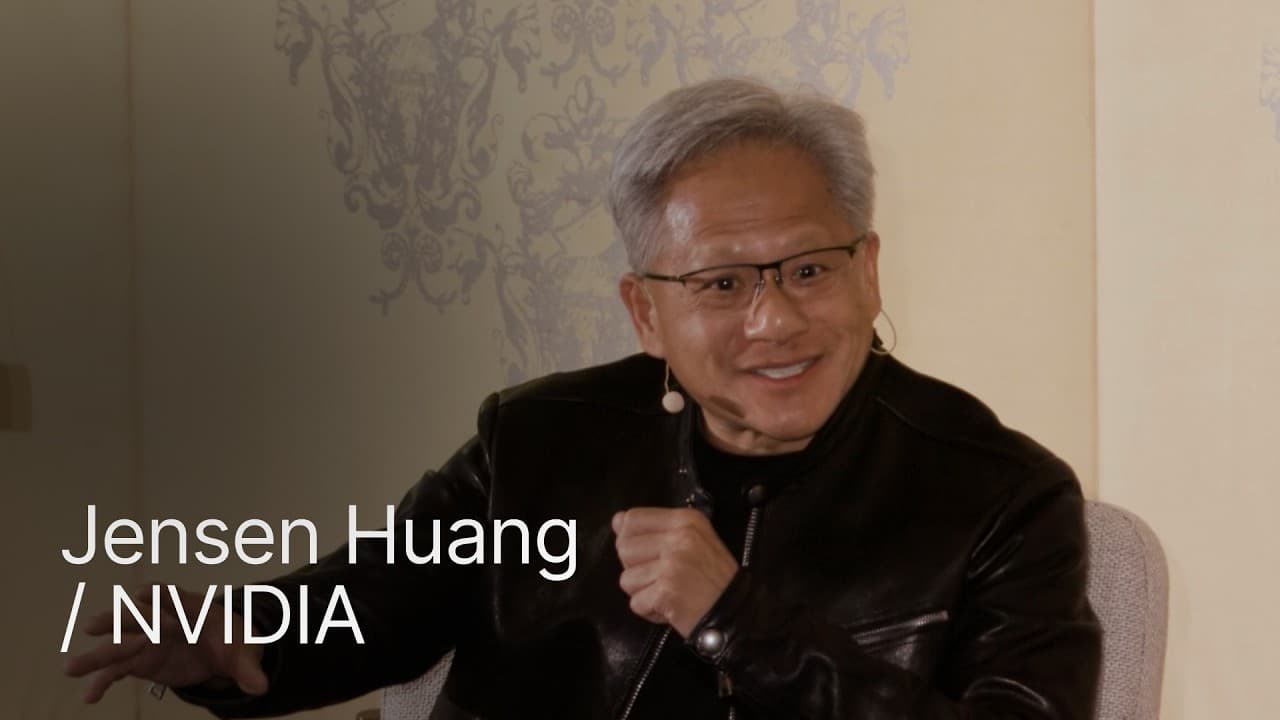
Jensen Huang on Why AI Factories Matter
TL;DR
AI factories turn electricity into tokens of intelligence, enabling computers to generate customized words, images, video, and useful work in real time instead of merely retrieving stored files. Jensen Huang argues that this shift creates opportunities across five investment layers and that workers who use AI will have an advantage over those who do not.
Transcript
Thank you so much, Jensen. So, uh we are in the middle of a massive AI revolution. Uh it is probably bigger and faster than even the industrial revolution and you have called out what's happening right now as the largest infrastructure buildout in human history. At the center of that buildout is the AI factory and the company enabling all of that i... Read More
Key Insights
- Generative AI is a system for translating information from one form into another, such as text to text, text to image, or image to text. Its capabilities have progressed from basic generation toward reasoning, problem solving, and useful action.
- Reasoning is enabled by generation because an AI system must generate internal thoughts and intermediate steps to think through a problem. This foundation allows modern systems to move beyond understanding information and toward completing work.
- Agentic AI is valuable because it can reason, use digital tools, and produce useful work. Huang contrasts this capability with early chatbots, which were interesting but less economically valuable because they primarily generated information rather than performed tasks.
- Modern computing is shifting from retrieval to generation. Traditional data centers primarily store files and retrieve them through systems such as recommenders, while generative computers create original outputs in real time from a user’s context, query, and circumstances.
- Personalized generation means that different people can receive different words, images, advertisements, stories, sounds, and videos. The output reflects who is asking, why they are asking, how they ask, and the context supplied to the AI.
- AI factories are large computers that generate intelligence. Huang describes them as the dynamos of the intelligence age because they take in electrical energy and produce tokens that can support digital work, industrial activity, and eventually mechanical control.
- AI investment spans five connected layers: energy, chips, infrastructure, models, and applications. The framework encourages investors and enterprises to examine both downstream industry effects and the upstream systems required to produce intelligence at scale.
- AI changes tasks without necessarily eliminating a job’s underlying purpose. The examples of radiology and software engineering support Huang’s argument that automation can raise demand, while workers face greater risk from other people who use AI effectively.
Install to Summarize YouTube Videos and Get Transcripts
Explore YouTube Video Summarizer or Get YouTube Transcript Extractor
Questions & Answers
Q: What is an AI factory and what does it produce?
An AI factory is a large computing system designed to generate intelligence rather than simply store and retrieve data. Huang describes it as a machine that takes in electrical energy and sends out tokens of intelligence. Those tokens can become customized words, images, video, decisions, tool commands, or other useful outputs produced in response to current context and queries.
Q: How is generative computing different from traditional computing?
Traditional computing is largely retrieval-based: people create programs, documents, photographs, music, and videos, save them as files, and retrieve them later. Generative computing creates outputs in real time. It interprets a new prompt and its context, reasons about the request, and produces an original response suited to the particular user and circumstance.
Q: Why did generative AI lead to reasoning systems?
Generative AI made reasoning possible because thinking requires the production of internal words or intermediate steps. A system that can generate these steps can reason through a problem instead of only translating an input into an output. This capability supports step-by-step problem solving and allows AI to determine how to use tools to accomplish a task.
Q: What makes agentic AI economically valuable?
Agentic AI is economically valuable because it can perform useful work rather than merely understand a prompt or produce entertaining text. It can reason, use tools such as browsers, spreadsheets, presentation software, image editors, and design applications, and complete tasks. Huang argues that people pay for completed work, making capable agents the basis of rapidly growing software businesses.
Q: How could AI agents work together inside a company?
AI agents can communicate with one another, divide work, and team up to solve company problems. Once an agent can operate independently, it can identify tasks that require help from other specialized agents and coordinate their contributions. Huang says NVIDIA already makes extensive use of agentic AI, with hundreds of thousands of agents potentially operating within the company.
Q: What are the five layers of AI investment?
The five layers identified in the description are energy, chips, infrastructure, models, and applications. Each layer supports the next: energy powers computation, chips execute it, infrastructure organizes the computing capacity, models generate intelligence, and applications apply that intelligence to useful tasks. The framework helps investors examine both upstream requirements and downstream commercial opportunities.
Q: Will AI eliminate jobs according to Jensen Huang?
Huang argues against treating jobs as fixed bundles of tasks that disappear when some activities are automated. The video uses radiology and software engineering to illustrate how automation can increase labor demand instead of destroying it. His practical conclusion is that a person is less likely to lose a job directly to AI than to someone who uses AI effectively.
Q: Why does personalized AI require more computing infrastructure?
Personalized AI generates each output for the user’s specific identity, interests, purpose, wording, and context. Rather than retrieving the same stored story, image, advertisement, sound, or video for everyone, the system may create a different version for each request. Producing original content repeatedly requires many generators, which creates demand for large computers and AI factories.
Summary & Key Takeaways
-
Computing is shifting from retrieving stored files to generating original content in real time. AI combines a user’s context and query, reasons about the circumstances, and produces a customized response. Huang expects future words, images, sounds, advertisements, stories, and videos to be generated for each person rather than uniformly retrieved.
-
Generative AI began with systems that could understand and translate information across formats, including text, images, and other media. Its deeper importance is that generation supports internal reasoning, step-by-step problem solving, and tool use. These abilities have produced agentic systems that can perform useful work and collaborate with other agents.
-
AI factories are presented as the infrastructure that produces intelligence by converting electrical energy into tokens. Huang maps the opportunity across five layers: energy, chips, infrastructure, models, and applications. He argues that AI will transform industries and tasks while increasing the value of people who learn to use it effectively.
Read in Other Languages (beta)
Share This Summary 📚
Summarize YouTube Videos and Get Video Transcripts with 1-Click
Try YouTube Summary with ChatGPT & Claude or YouTube Transcript Generator
Explore More Summaries from Sequoia Capital 📚





Summarize YouTube Videos and Get Video Transcripts with 1-Click
Try YouTube Summary with ChatGPT & Claude or YouTube Transcript Generator