How to Improve Morning Mobility With Yoga
TL;DR
Start with gentle floor stretches, then progress through hip rotations, squats, spinal movements, Downward Facing Dog, twists, lunges, and supported standing poses. Use slow breathing and bodily feedback to adjust every shape, keeping options such as lifted heels, lowered knees, or supported hands whenever stiffness or energy levels make a deeper variation unsuitable.
Transcript
Top of the morning! Welcome to Yoga with Adriene. Thank you so much for being here. I'm Adriene, this is sweet Benji. And today we have a Morning Mobility Practice. So hop into something comfy and let's get started. All right, let's start on our backs. Come on down to the ground. Right away, big “good morning” stretch. So take the arms up and overh... Read More
Key Insights
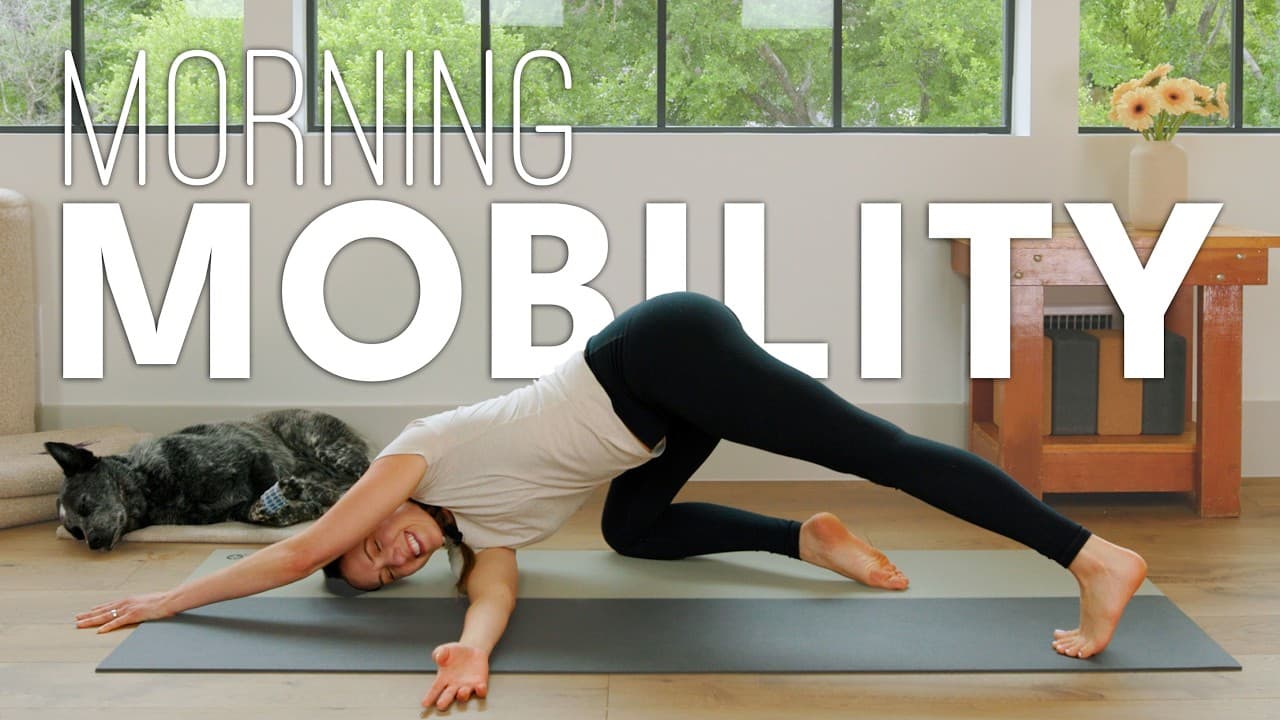
- • The practice is a 22-minute morning mobility sequence designed to circulate synovial fluid, reduce stiffness and tension, and enhance range of motion for daily activities. It combines gentle stretching, dynamic yoga movement, strength, balance, and attention to physical and mental sensations.
- • Body feedback is the primary guide for choosing each variation. Practitioners are repeatedly encouraged to listen to sensations, energy, and breathing, then remain in a supported position or explore additional movement depending on what feels appropriate in their bodies.
- • The opening floor sequence mobilizes several areas before weight-bearing movement begins. Full-body extension, knee circles, hamstring stretches, ankle rotations, and thread-the-needle shapes gradually address the legs and hips while allowing the breath to remain soft and steady.
- • Hip mobility is developed through both internal and external rotation. Windshield-wiper legs, supported squatting, stacked-hip three-legged dog, Lizard Pose, and low-lunge variations explore different directions while offering adjustments such as raised heels, lowered knees, or hand support.
- • Spinal and shoulder mobility is supported by Cat-Cow, threaded twists, Puppy Pose, and Downward Facing Dog. Exhalation cues spinal rounding, chest release, and heart-space lowering, while practitioners are asked to maintain steady breathing and avoid forcing a deeper position.
- • Core engagement helps control the dynamic transitions. Knee-to-elbow and repeated knee-to-nose movements connect three-legged dog with forward shifts, asking practitioners to press evenly through both palms and use the core as the leg travels forward.
- • Pelvic alignment is emphasized in the abbreviated Warrior Two sequence. The tailbone lengthens downward, the head, heart, and pelvis form a centered stack, and small forward shifts are performed without overextending before returning to the central alignment.
- • The practice is presented as suitable for all levels because multiple options accompany demanding shapes. Froggy can replace a deeper Malasana, the back knee can stay lowered in Lizard Pose, and practitioners can use palms, fingertips, forearms, or extended legs according to comfort.
Install to Summarize YouTube Videos and Get Transcripts
Explore YouTube Video Summarizer or Get YouTube Transcript Extractor
Questions & Answers
Q: How do you begin a morning mobility yoga practice?
Begin on your back with the arms reaching overhead for a comfortable full-body stretch. Close your eyes if that feels good, breathe deeply, and start noticing your body and energy. Next, hug both knees toward the chest and explore gentle circles or opening and closing movements. Let physical sensations and breathing guide the size and direction of every movement.
Q: How can morning yoga mobilize the ankles and hamstrings?
Extend one foot toward the sky while supporting the raised leg behind the thigh or calf. Draw wide circles with the toes to articulate the ankle in both directions, then optionally lengthen the opposite leg along the ground to deepen the hamstring stretch. Repeat on the other side, using a slow inhale and a long exhale throughout the position.
Q: How is thread-the-needle used for hip mobility?
Place one foot on the ground, cross the opposite ankle over the supporting thigh, and lift the supporting knee toward the face, head, and chest. Interlace the fingers behind that thigh and breathe without forcing the shape. Soft movement is welcome, but remaining still is also appropriate. Repeat the same setup on the second side for balanced hip opening.
Q: What squat options are offered for morning stiffness?
Enter the squat with the hands providing support and keep the heels lifted, especially when practicing early in the morning. Gently rock from side to side while breathing and relaxing the face. If the body allows, lower the heels and bring the palms together for Malasana. If that position feels too tight, remain in the lifted-heel Froggy variation instead.
Q: How does the sequence combine hip mobility with core work?
From Downward Facing Dog, lift one leg, bend its knee, and stack the lifted hip over the supporting hip while keeping the shoulders as square as possible. Then use the core to draw the knee forward toward the same-side elbow before returning to three-legged dog. The later sequence repeats a similar pattern by moving the knee toward the nose several times.
Q: How are the spine and shoulders mobilized in this practice?
Cat-Cow begins the spinal work by alternating between dropping the belly and opening the chest on an inhale, then rounding the spine on an exhale. Threaded twists add rotation as one arm reaches upward and passes beneath the body. Puppy Pose then opens the shoulders by lowering the heart while the hips and hip creases remain lifted.
Q: How should pelvic alignment be managed in Warrior Two?
In the abbreviated Warrior Two variation, organize the head, heart, and pelvis into a centered vertical stack. Lengthen the tailbone downward instead of allowing the pelvis to drift behind the body. Keep the toes pointing forward, shift slightly forward without overextending, and return to the centered position. The movement is repeated slowly with steady breathing and attention to alignment.
Q: How can Lizard Pose be adapted to different energy levels?
Enter Lizard Pose with the front knee positioned over the front ankle and the hands placed inside the front foot. Depending on available energy and comfort, keep the back knee lowered or lift it, and remain on the palms or lower onto the forearms. When transitioning into the open variation, engage the glutes to support the stretch through the hip creases.
Summary & Key Takeaways
-
The 22-minute practice begins on the back with a full-body stretch, knees drawn toward the chest, ankle circles, hamstring stretches, and thread-the-needle hip openers. These early movements encourage practitioners to assess their energy, notice physical sensations, and select variations based on the feedback their bodies provide that morning.
-
The middle sequence develops mobility through windshield-wiper legs, a supported squat, Cat-Cow, Downward Facing Dog, three-legged dog, Child's Pose, threaded twists, and Puppy Pose. Slow breathing accompanies transitions, while optional heel placement, leg extensions, and gentle movement make the sequence adaptable to different bodies, stiffness levels, and available energy.
-
The later sequence adds repeated knee-to-nose movements, low lunges, abbreviated Warrior Two, Gate Pose variations, and Lizard Pose. Attention remains on pelvic alignment, core engagement, hip mobility, shoulder opening, balance, and controlled transitions. The overall approach integrates mobility, strength, body awareness, and intentional movement without encouraging practitioners to overextend.
Read in Other Languages (beta)
Share This Summary 📚
Summarize YouTube Videos and Get Video Transcripts with 1-Click
Try YouTube Summary with ChatGPT & Claude or YouTube Transcript Generator
Explore More Summaries from Yoga With Adriene 📚


Summarize YouTube Videos and Get Video Transcripts with 1-Click
Try YouTube Summary with ChatGPT & Claude or YouTube Transcript Generator